
AI changed the marketing funnel twice over: it automates execution inside every stage, and it now mediates discovery before the funnel starts. The five stages are unchanged, but awareness increasingly happens inside AI answers rather than on your site, which breaks last-click attribution and makes citation the signal that matters. Build in dependency order: audit discovery, fix crawler access, then build the awareness layer before automating the middle.
Your content output is up, your traffic is flat, and nobody can explain the gap. That's the most common symptom of the AI marketing funnel problem, and it's often misdiagnosed as a content quality issue.
The shift is structural: AI didn't just give marketers better tools, it changed where buyers enter the funnel. A growing share of buyers now get their category questions answered inside ChatGPT or a Google AI Overview, and the answer gives them a shortlist the engine assembled rather than sending them to a ranked list of options to evaluate themselves.
If you aren't on that shortlist, you were never really in the running, and your analytics won't hint at why you were left out.
Key Takeaways
An AI marketing funnel runs the same five stages as a traditional funnel, but awareness now happens partly inside AI answers rather than on your site.
An AI answer returns a shortlist the engine assembled rather than a ranked page of options, so citation becomes a key visibility metric.
Buyers use multiple AI assistants, so a ChatGPT-only dashboard misses a large share of the AI answers shaping your category.
Most of what AI engines repeat about your brand comes from third-party sources, so much of the information you need to influence sits outside the channels you own.
Last-click attribution can systematically misread AI-driven journeys, because buyers get qualified inside the answer and may arrive weeks later through branded search.
Build in dependency order rather than funnel order: audit discovery, fix crawler access, then build the awareness layer before automating the middle of the funnel.
What is the AI marketing funnel? The 5 stages explained
The AI marketing funnel is a customer journey where AI changes what happens both inside the funnel and before it starts. AI engines can automate execution at each stage, while also shaping discovery before a buyer ever reaches your site.
The five stages of the AI marketing funnel are awareness, consideration, intent, conversion, and loyalty. The names carry over from the classic funnel. What changes at each stage is where your audience actually comes from, how much of the work AI can do for you, and which metric tells you whether the stage is healthy.
The AI marketing funnel: five stages, where each one now happens, and what to measure
Stage 1: Awareness
Make people aware you exist.
Awareness used to mean winning a blue link and getting the click, and the click was proof that somebody found you. Now, a large share of category questions get resolved inside an AI answer, with the engine assembling a shortlist before the buyer ever reaches your site.
Visibility here is no longer about whether someone saw you. It's about whether an engine names you when someone asks the question your product exists to answer. That narrower opening is why teams can do everything right on paper and still watch top-of-funnel traffic shrink without an obvious explanation.
Where your audience is. Organic social, mainly LinkedIn and TikTok, is where many category conversations happen. AI search is where more category questions are now getting answered. Traditional top-of-funnel SEO content stays part of the source material AI engines read, which is why it's still important.
How to run it. Write the ten questions your buyer would type before they know your name, using their language rather than your category terminology. Run each through ChatGPT, Gemini, and Google AI Overviews, and log three things: which brands got named, which sources got cited, and whether your brand appeared at all.
The cited sources you don't recognize become your outreach list. The questions where you're absent become your content plan. That is the whole audit, and it can be done in an afternoon.
What it won't do is hold. Ten questions across three engines is thirty prompts, and answers vary enough between runs that one pass tells you what happened once rather than what is true. Repeat it monthly with the prompts and the run order matched to the original, and the afternoon becomes a standing job. That is the point where continuous prompt tracking stops being a tooling preference and becomes the only way the numbers stay comparable.
Tracked continuously, those same three signals come back on every run rather than once. They also roll up into a report showing which questions your brand has no coverage on at all.
What to measure.
Organic traffic growth
Still valid, but now under-reporting awareness
Zero-click searches do their job without sending you the click.
Impressions
The weakest of the three
The one most likely to make your visibility look healthier than it is.
Mentions and citations are not the same measurement. A mention names your brand, while a citation credits a specific page, and only the second tells you which piece of content earned its way into the answer.
The plays. Structure content so an answer engine can lift it cleanly, with plain definitions, extractable sections, and sources cited inline. Put a named person in front of it, because a human is more citable and more shareable than a brand account.
Write for citation rather than for length. Citations are earned from a specific claim an engine can lift and attribute, so a tight 800-word answer will out-cite a padded 3,000-word one.
What breaks if you skip it. You keep publishing but traffic flatlines, and the natural conclusion is that content stopped working. The content is working, it's just not being credited because the answer is getting served without you in it.
Stage 2: Consideration
Educate and nurture that audience.
Consideration used to happen on your site and on the pages you controlled. Someone read three blog posts, downloaded something, and you could see that activity in your analytics. Now, buyers can get that same information inside a chat window on platforms you don't control, and you may never see those interactions.
AI engines are summarizing an explanation of your category. When that explanation isn't coming directly from you but from many different sources, the buyer builds their view from a competitor's framing or a stranger's forum comment. Those threads are exactly the third-party ground AI engines draw on, which turns community presence into a distribution decision rather than a community-management one.
Where your audience is. Organic blogs are still the workhorse and the only place where you can go deep enough to be cited. Educational social content keeps you in the feed between purchases. Forums are third-party ground AI engines draw on, and the channel most B2B teams usually ignore because nobody owns it internally.
How to run it. Find the threads where your category gets compared, whether on Reddit or whichever trade forums your buyers actually read, and check whether you appear in them. Where you don't, have someone on your team who knows the product answer the technical question under their own name, with no link and no discount code.
This works slowly and only if the account is genuinely useful, because promotional posts get removed or buried before they have a chance to be cited. Treat it as a standing commitment rather than a campaign with an end date.
What to measure.
Session time and scroll depth
Better indicators than pageviews
They show whether someone is engaging with the content rather than bouncing off it.
Returning visits
The clearest consideration signal you have
It is also the one most teams never segment for.
AI snippet appearances
Whether your explanation is the one being repeated
Tells you if AI answers echo your framing of the category or somebody else's.
The plays. Build mid-funnel content answering the comparison and how-does-this-work questions, because that's what an engine reaches for when a buyer weighs options. Engage in the communities AI engines read, and do it properly, meaning no promotional posting that gets downvoted and never cited. Use gated content but sparingly: a gate an engine can't read is a page it can't cite.
What breaks if you skip it. The buyer assembles their shortlist somewhere you never appear, and none of it touches your analytics. The first signal is usually a lost deal against a competitor you didn't know was in the running.
Stage 3: Intent
Capture those evaluating your offer.
AI search distorts how you measure intent, making it the most expensive misunderstanding in the funnel. The buyer evaluates your offer inside the answer, arrives already qualified, and lands on your site through a branded search. Last-click attribution hands the credit to branded organic. The channel that did the persuading gets none of it.
There's a second divergence behind that one. The pages AI engines read most heavily are often not the pages they link to, so a page can be doing serious work in your funnel without appearing in your referral data.
Ranking pages by AI crawl volume, with human visits alongside each one, is how you tell the two apart.
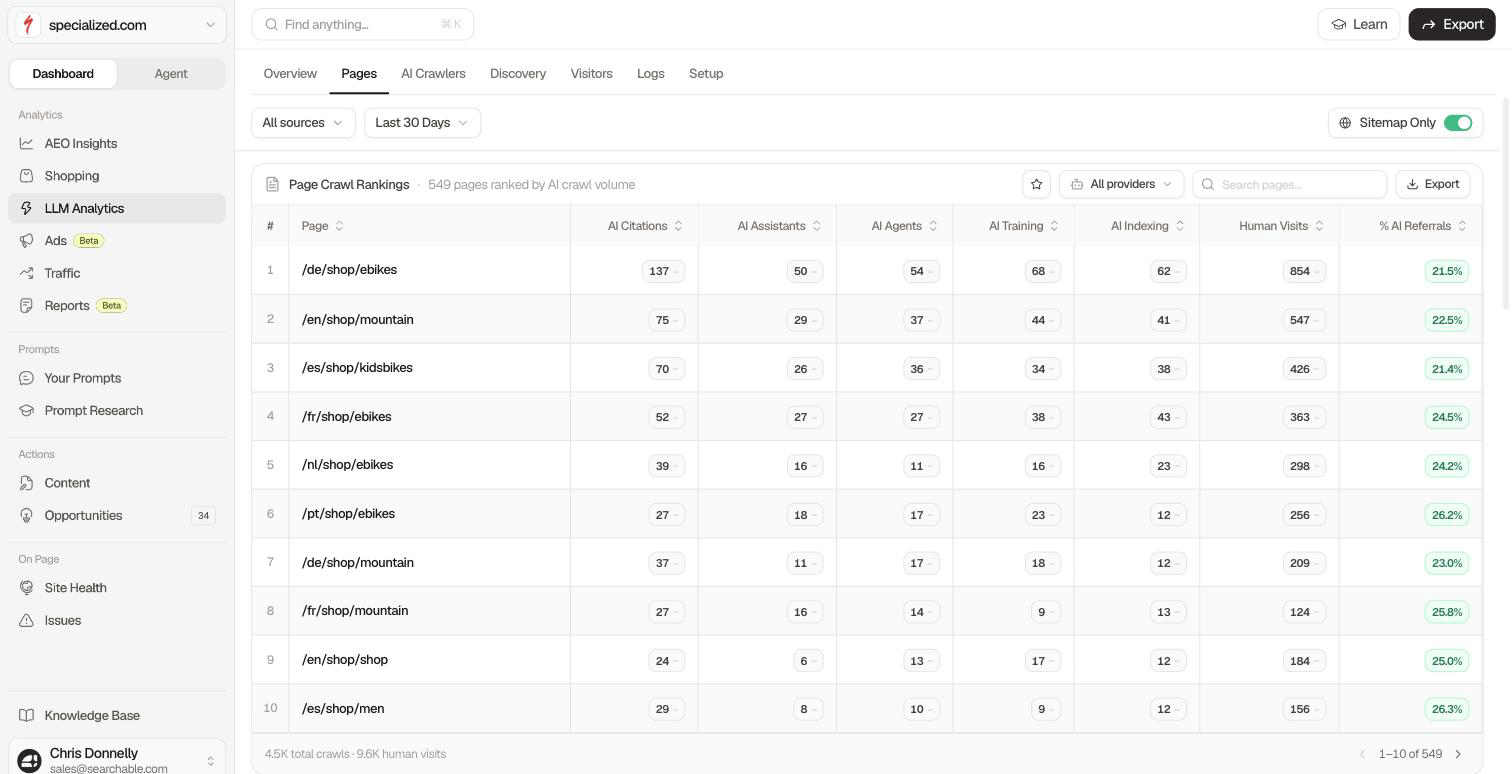
Where your audience is. Pricing, reviews, and comparison pages are disproportionately what AI engines pull from during evaluation, which makes them strategic assets rather than housekeeping. AI chat on landing pages qualifies people at the moment of interest. Branded search is the arrival channel, not the discovery channel, and conflating the two starts the attribution problem.
How to run it. Put a chat assistant on your pricing page trained only on your own documentation and price list, so it answers the integration and edge-case questions that stall an evaluation outside working hours. It's best to constrain it to those sources, because a general-purpose assistant will invent capabilities you don't have.
Tag every conversation with the blocker the prospect raised and pass that to the rep. The call then opens after the initial discovery, which is where most of the time in a first demo goes.
What to measure.
Demo requests and calendar bookings
The clearest conversion signals at this stage
The events worth judging the stage on.
Form completions
A better sense of intent
Though a low-friction form also catches people who weren't evaluating anything.
Branded search volume
The metric most teams overlook here
Buyers who discover your brand in an AI answer may later search for it by name.
Pull the branded versus non-branded split from Search Console on a monthly cadence and chart them on the same axis. If branded impressions climb while non-branded impressions stay flat, something is introducing you to people before they reach Google, and AI answers are the most likely candidate. It's a free proxy for a channel that resists direct measurement, and worth keeping even once you can see the AI referrals directly.
The plays. Make your pricing legible to a machine, with real numbers in real text rather than a figure locked inside an image or a "contact us for pricing" wall. An engine can't quote what it can't parse and will happily quote the competitor who published one.
Publish the most honest comparison page for your category, including the rows where you lose. A page that wins every category reads as marketing and doesn't get cited. If you don't publish that comparison, an affiliate site will, and it can become the source an engine cites instead.
What breaks if you skip it. Someone else's comparison page becomes the answer on your own pricing, and an affiliate wrote it. Branded search keeps climbing the whole time, so the stage looks healthy in exactly the report you'd check.
Stage 4: Conversion
Turn intent into revenue.
This is the stage where AI's contribution is the most mature and the least interesting. AI's real advantage here is speed: you can produce and test more variants in a week than a copywriter could write in a month.
That speed creates a new problem, though. Generating variants faster than you accumulate traffic means calling winners on samples too small to mean anything, and a team shipping forty AI-written headlines against 900 sessions is reading noise with total confidence.
Where your audience is. Landing pages and checkout flows are the obvious places where conversion happens, and email nurture sequences still carry more revenue than most teams give them credit for. Social DMs are increasingly where B2B deals progress, and almost nobody measures them, which puts a real slice of this stage outside every dashboard in the company.
How to run it. Generate the variants with AI, then hold the line on the statistics. Decide the sample size before you look at results, and don't call a winner early because the variants were cheap to produce. AI can speed up the work of creating variants, but it can't make a small sample meaningful.
Start by testing a specific named pain against a generic benefit line, since that is the comparison that most reliably moves a demo page and it tells you quickly whether your positioning is concrete enough.
What to measure.
Conversion rate
The headline number
Also the one most likely to mislead you at this stage.
Revenue per lead
The better metric
AI-sourced traffic skews lower in volume and higher in quality, so value per visit tells you more than volume.
Cart abandonment or demo no-show
The ecommerce and B2B versions of one signal
Both tell you that interest isn't translating into action.
That second metric matters more here than anywhere else in the funnel. AI-referred visitors arrive pre-qualified, with lower bounce rates and longer sessions, and they convert at meaningfully higher rates for considered purchases. Judge the channel on value per visit rather than volume, because a dashboard built around raw conversion rate will consistently under-rate it.
The plays. Personalize CTAs off behavioral signals rather than demographics, since what someone just did is a better predictor than who they are. Test AI-generated variants but keep the discipline to wait for statistical significance, even when the variants are cheap to produce. Use time-bound offers selectively, because urgency works best when someone is already ready to make a decision.
What breaks if you skip it. You optimize the last five percent of the journey while the first ninety-five stays invisible. That's the most common failure: teams improve conversion with AI, see real gains, and conclude they've built the AI marketing funnel. What they've actually built is an AI conversion layer on a funnel that still starts where it always did.
Stage 5: Loyalty
Retain and grow customers.
Loyalty now feeds directly back into awareness, and that part is genuinely new. Customer reviews, community threads, and support documentation are exactly the type of third-party sources AI engines reach for when answering a category question.
A satisfied customer who publicly explains how your product solved a problem can influence what future buyers learn about your brand. That makes customer retention part of your acquisition strategy, not just a measure of how many customers you keep.
Where your audience is. Email carries the loyalty programs and upsell flows, and it's still the only channel here you fully own. Community platforms, Discord for product-led companies and LinkedIn groups for B2B, are where customers answer each other in public. Help articles and support hubs are the most-read and least-optimized pages most companies own.
How to run it. Build the churn signal off product usage rather than renewal dates. If an account's core action declines for three consecutive weeks, flag it and route it to a person before the renewal conversation, rather than waiting for the cancellation email.
Run the same data the other way to surface accounts pressing against their plan ceiling. The result is an upsell list that nobody has the time to assemble by hand, built from the same infrastructure you already use to identify churn risk.
What to measure.
Retention and repeat purchase rate
Still the foundation of the stage
The baseline numbers everything else here builds on.
Referral sign-ups
Whether customers are recommending you
To other people, and increasingly to AI engines as well.
Engagement in community spaces
Connects this stage back to stage one
A customer answering a question in public is producing the third-party evidence that shapes what AI says about you.
The plays. Build loyalty loops that respond to actual product usage rather than calendar dates. Use predictive churn alerts and act on them early, because a churn model flagging risk two weeks out is only worth having if somebody makes the call. Encourage community-led growth on purpose, and treat a customer's public answer as a marketing asset.
What breaks if you skip it. You treat retention as a finance metric and starve the channel that most shapes what AI says about you. The compounding runs both ways: churned customers write reviews too, and AI engines can draw on those reviews as well.
The five stages at a glance, with the channel that matters most and the metric that tells you the stage is healthy:
| Funnel stage | Where it now happens | Primary KPI | The metric it replaces |
|---|---|---|---|
| Awareness | AI search, organic social, top-of-funnel SEO | AI citations and mentions | Keyword rankings |
| Consideration | Blogs, forums, educational social | AI snippet appearances | Pageviews |
| Intent | Pricing and comparison pages, on-site AI chat | Branded search volume | Raw form fills |
| Conversion | Landing pages, email nurture, social DMs | Revenue per lead | Conversion rate alone |
| Loyalty | Email, communities, support hubs | Community engagement | Retention rate alone |
Why did AI search break the top of the funnel?
AI search breaks the top of the funnel by answering the question before the click. A results page lists options and lets the searcher choose, while an AI answer returns a shortlist the engine has already assembled. Awareness is no longer just about whether you were seen. It's about whether you were named.
How concentrated that shortlist gets is worth being precise about, because the field routinely oversells it. A 2026 study of 3,750 AI responses across five industries found the top three brands took 48.6% of recommendations on average, ranging from about 42% in SaaS to 62% in ecommerce. That is real concentration, but it's a long way from winner-takes-all: a few names absorb roughly half of the recommendations, while the rest are still in play.
The practical difference is positional. On Google you could rank fourth and still get found. In an AI answer there is no numbered fourth slot to occupy. You're either named in the answer or you're not.
Four differences drive most of the practical change:
Classic funnel vs AI marketing funnel
That last row is the one that catches teams out. Much of what AI engines repeat back about a brand comes from earned media rather than owned pages, which is why AEO strategy starts with that split. Much of the information you need to influence sits outside the channels you own.
You can rewrite your homepage this afternoon. You can't rewrite the forum thread the engine learned from.
Which engines matter most is a wider question than most dashboards assume. In a February 2026 survey of 5,119 US adults, Pew Research Center found that 44% use ChatGPT, 24% use Gemini, and 17% use Copilot.
Many people use more than one assistant, which means a single-engine view can be misleading. Your buyers are not all asking the same tool, so checking one engine tells you about one slice of them.
Two approaches are useful here: Answer Engine Optimization (AEO) and Generative Engine Optimization (GEO). AEO focuses on getting your brand or content surfaced as the answer to a specific question, and GEO takes a broader view that focuses on visibility across AI-generated responses. Most teams need both AEO and GEO, and the distinction matters more in vendor marketing than it does in the work itself.
SEO became the substrate rather than the casualty. AI engines read pages, and the pages they read most are often the ones already structured well enough to rank. Ranking just stopped being the finish line.
AI visibility tracking tells you which answers name you today, before you change anything.
See which AI answers name you today
Track brand mentions and citations across ChatGPT, Perplexity, and Google AI Overviews before you change a single page.
How do you build the AI marketing funnel?
Build the AI marketing funnel in dependency order, not funnel order. Start by auditing where AI currently mentions you, confirming that crawlers can read your site, and fixing any inconsistencies in how your brand is described. Then build the awareness layer before automating the middle of the funnel. Add measurement once these foundations are in place.
Most implementation guides walk you through the funnel stage by stage, which sounds logical but can waste months. You can automate conversion all you want, but it won't help if buyers aren't discovering you in the first place. You may not see that gap until the quarter closes. The steps below are sequenced by what each one depends on.
-
Audit where you get discovered now. Run the ten questions your buyer would genuinely type through ChatGPT, Perplexity, and Google AI Overviews. Record which brands appear, which sources AI engines cite, and whether your brand appears at all. This gives you a baseline for how AI engines currently represent your category and your brand.
-
Confirm the crawlers can actually read you. Access fails in four places: robots.txt, your CDN, JavaScript, and any infrastructure change since the last check. Vercel's analysis of AI crawler traffic found that none of the major crawlers execute JavaScript, including OpenAI's, Anthropic's, and Perplexity's, so client-side content is invisible to AI crawlers. Gemini and AppleBot are the exceptions, because both render through browser-based infrastructure. CDN configuration is another common failure point: Cloudflare and Akamai can block AI crawlers in some configurations regardless of what robots.txt says.
-
Fix your brand facts. Check your site and third-party profiles for conflicting descriptions, retired product names, outdated company information, and other details that could give AI engines conflicting signals.
-
Build the awareness layer for citation. Answer engine optimization means structuring content so an engine can lift it cleanly, with plain definitions, real figures, and sources cited inline. Researchers at Princeton and Georgia Tech found that optimizing for generative engines can lift visibility by up to 40%, with adding statistics and quotations among the strongest individual methods.
-
Automate the middle. Lead scoring, chat qualification, nurture sequences, variant testing. This comes fifth deliberately, because automating a funnel nobody enters is an expensive way to get better at converting nobody.
-
Instrument the measurement. Track crawled, cited, traffic, and revenue as four separate things rather than collapsing them into one number, since the gaps between them are where the diagnosis lives.
-
Review on a cadence. Monthly beats daily. AI answers vary enough between runs that checking every morning generates anxiety rather than signal, and you'll end up reacting to variance. A rerun only proves something if the prompts and the run order match the original baseline exactly.
Steps one through three usually take two weeks and cost little beyond attention. Step four is the ongoing work, and it's where most of the year goes.
How do you measure the AI marketing funnel?
Measure the AI marketing funnel on four separate rungs: whether crawlers reach your pages, whether AI engines cite them, whether that produces traffic, and whether that traffic produces revenue. Collapsing these into a single number hides the diagnosis. The gap between any two rungs tells you which part of your funnel is broken.
Most teams track the last rung and wonder why the report never explains anything. Revenue is an outcome, not a diagnostic, and by the time it moves you've lost two quarters of information about why.
The four rungs, and what a gap at each one tells you
Measures whether AI crawlers can reach and render your pages at all. A gap here is a technical problem: JavaScript rendering, robots.txt, or CDN blocking. It is the cheapest rung to fix and the one most often skipped.
Two gaps tell you a lot about where the problem sits. If AI crawlers are reaching your pages but AI engines aren't citing them, the problem is with the content or its authority. If there's no crawling at all, it's an access problem, and nothing downstream can happen until you fix it.
Each rung needs its own instrument, which is the practical reason they have to stay separate. Crawler access is a log-level crawlability check. Citations need something querying the engines directly, because no analytics package records an answer you were never clicked from. AI referral traffic arrives tagged inconsistently between engines and needs its own segment before it means anything.
Searchable is built around that split, tracking citations and mentions separately from the AI traffic they produce, so a gap between two rungs reads as a diagnosis instead of a mystery.
Last-click attribution breaks down here in a predictable way. Someone asks an engine to compare options, reads the answer, forms a preference, but they don't click through. Three weeks later, they search your brand name and convert. Analytics records branded organic as the source, while the answer that influenced the decision is nowhere in the attribution report. A team optimizing against that report can end up defunding the channel that actually influenced the buyer.
The substitutes are imperfect and worth using anyway. Track branded search against non-branded search as a directional proxy. Add a "How did you hear about us" field to your demo form, which is unfashionable and more accurate than most attribution software. Segment the AI-referral sessions carrying an identifiable referrer, and accept that many arrive with none.
Without a persistent way to connect those sessions across time, the original AI interaction may never be tied back to the eventual conversion, so treat citation counts as the leading indicator. Crawling responds within days of a technical fix, citations shift over weeks, and traffic and revenue follow over months. AI search doesn't send human visitors by design, so a small referral share is the architecture succeeding.
Tracking visibility over time is what separates a real trend from the day-to-day variance in how AI engines answer.
What are the most common mistakes?
The most common AI marketing funnel mistakes are blocking the crawlers that would cite you, automating the middle while ignoring discovery, tracking a single engine, and judging AI search on last-click attribution. Each problem is straightforward to address once you can see it, but a standard analytics dashboard won't show you most of them.
Frequently asked questions
The AI marketing funnel is a customer journey where AI both automates execution inside each stage and mediates discovery before the funnel begins. It runs the same five stages as a traditional funnel, but awareness now happens partly inside AI answers rather than on your own site.
Get started on your AI marketing strategy
The AI marketing funnel didn't replace the funnel you already run. It changed where the top of it lives and which numbers tell you the truth about the rest.
Most teams reading this will find that stages three, four, and five are in reasonable shape. The real work is almost always concentrated in one and two, where discovery moved onto ground you don't own and your analytics quietly stopped reporting it.
So start narrow: this month, run the discovery audit from step one and nothing else. If you aren't in those answers, you've learned which stage to fix first, and you've learned it before it surfaces in a pipeline report. You can free AI visibility report and treat that as the baseline.
Start with the stage that's actually broken
Searchable tracks which AI answers name your brand across ChatGPT, Perplexity, and Google AI Overviews, shows you the sources they pull from, and turns the gaps into work you can action.

