
In Searchable data from August and September 2026, Claude mentioned a brand, product, or company in 70% of unbranded answers, compared with 78% for ChatGPT on the same prompts. Your Claude visibility can't be read off ChatGPT, so it needs its own tracking. This guide reviews 10 platforms with real pricing and says who each one is built for.
A widely quoted Spotlight analysis of 1.8 million AI responses found that Claude mentions a brand in 97.3% of its answers, compared with 73.6% for ChatGPT. It's often used as proof that Claude is the first engine to track.
We see the opposite in Searchable. When we ran the same 3,687 unbranded prompts through both engines between August 23 and September 26, 2026, Claude mentioned at least one brand, product, or company in 70% of its answers, while ChatGPT did in 78%. Claude came in lower for 40 of the 49 brands with enough answers to compare.
Studies use different prompts and different definitions of a brand mention, so neither number is universal. The practical point holds either way: the two engines answer the same question differently, so your Claude visibility can't be read off your ChatGPT numbers and has to be tracked on its own.
This guide covers two questions: what you miss if you don't track Claude, and which Claude tracker to buy. We'll explain why Claude's answers differ from other AI engines, then review 10 tools with real pricing, honest limitations, and who each one is built for.
Key Takeaways
On the same unbranded prompts, Claude mentioned a brand, product, or company in 70% of answers and ChatGPT in 78% (Searchable data, August to September 2026), so Claude isn't automatically the easier engine to appear in
Claude came in below ChatGPT for 40 of 49 brands compared, so a ChatGPT number won't tell you where you stand in Claude
Method matters: browser-based tools capture real Claude answers while API tools trade accuracy for speed - know which your tool uses before you pay
40-60% of cited domains change each month, so Claude tracking is ongoing work, not a one-time audit
Start with a free Claude visibility check from Searchable; paid options start at $20/mo (Rankscale) up to enterprise custom pricing
Why Claude Needs Its Own Tracking
Claude SEO tracking matters because Claude answers identical prompts differently from ChatGPT. In Searchable data, Claude mentioned at least one brand, product, or company in 70% of unbranded answers, against 78% for ChatGPT on the same prompts, and the gap held for 40 of the 49 brands we compared. So a strong ChatGPT number tells you little about how you're doing in Claude.

Answers Mentioning a Brand, Same Prompts
% of unbranded answers mentioning at least one brand, product, or company. 3,687 prompts run on both engines. Source: Searchable, August 23 to September 26, 2026
Claude70%
Claude came in lower than ChatGPT for 40 of the 49 brands compared
Anthropic ARR Growth
+1,300%
Dec 2024 to Feb 2026 - SaaStr
One of the fastest ARR climbs in enterprise software history
The scale of the opportunity is growing fast. Anthropic went from $1 billion ARR in late 2024 to $14 billion ARR by February 2026, one of the fastest climbs in enterprise software history. The platform has roughly 30 million monthly active users and a mobile app that grew from 2.9 million to 7.4 million MAU through 2025. Claude is not a fringe engine.
What makes tracking urgent is citation churn. BlissDrive's analysis found that 40-60% of cited domains change each month. The brand Claude recommends today may not be the one it recommends next month. Without ongoing monitoring, you won't catch a drop until it shows up in revenue.
The question isn't whether Claude visibility matters. It's whether you're tracking it before your competitors do.
A note about the data: the Claude and ChatGPT figures come from brands tracked in Searchable. We compared answers from each engine's consumer app to the same unbranded prompts between August 23 and September 26, 2026, about 40,000 Claude answers and 42,500 ChatGPT answers across 54 brands.
Brand-level comparisons use the 49 brands with at least 30 answers on each engine. An answer counts if it mentions at least one brand, product, or company. Branded prompts, which name the brand being tracked, were excluded. Source: Searchable, August 23 to September 26, 2026.
See How Your Brand Appears in Claude
Check your Claude visibility for free - then track it across ChatGPT, Perplexity, and more.
How Claude Tracking Tools Actually Work (And Why It Matters for Accuracy)
Claude tracking tools collect data in three ways: browser simulation (runs real queries in Claude's web app), API monitoring (calls Claude's API directly), and hybrid tools that mix both. Claude gives different answers to the same prompt each time, so tracking frequency, prompt variety, and method all shape accuracy.
This matters more than any pricing table. Method is the single biggest factor in whether a tool's data is worth paying for, and almost no article in this space covers it in any depth.
How Claude Tracking Tools Collect Data
Three methods, three different accuracy and cost trade-offs
Highest accuracy
Opens a real Claude session, types queries, and captures what a human sees - including UI-only features. Mirrors actual user experience. Trade-off: heavier servers mean fewer queries per plan and higher cost.
Fastest and cheapest
Calls Claude's API directly, skipping the web app. Can run hundreds of queries per minute at lower cost. The catch: API answers can differ from web answers - Claude may use different logic depending on how it's accessed.
Best of both
Uses API for scale and speed, browser capture for spot-check validation. Balances accuracy with cost efficiency. The most reliable method for ongoing tracking at volume.
Ask any tool which method they use. If they can't give a clear answer, treat that as a red flag.
Headless Browser Simulation
Browser tools open a real session with Claude's web app. They type queries, wait for answers, and grab what a human would see. This gives the most true-to-life data. It mirrors real user experience, including UI-only features.
The trade-off: cost and speed. Running browsers at scale needs heavy servers. These tools offer fewer queries or charge more per prompt. But accuracy is higher. The data matches what your audience sees.
API-Based Monitoring
API tools call Claude's API, skipping the web app. This is faster and cheaper. A tool can run hundreds of queries a minute. The catch: API answers can differ from web answers. Claude may use different logic depending on access method.
For most cases, the gap is small. But for brands that need exact AI search analysis of how products appear in chat, it matters.
Why Non-Determinism Matters
Claude does not give the same answer twice. Ask one question ten times. You may get ten different brand mentions, sources, or layouts. This is nothing like Google, where rankings hold steady hour to hour.
A tool that queries once a week gets a snapshot. A tool that runs queries many times, with varied prompts and regions, gets a trend. Snapshots are noise. Trends are signal.
When picking a tool, ask how often it queries and how it handles variation. A tool that averages across many runs gives better data than one that grabs a single answer.
All 10 Claude SEO Tracking Tools at a Glance
The tools below range from $15/mo to enterprise custom pricing. We scored each on five criteria: Claude coverage in the base plan, multi-LLM breadth, tracking method accuracy, depth of actionable insight, and pricing transparency. Read the detailed reviews below for the nuances that a score alone won't reveal.
All 10 Claude Tracking Tools at a Glance
92

78

Best Analytics
4 engines, GA4 revenue attribution, enterprise reporting
Custom
74

Best Granularity
4 engines, prompt-level tracking, clean UI
$39/mo
71

Best Actions
3 engines, browser-based, action centre with recommendations
$49/mo
68

Best Sentiment
5 engines, sentiment analysis, Claude is a paid add-on
$39/mo
65

SEO-Familiar
3 engines, keyword-based approach, position tracking
$29/mo
64

Best Add-on
4 engines, included with Ahrefs plan, share-of-voice reporting
Ahrefs plan
61

Budget Pick
3 engines, cheapest dedicated option, simple interface
~$15.60/mo
59

Persona Tracking
2 engines, browser-based, tracks by audience segment
$49/mo
56

Cheapest Ongoing
3 engines, daily prompt refresh, simple focused interface
$20/mo
The 10 Best Claude SEO Tracking Tools (Detailed Reviews)
The best Claude SEO tools all track how your brand shows up in AI answers, but they differ in depth, method, price, and what they do with the data. These reviews cover strengths, honest limits, pricing, and who each tool fits best based on hands-on testing.

- Searchable
Searchable is a full-stack AI visibility platform that tracks brand mentions across Claude, ChatGPT, Perplexity, Google AI Overviews, and Copilot. It also provides content tips and runs tech audits built for AI search.
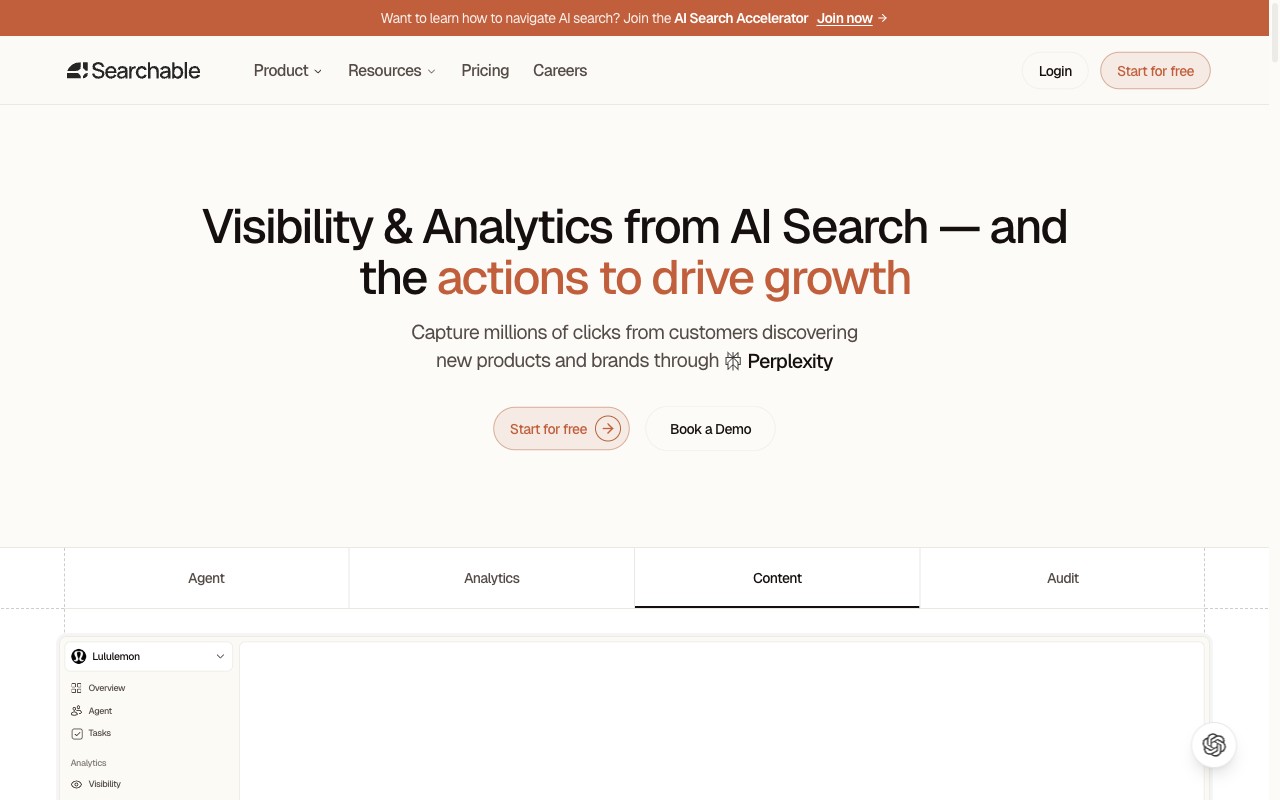
Tracks your brand across Claude, ChatGPT, Perplexity,
AI Overviews
, and Copilot from one dashboard. Pairs monitoring with a built-in AI content engine, technical audits, and
MCP integration
for dev workflows. Doesn't just show data - tells you what to do about it.
5 engines including Claude in the base plan
Content engine and tech audits built in - not just monitoring
- Newer platform; less brand recognition than legacy SEO tools
Best for: Teams wanting a full-stack platform that goes beyond monitoring into actionable optimisation.
Searchable was built for AI search from the start. That matters for Claude, because AI engines recommend brands inside an answer, and the signals behind those recommendations include content quality and citation density, which a keyword rank tracker doesn't measure.
Why Searchable is built differently for Claude
Claude next to other engines
Searchable collects Claude answers through Claude's API and runs the same prompts on the other engines it tracks, so you can compare Claude with ChatGPT, Perplexity, and Gemini on one prompt set.
AI content engine
Generates content structured for AI citation - lists, comparisons, definitions, and answer-shaped formats that Claude is statistically more likely to surface and recommend.
Technical AEO audits
Checks ClaudeBot crawl access, schema markup, plain-HTML content, and site structure - the technical layer that determines whether Claude can read your content at all.
GA4, GSC, HubSpot & Salesforce
Connect Claude visibility data directly to revenue. See which AI-driven sessions convert, tie pipeline to specific prompts, and report on ROI in the language leadership understands.
MCP for Claude Code & Cursor
Dev teams can pull Searchable's AI visibility data directly into their coding environment via MCP. The only tracking tool with a native developer workflow integration.
Why use Searchable for Claude tracking?
Searchable adds an AI content engine, technical audits, and revenue attribution through GA4 and CRM integrations to its tracking, so you can act on what the numbers show.
Claude answers the same prompts differently from ChatGPT, so it needs its own numbers. Searchable tracks Claude next to ChatGPT, Perplexity, Gemini, and Google's AI results in one place.
Free Claude Visibility
See where your brand appears in Claude responses and where it's missing.
2. Scrunch AI
Scrunch AI is an enterprise AI visibility platform with deep analytics and revenue tracking. Its GA4 link ties AI visibility data to real business results.
Key features: Deep analytics dashboards with trend analysis, revenue attribution connecting AI visibility to conversions, native GA4 integration, competitor benchmarking, enterprise-level reporting and team collaboration.
Where it excels
GA4 ties Claude data to revenue - rare for this category. Analytics go deeper than basic mention counts. Rival share-of-voice tracking spans several LLMs.
Where it falls short
Enterprise pricing locks out smaller teams and solo marketers. The depth can feel like overkill if you just want simple visibility tracking.
Pricing
Custom (enterprise)
Best for
Enterprise teams needing deep analytics and revenue attribution from AI visibility data.
3. AIclicks
AIclicks tracks visibility at the prompt level. It shows which exact queries trigger brand mentions and where those mentions sit inside Claude's answers.
Key features: Prompt-level visibility tracking, clean intuitive UI, multi-LLM coverage including Claude, ChatGPT, Perplexity, and Gemini, historical tracking with trend visualisation, competitor mention tracking per prompt.
Where it excels
Prompt-level detail shows not just if Claude mentions you, but for which exact questions. The UI is clean and accessible for non-technical team members.
Where it falls short
Feature set still maturing. Pricing rises fast when tracking many prompts across many rivals. Monitors well but offers little guidance on what to do next.
Pricing
From $39/mo
Best for
Teams wanting prompt-level granularity to understand exactly when and where Claude mentions their brand.
4. Orchly.ai
Orchly.ai pairs browser capture with an action centre. It turns raw tracking data into clear, ranked steps for boosting Claude visibility.
Key features: Browser-based capture that mirrors real user experience, action centre with prioritised optimisation recommendations, Claude-specific tracking features, competitor visibility comparison, weekly reporting with actionable insights.
Where it excels
Data shows what real users see, not just API output. The action centre bridges "here is the data" and "here is what to do" - a gap most tools ignore.
Where it falls short
Covers fewer LLMs than tools tracking five or more. Smaller user community, fewer integrations. Browser method can mean slower data refresh cycles.
Pricing
From $49/mo
Best for
Teams wanting actionable insights alongside monitoring, not just another dashboard.
5. Peec AI
Peec AI tracks brand mentions across five LLMs: Claude, ChatGPT, Perplexity, Gemini, and Copilot. Its sentiment scores go past simple mention counts.
Key features: Broad multi-LLM coverage across five platforms, sentiment analysis of brand mentions, tone and positioning tracking, competitive landscape monitoring, custom reporting and alerts.
Where it excels
Sentiment adds a layer most tools miss. Knowing Claude names you is less useful than knowing if it praises or warns about you. Wide LLM reach for brand tone tracking.
Where it falls short
Claude is a paid add-on, not in the base plan. Teams focused on Claude pay extra for the one platform they came for. Broader than it is deep on any single LLM.
Pricing
From $39/mo (Claude add-on)
Best for
Teams already tracking other LLMs who want to add Claude to their monitoring stack.
Stop Guessing. Start Tracking.
Searchable monitors your brand across Claude, ChatGPT, Perplexity, AI Overviews, and Copilot - all in one dashboard.
6. LLMrefs
LLMrefs brings classic rank tracking logic to LLMs. Track keywords and see where you show up - but in Claude and AI platforms, not Google.
Key features: Keyword-based tracking familiar to traditional SEOs, multi-LLM support (Claude, ChatGPT, Perplexity), position tracking within AI responses, historical keyword performance data, exportable reports.
Where it excels
For SEOs who think in keywords, LLMrefs feels like home. The jump from Google rank tracking to LLM tracking is smooth. Setup is simple: add keywords, pick your LLMs, and go.
Where it falls short
Keywords alone miss nuance. The same keyword gets very different Claude answers based on prompt wording. Shows less about prompt variation and chat context.
Pricing
From $29/mo
Best for
SEO professionals who want a familiar keyword-tracking approach applied to Claude and other LLMs.
7. Ahrefs Brand Radar
Ahrefs Brand Radar adds AI tracking to the Ahrefs suite. Teams see Claude brand mentions right next to their normal SEO data. No new tool needed.
Key features: Integrated with the broader Ahrefs toolset, brand-level monitoring across Claude, ChatGPT, Perplexity, and Gemini, share-of-voice reporting, trusted data infrastructure, fits existing Ahrefs workflows.
Where it excels
Already use Ahrefs? Brand Radar adds AI data with no new logins. Tie backlinks, keyword ranks, and site audits to AI visibility trends in one place.
Where it falls short
Brand-level only, not prompt-level. Won't show which exact queries trigger mentions. Needs an Ahrefs plan, which adds significant cost.
Pricing
Included with Ahrefs (from $129/mo)
Best for
Existing Ahrefs users who want AI visibility monitoring without adding another tool.
8. Mangools AI Search Watcher
Mangools AI Search Watcher is the cheapest dedicated Claude tracking tool. It starts at about $15.60 per month with Claude in the base plan.
Key features: Claude tracking in the base plan (no add-ons needed), simple clean interface, basic multi-LLM coverage (Claude, ChatGPT, Perplexity), affordable entry point, integrates with the broader Mangools SEO suite.
Where it excels
Price. Solo marketers and small teams can test Claude tracking without a big spend. Simple interface doesn't overwhelm - a plus for teams new to AI visibility.
Where it falls short
Lighter features than full AI visibility platforms. Fewer LLMs, less depth, limited rival tracking. Basic tracking at a great price - not a full strategy.
Pricing
~$15.60/mo
Best for
Budget-conscious teams or solo marketers starting with Claude rank tracking.
9. Gumshoe AI
Gumshoe AI uses personas. It mimics how different user types - by age, skill, and goal - find your brand in Claude's AI answers.
Key features: Persona-based tracking (test different user segments), demographic and expertise-level simulation, browser-based capture for realistic responses, brand perception analysis across audience types, competitor comparison by persona.
Where it excels
The persona angle is unique. Most trackers ask "does Claude mention us?" Gumshoe asks "does Claude mention us differently to a CTO versus a marketing manager?"
Where it falls short
Niche focus means fewer features outside persona tracking. Teams needing broad multi-LLM monitoring will find it limited. Persona setup adds time and learning.
Pricing
From $49/mo
Best for
Teams wanting to understand how different audience segments encounter their brand in Claude's responses.
10. Rankscale
Rankscale gives simple Claude rank tracking at a low price. It refreshes prompts daily and keeps the screen focused on basics.
Key features: Daily prompt refresh, simple focused interface, multi-LLM tracking (Claude, ChatGPT, Perplexity), basic competitor tracking, trend visualisation over time.
Where it excels
Does the basics well and cheaply. Daily refresh keeps data fresh - a real edge since 40-60% of cited domains shift each month. For no-frills tracking, it works.
Where it falls short
Less depth than Scrunch or Searchable. Fewer integrations, no built-in tips, smaller team. Basic reports may frustrate teams used to full SEO platforms.
Pricing
From $20/mo
Best for
Small teams wanting basic Claude rank tracking at a low price point without unnecessary complexity.
Best Free Claude Rank Tracking Options
Free Claude rank tracking options include Searchable's 14-day Pro trial, Mangools AI Search Watcher's free tier, and Rankscale at $20 per month. Truly free tools are scarce - most restrict tracking frequency, query volume, and historical data. A free trial is the best way to test whether Claude tracking delivers ROI before committing to a paid plan.
The honest truth: truly free Claude tracking barely exists. The space is too new. Server costs are too high. The market is not ready for ad-funded free tools yet.
Here is what is actually available:
Searchable's 14-day Pro trial gives full access. Multi-LLM tracking, content engine, tech audits, and links to other tools. No feature caps - only a time cap. After 14 days, plans start at $125/month.
Mangools AI Search Watcher has a free tier with capped queries. Good for checking if Claude names your brand at all. But the caps block trend data and rival benchmarks. The paid plan at ~$15.60/month lifts most limits.
Rankscale at $20/month is not free, but it is the cheapest way to get ongoing Claude tracking with daily refresh. For teams that need more than a trial but cannot justify $125+/month yet, it is a good stepping stone.
Searchable free trial
Full Pro features with no caps - multi-LLM tracking, content engine, and tech audits included.
Cheapest ongoing plan
Mangools AI Search Watcher - the lowest-cost dedicated Claude tracking tool available.
Start with a free trial from the tool that fits your needs. Set a baseline. Does Claude name your brand? For which queries? How do rivals stack up? If the data shows gaps, the paid tool pays for itself. If not, you saved a subscription.
What to Look for When Choosing a Claude Tracking Tool
Pick a Claude SEO tool based on six factors: data method (browser vs API), update speed (daily or weekly), LLM count (Claude-only or multi-platform), action level (just dashboards or real tips), price shape (per query, per brand, or flat), and links to tools you use like GA4 and Search Console.
Data Collection Method
Browser tools capture what users see. API tools are faster but may miss UI details.
Browser tools (Orchly, Gumshoe) open a real session with Claude's web app and capture what a human would see. API tools (AIclicks, LLMrefs, Rankscale) are faster and cheaper but answers may differ from web output. Hybrid tools mix both approaches, and Searchable uses Claude's API. Ask which method a tool uses, and treat a vague answer as a red flag.
Update Frequency
40-60% of cited domains change monthly. Old data means blind spots.
Daily tracking (Rankscale, Searchable) spots shifts faster than weekly tools. If your industry moves fast or Claude sends real traffic to your site, daily refresh is worth the extra cost. Weekly tools catch big drops but miss the rapid churn that defines AI answers.
Multi-LLM Coverage
Most teams need Claude plus ChatGPT, Perplexity, and AI Overviews.
Check if Claude is in the base plan - Peec charges extra. Tools with five or more LLMs (Searchable, Peec) give the widest view. Some teams only need Claude, but most benefit from seeing how visibility compares across all major AI platforms.
Actionability
Monitoring shows where you stand. Action tools show what to do next.
Searchable's content engine, Orchly's action centre, and Scrunch's revenue attribution go beyond basic charts. If your team can interpret raw data, monitoring-only tools work fine. If you need guidance on improving visibility, pick action-first platforms.
Pricing Model
Per-query pricing can spike fast. Flat rates keep costs predictable.
Some tools charge per query, others per brand or domain, others use flat tiers. Per-query pricing escalates when tracking dozens of prompts across multiple competitors. Flat rates (Mangools, Rankscale) keep costs steady and predictable for budget planning.
Integrations
A tool that sits alone creates data silos. Connect AI data to revenue.
Tools that link to GA4 (Scrunch, Searchable), Search Console, or CRMs connect AI visibility data to what leadership cares about: conversions, pipeline, and revenue. Standalone tools create data silos that require manual reporting to demonstrate value.
Data Collection Method
This matters more than most buyers think. Browser tools (Orchly, Gumshoe) capture what users see. API tools (AIclicks, LLMrefs, Rankscale) are faster and cheaper but may miss UI details. Hybrid tools mix both, and Searchable uses Claude's API. Ask each vendor which method it uses, and treat a vague answer as a red flag.
Update Frequency
Since 40-60% of cited domains in AI answers change monthly, old data creates blind spots. Daily tracking (Rankscale, Searchable) spots shifts faster. If your industry moves fast or Claude sends real traffic, daily refresh is worth the extra cost.
Multi-LLM Coverage
Some teams only need Claude. Most want coverage across Claude, ChatGPT, Perplexity, and Google AI Overviews. Check if Claude is in the base plan - Peec charges extra. Tools with five or more LLMs (Searchable, Peec) give the widest view. For a side-by-side of multi-engine coverage, see our list of the best AEO tools.
Actionability
Monitoring shows where you stand. Action tools show what to do next. Searchable's content engine, Orchly's action centre, and Scrunch's revenue data go past basic charts. If your team reads raw data well, monitoring works. If you need help, pick action-first platforms.
Pricing Model
Some tools charge per query. Others charge per brand or domain. Others use flat tiers. Per-query pricing can spike fast when tracking dozens of prompts across rivals. Flat rates (Mangools, Rankscale) keep costs steady.
Integrations
A tool that sits alone creates data silos. Tools that link to GA4 (Scrunch, Searchable), Search Console, or CRMs connect AI data to what leadership cares about: conversions, pipeline, revenue.
Quick decision matrix:
- Budget under $30/month → Mangools AI Search Watcher or Rankscale
- Need prompt-level granularity → AIclicks or Orchly.ai
- Enterprise analytics and revenue attribution → Scrunch AI
- Full-stack platform (tracking + content + technical) → Searchable
- Already using Ahrefs → Ahrefs Brand Radar
- Audience segmentation insight → Gumshoe AI
How to Improve Your Claude Visibility Once You Start Tracking
To boost Claude visibility: write in answer-ready formats like lists, comparisons, and guides. Get mentions from trusted outside sources. Stay active on Reddit. Add schema markup. And use tracking tools to measure what works. Claude favours content that shows up across many independent sites.
Tracking without action is just watching. The real value of any Claude SEO tool is what you do with the data. Here are five tactics that move the needle.
Structure Content for Extraction
0/2Build External Corroboration
0/3Invest in Reddit Presence
0/2Optimise Technical Signals
0/3Measure and Iterate
0/21. Structure Content for Extraction
Claude favours content it can easily extract and rephrase. Lists, comparison tables, numbered steps, and clear definitions all boost citation chances. Write answer-shaped content: if someone can read a single paragraph and get a complete answer, Claude is more likely to surface it.
Think of each section as a standalone answer unit. Not part of a long narrative that requires reading the full page.
2. Build External Corroboration
SparkToro's research found that LLMs favour brands that show up often across many sources on the web. A single mention on your own site is not enough.
Your brand needs to appear in industry publications, expert roundups, partner sites, and directories. The more independent sources that mention you, the more likely Claude is to cite you. Building strong E-E-A-T signals directly supports this.
3. Invest in Reddit Presence
Reddit threads are key data sources for Claude's training and retrieval. A post with 100+ upvotes and 30+ comments carries real weight in AI citations.
Genuine, helpful replies in relevant subreddits - answering questions, sharing expertise, and suggesting solutions - create signals that Claude picks up. This is not astroturfing. It is joining the communities where your audience already asks questions.
4. Technical Signals
Schema markup, clean site layout, and AI crawler setup all affect whether Claude can read your content. Check that ClaudeBot is not blocked in robots.txt. Add Article, FAQ, and Organisation schema. Keep key text in plain HTML - not behind JavaScript that AI crawlers skip.
5. Measure and Iterate
Use your Claude rank tracking tool to test content changes. Update a page, then watch whether Claude's mention of your brand shifts over the next few weeks.
Track which formats, topics, and structural changes link to better visibility. The tools in this article give you the data. The optimisation strategy turns that data into growth.
Frequently Asked Questions
Not in Searchable's data. When we ran the same 3,687 unbranded prompts through both engines between August 23 and September 26, 2026, Claude mentioned at least one brand, product, or company in 70% of answers and ChatGPT in 78%, and Claude came in lower for 40 of the 49 brands compared. Other studies have reported the opposite, so it's worth measuring Claude directly.
Track Your Brand Across Every AI Platform
Searchable monitors Claude, ChatGPT, Perplexity, AI Overviews, and Copilot - with a content engine and technical audits built in.
