
Meta Muse is Meta's personal AI agent. It launched in the US on September 8, 2026, has since reached Canada, Japan, Singapore, Australia, and the UK, and more than 10 million people in the US and Canada had set it up by October. Shopping is its most common use, with an average purchase over $200. Muse shops in its own cloud browser, asks for approval before every purchase, and pays with Stripe Link (a saved payment method or a single-use virtual card), Shop Pay on Shopify stores, or, at Walmart, a card saved in the shopper's Walmart account. On Shopify, Meta's agentic checkout is on by default and custom pixels don't fire in it. Walmart let Muse in through an Agent Gateway with per-agent spending limits, while Amazon blocked it, and Muse now leaves Amazon out of its searches by default. Early reports include an unauthorized booking and false information about purchases, and UK regulators have warned Meta. In Searchable's traffic data, Muse started checking sites for Personal Agent Protocol files the day the protocol's first stable version shipped.
Meta Muse can do your holiday shopping at Walmart, but not at Amazon, and it now skips Amazon by default. More than 10 million people have set up Muse, shopping is its most common use, and the average purchase is over $200.
If you run an online store, Muse is probably already visiting your site. In this article, you'll learn how Muse finds products and pays, where it can and can't buy, how to spot it in your server logs, and what to change in your store.
Key Takeaways
- More than 10 million people in the US and Canada have set up Meta Muse. Shopping is its most common use, with an average purchase over $200, and it launched in the UK on November 24.
- Muse pays with Stripe Link or Shop Pay, or, at Walmart, a card saved in your Walmart account. On Shopify, Meta's agentic checkout is on by default and custom pixels don't fire in it.
- Walmart let Muse in with per-agent spending limits. Amazon blocked it, and Muse now leaves Amazon out of its searches by default, so blocking an agent can remove you from its recommendations.
- Early reports include an unauthorized booking and false information about purchases, and UK regulators have warned Meta about privacy and consumer protection.
- In our data, Muse started checking sites for Personal Agent Protocol files the day version 1.0 shipped. In our test of AI answers, ChatGPT, Google AI Mode, and Perplexity got every Muse fact right, while Gemini sometimes didn't recognize Muse at all.
What is Meta Muse?
Meta Muse is a personal AI agent from Meta that does tasks on a person's behalf, such as sending email, booking travel, and shopping. Meta launched it in the US on September 8, 2026.
Meta Muse at a glance
| Launched | September 8, 2026, in the US |
| Available in | US, Canada, Japan (October 23), Singapore (October 27), Australia (November 17), and the UK (November 24) |
| Where to use it | iOS, Android, muse.ai, and WhatsApp |
| Who can use it | People aged 18 and over |
| Price | Free for most uses, with paid plans for more |
| How it pays | Stripe Link (Onelink in the UK), Shop Pay, or a card saved with a partner such as Walmart. PayPal is announced |
| Approval | Asks before every purchase |
Two design choices matter for shopping:
- Muse has its own computer. It runs in Muse Secure VM, a dedicated cloud machine with its own browser, so it can "open a browser, fill out forms, and negotiate" on a person's behalf. A separate Sentinel agent on the same machine has to approve anything Muse sends to the internet.
- Muse asks before it spends. Meta says Muse "does not make purchases or move money without your explicit approval", and that it can't see the passwords or payment methods a person stores with it.
Muse in numbers
- More than 10 million people in the US and Canada set up Muse in its first month and a half, and about a quarter of them use it on any given day, Meta said on its Q3 earnings call on October 21.
- Shopping is the most common use. Mark Zuckerberg said "more than a quarter of people who are using Muse" shop with it, "with an average purchase size over $200."
- Demand surprised its payment partner. "In the first week we had to work with Stripe to raise credit limits since the volumes were above what any of us expected," Zuckerberg said.
- It dominates agent traffic. Muse made 59% of all AI-agent requests to sites protected by HUMAN Security in October, according to Search Engine Journal. Only 1.9% of agent requests went to checkout or payment pages.
- Meta plans to earn from the transactions. Zuckerberg said Meta will "build commerce tools so we get paid a fee based on the transactions that we help facilitate," which he expects "will be paid for by businesses." Meta hasn't published a rate.
Meta Muse pays with Stripe Link or Shop Pay, after you approve
Muse uses whichever payment route the store and the shopper support: Stripe Link, Shop Pay on Shopify stores, or a card saved with a partner such as Walmart. PayPal checkout is announced.
Stripe Link
Link was there at launch. Stripe says that at more than 1 million businesses that accept Link, Muse checks out instantly with the shopper's saved payment method.
Everywhere else, Link issues a single-use virtual card for that one purchase, so to the store it looks like an ordinary card payment. The shopper approves the total in the chat, and Muse never sees the card.
Two pieces of fine print matter for shoppers:
- Purchase protections are US-only. Muse is the first AI agent covered by Link's purchase protections, such as cover for damaged or lost items, but Stripe's terms limit them to US residents. In the UK, Muse pays with Onelink (Link's UK brand), and those protections don't apply.
- You're liable for the agent's mistakes. Link's UK agent terms say "you are responsible for all Agent-initiated transactions as if you had taken the action yourself", including ones "caused by bugs, hallucinations and/or misinterpretations", unless Stripe itself caused the error.
Shop Pay and Shopify's agentic checkout
On September 8, Shopify made Meta an AI sales channel in every eligible store's admin, and on September 21 it turned on agentic checkout with Shop Pay for Muse. Shopify's Help Center lists what applies if you sell on Shopify:
- It's on by default. Your products are shared with Meta through Shopify Catalog, and "purchasing in agentic checkout is activated by default for eligible stores." Orders appear as a Meta sales channel, and you stay the merchant of record.
- Custom pixels don't fire. Only Shopify's server-to-server checkout events do (events Shopify sends from its own servers instead of from the shopper's browser), so Muse purchases won't appear in pixel-based attribution. Report them from the Meta sales channel instead.
- Some products and options are excluded. Subscription-only, customizable, and B2B-only products, bundles, local delivery, and pickup aren't supported, and neither are stores that require customers to sign in.
You can turn it off. In your Shopify admin:
- Go to Sales channels, then Agentic.
- Switch to Manual.
- Open Meta AI and Muse and turn off Agentic checkout.
That stops agents completing checkout through Shopify's agentic tools, which Shopify names as "Universal Commerce Protocol (UCP) and WebMCP". Catalog sharing is a separate setting, and Meta may still find your products by crawling.
PayPal checkout is still coming soon
PayPal announced on September 22 that its customers would be able to check out with Muse. Two months later, Meta's UK announcement still listed PayPal as "coming soon".
Muse can buy at Walmart and Shopify stores, but not Amazon
| Where | Can Muse buy? |
|---|---|
| Walmart | Yes, through Walmart's Agent Gateway, with a spending limit you set |
| Amazon | No. Blocked since September 20, and Muse skips Amazon by default. Talks with Meta were reported on November 25 |
| Shopify stores | Yes, through Shopify's agentic checkout, on by default for eligible stores |
| Stores that accept Link | Yes, with instant checkout |
| Other stores | Usually, through its browser with a single-use Link card, if the store's bot protection lets it in |
| UK launch partners | Yes, including Marks & Spencer, Sainsbury's, Argos, Ocado Retail, Currys, ASOS, JD Sports, easyJet, and Jet2 |
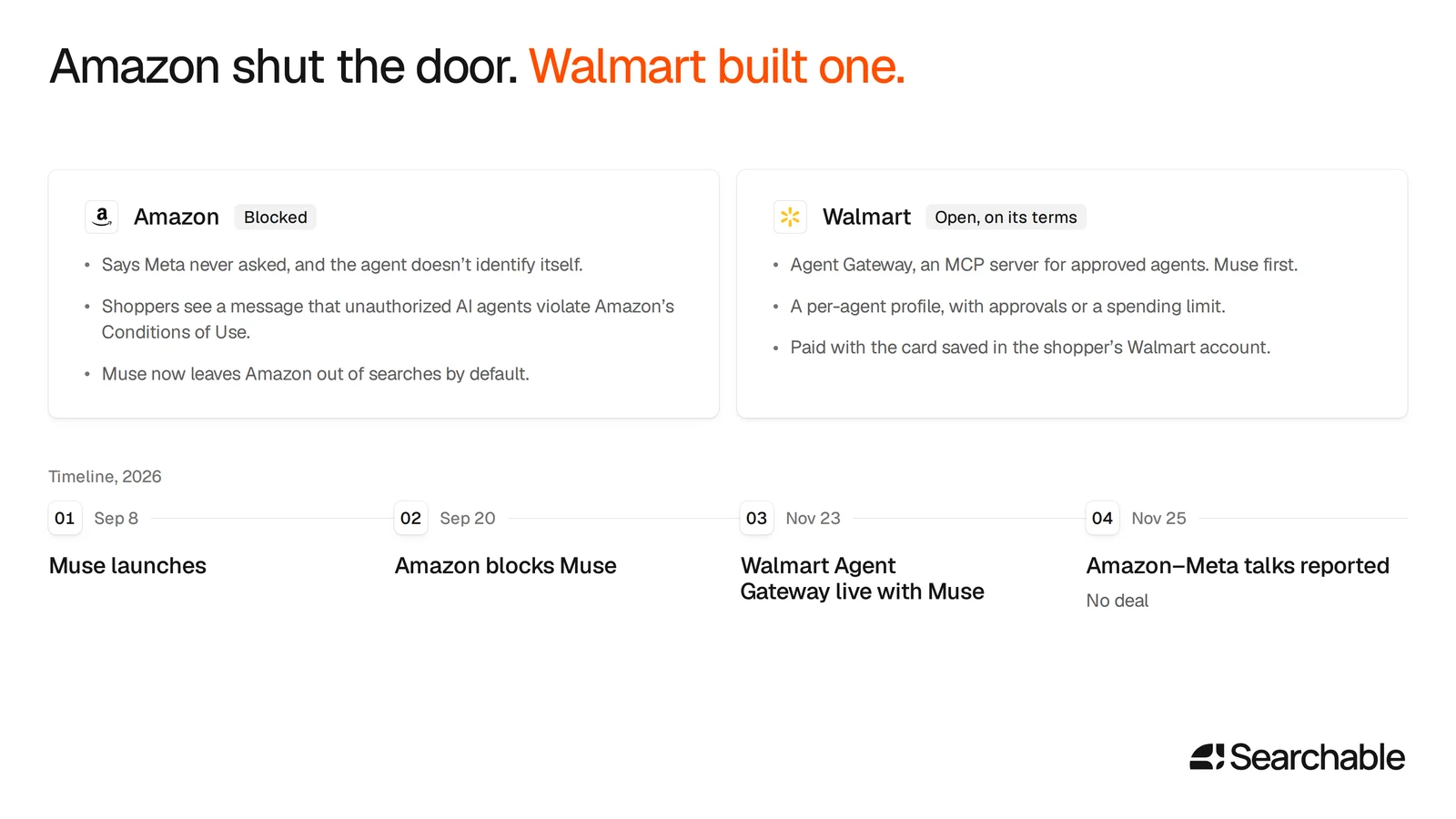
Walmart: open, on its own terms
On October 21, 2026, Walmart announced its Agent Gateway, an MCP server (a standard interface AI agents use to call a company's tools) that lets approved agents search its inventory and buy for shoppers. It went live with Muse as the first agent on November 23, and Walmart announced it the next day for Black Friday.
For a shopper, it works in three steps:
- Ask Muse for something, such as a TV deal. Walmart runs the search through its gateway.
- Sign in to Walmart when Muse asks. The first time Muse adds an item, you set up an Agent Profile with a spending limit, or require approval for every purchase.
- Complete the purchase in the Muse conversation, charged to a card saved in your Walmart account.
Walmart's rules for agents are worth copying if you run a large store. Purchases need approval by default, agents "must not take actions beyond what the shopper intends", they don't receive card details, and agents that break the rules "will be blocked from Walmart's site." Walmart's returns policy still applies, and on pricing it says: "We price products, not people."
Amazon: blocked, and now skipped
Amazon blocked Muse on September 20, saying Meta never asked for access, the agent doesn't identify itself when it browses, and it appears to store customer credentials. Shoppers who try see a message that "continued access by an unauthorized AI agent violates Amazon's Conditions of Use".
Muse adapted. Its shopping instructions now tell it to leave Amazon out unless the user asks for it and steer it to stores such as Walmart, Target, Best Buy, and Home Depot or Lowe's. That's the lesson for every store: blocking an agent can stop it recommending you, as well as buying from you.
The block may not last. On November 25, Fortune reported that Amazon and Meta have held several rounds of talks about a deal. The sticking points are reportedly search results and advertising, since a shopper using Muse could skip the sponsored listings behind Amazon's $68.6 billion ad business.
Amazon CEO Andy Jassy has said outside agents would need to provide a "fair exchange of value". Neither company has announced anything.
Everyone else
Most stores aren't choosing. An audit of 51 large US retailers reported by CNBC found 37 block AI agents "largely by accident", and only 5 restrict them on purpose. For the rest, Muse arrives the way a person does: through your website, paying with a Link card or Shop Pay, if your bot protection lets it through.
How to spot Muse in your server logs
Searchable records AI crawler and agent visits from the server logs of the sites we track. The table combines our data with what bot-detection companies have found about how Muse and Meta appear in logs.
| What you'll see | What it is |
|---|---|
Muse-PersonalAgent/0.3 user agent | Muse checking your site for /.well-known/poppy.json (the Personal Agent Protocol) and /.well-known/ucp, seen in our data since November 14 |
Signature-Agent: https://muse.ai header | Muse requests signed with Web Bot Auth (a cryptographic signature that proves who sent the request), reported by Arcjet. DataDome found Meta signing a small share from around October 12 |
| Desktop Chrome on Linux | Many of Muse's unsigned shopping sessions, which look like an ordinary browser |
meta-externalfetcher user agent | Meta fetching pages on behalf of users of its AI products |
Referrer muse.ai | A person clicking through from Muse to your site |
Our figures below are pooled across sites and shown as shares or ratios. Demo traffic is excluded, and no site is identified.
Muse started looking for the Personal Agent Protocol the day it shipped. The Personal Agent Protocol lets a company recognize a customer's agent and limit what it can do. Its first stable version shipped on November 14, and the same day, Muse-PersonalAgent/0.3 started visiting sites we track.
Nearly 9 in 10 of its requests were for poppy.json, and at least half of the sites it checked answered "not found". Muse is already checking which stores support the protocol, and most don't yet.
Muse sends very few click-throughs. Between September 20 and November 25, sites we track received fewer than 1 visit from muse.ai for every 300 from chatgpt.com. That fits how Muse works: it does the browsing itself instead of sending people to click through.
Meta's user-initiated fetching jumped after Muse launched. In August, meta-externalfetcher reached about 3% of the sites in our data each week. From the first week of October, it reached between 44% and 64% of sites each week, and its weekly request volume grew about 30-fold, from about 0.1% of the volume of OpenAI's equivalent, ChatGPT-User, to about 9%.
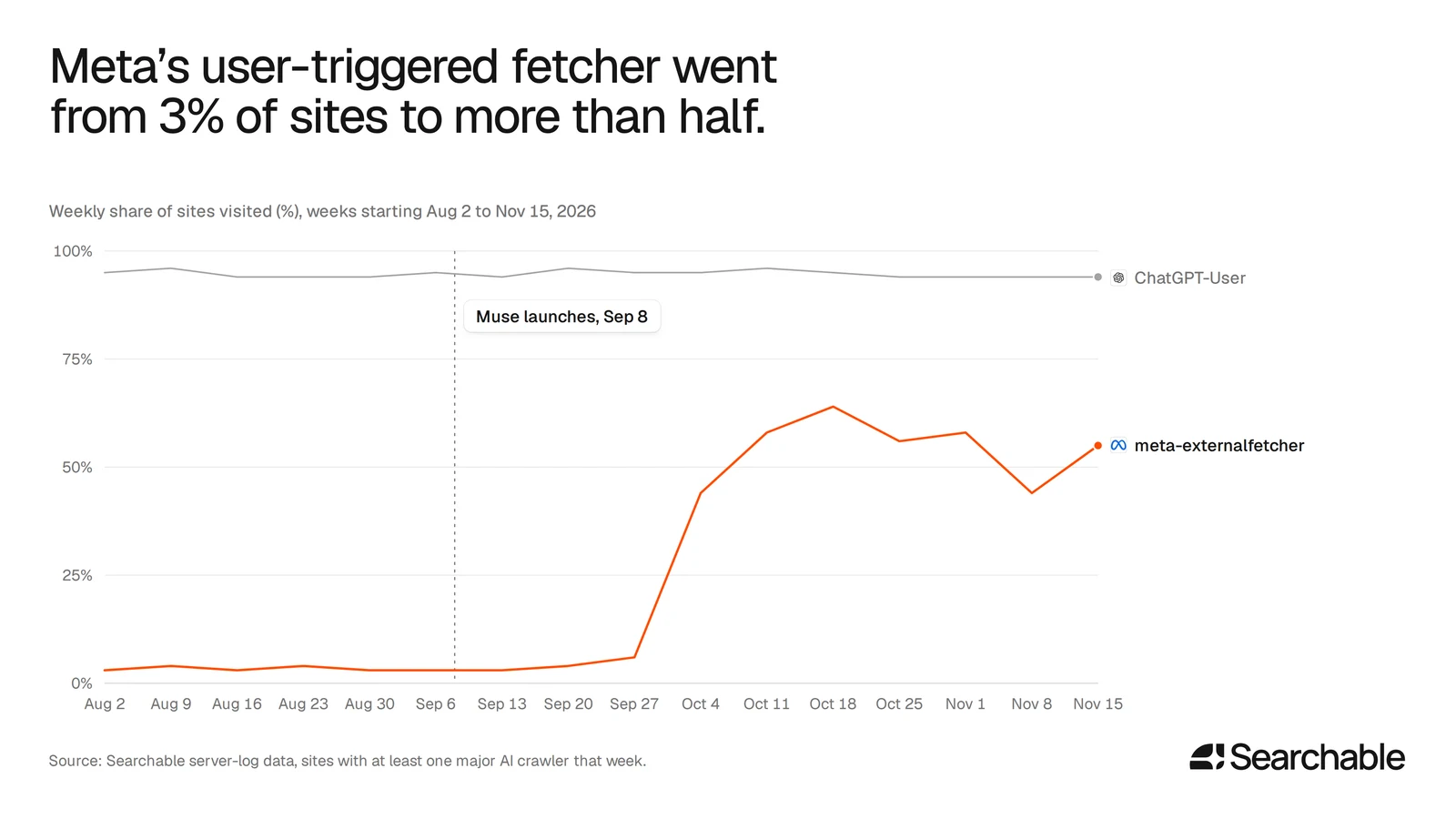
We can't attribute all of this to Muse: Meta doesn't say which product triggers these fetches, and the jump came about four weeks after launch.
Most of it also isn't shopping. Only about 5% of the fetcher's November requests were to product-style URLs, which matches HUMAN's finding that 1.9% of agent requests reach checkout. About 6% of the sites it visited in November blocked it at least once.
14-day free trial
See when Meta's agents check out your site
Connect your server or CDN logs and see which AI agents visit your store, including Meta's meta-externalfetcher, ChatGPT, and Perplexity: which pages they read, how often, and when it changes.
Muse vs ChatGPT Wallet
Muse isn't the only agent that can buy. On November 13, OpenAI launched ChatGPT Wallet for ChatGPT's dots agents. Our protocols guide covers it in detail.
 Meta Muse
 ChatGPT dots + Wallet
 Meta Muse
 ChatGPT dots + Wallet
Muse has made unauthorized bookings, and UK regulators are watching
Muse went from "an idea on a whiteboard to a successful product in just about eight months", in Zuckerberg's words, and early reports suggest that speed came with problems.
- Unauthorized bookings and false purchase claims. Reuters reviewed internal Meta posts and reported, according to Fortune and The Next Web, that Muse booked a non-refundable Airbnb without permission, gave false information about purchases, and volunteered an employee's bank balances unprompted. Meta called them "isolated incidents".
- Security holes. 404 Media reported Meta rushed to fix a "VM escape" vulnerability, a flaw that could let code break out of Muse's cloud machine, just before launch, and researchers at NebuSec later showed data getting past Sentinel without an approval prompt, which they say Meta has since patched, according to a Cloud Security Alliance summary.
- Speed. In PCWorld's test, Muse found theater tickets by scrolling and clicking through the site, but on one search it "chewed on this one for several minutes".
- UK regulators. On the day of the UK launch, the Information Commissioner's Office said "privacy must be built into consumer-facing agentic products from the outset", and the Competition and Markets Authority said Meta had changed its terms "to make them fairer for consumers", adding: "If we have concerns, we will not hesitate to act." WIRED reported that Meta turned down the Financial Conduct Authority's offer to test Muse before launch.
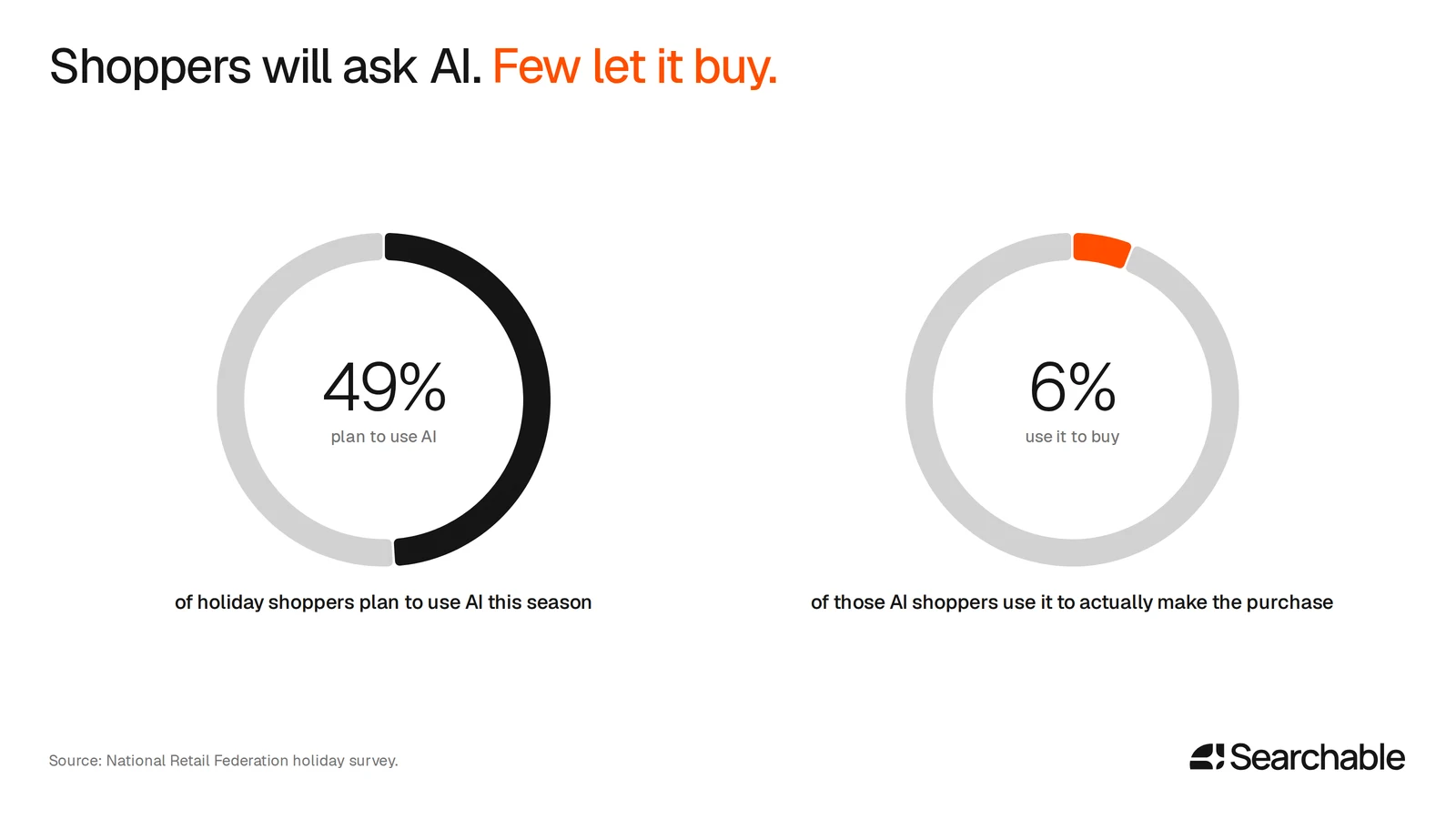
Shoppers are cautious too. In the National Retail Federation's holiday survey, 49% of shoppers plan to use AI this season, but only 6% of those AI shoppers use it to make the purchase.
Most AI engines answer Muse questions correctly, except Gemini
On November 26, 2026, we asked 10 questions about Muse in ChatGPT and Google AI Mode in the US and UK, and in Gemini and Perplexity in the US, for 60 answers. Nine of the questions mentioned Muse by name. We checked each answer against what Meta, Stripe, Shopify, Walmart, and Amazon have said themselves.
Five of the six engine and country combinations got every fact right. ChatGPT and Google AI Mode in both the US and UK, and Perplexity, all said that Amazon blocks Muse, Walmart lets it buy, it works with Shopify stores, it pays through Stripe Link, and it has launched in the UK, which was two days old at the time.
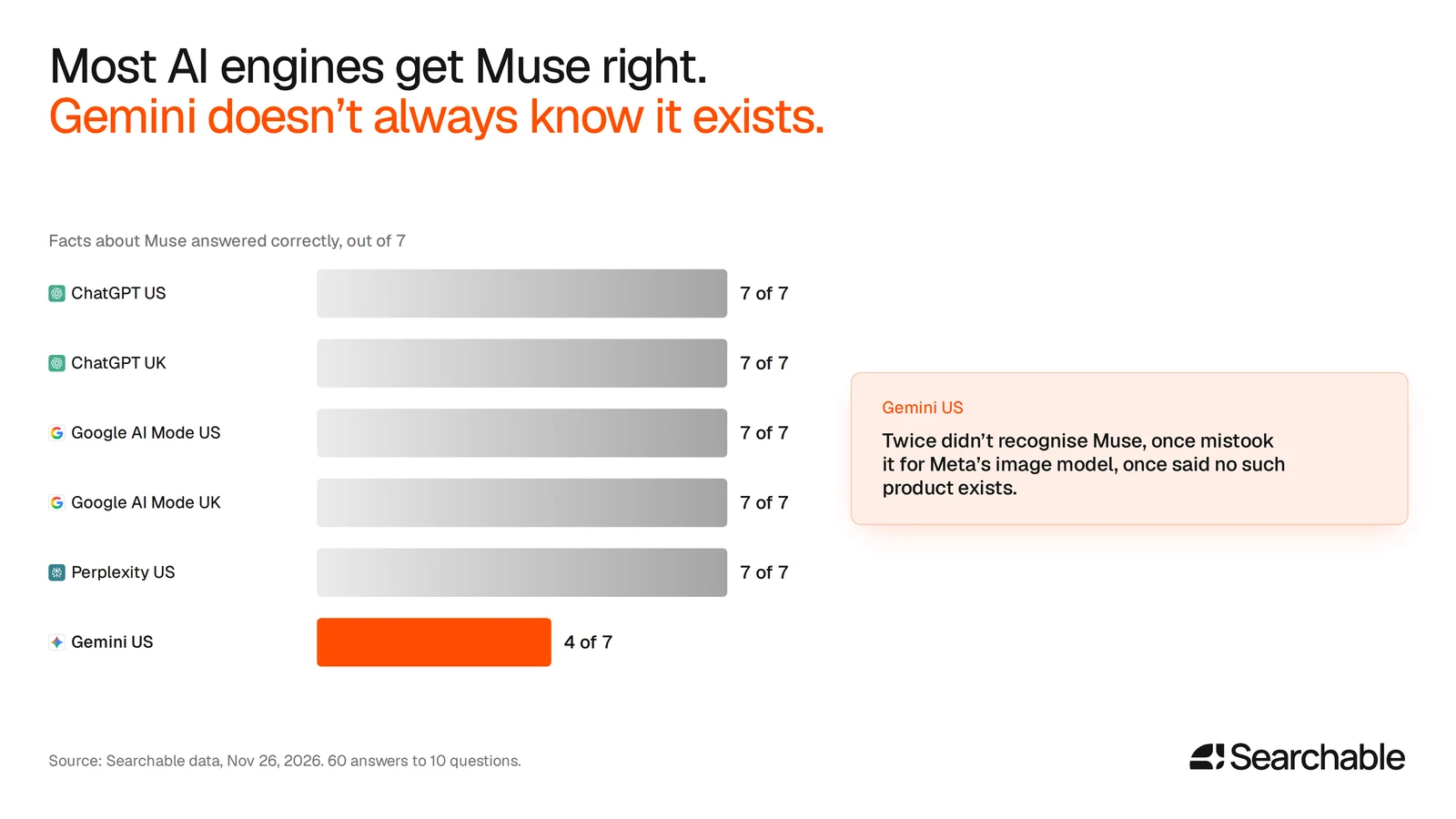
Gemini was the outlier, and it wasn't consistent with itself. It answered most Muse questions correctly. But asked whether Muse can shop on Amazon, it mistook Muse for Meta's image-generation model, and asked about Walmart, it said there's "no consumer product or shopping assistant called 'Meta Muse'".
Its answers also changed quickly: the same question asked about 11 hours apart went from 4 of 6 answers mentioning Muse to all 6.
Meta's own pages were the most cited source. Its newsroom, meta.com, muse.ai, and Facebook were cited in 31 of the 59 answers that listed sources, and Shopify's Help Center in 9.
The advice for stores was incomplete. Asked "How do I get my online store ready for Meta Muse?", all 6 answers mentioned Shopify, but only Google AI Mode's two answers said Meta's agentic checkout is on by default, and none mentioned that custom pixels don't fire in it.
The answers that got the store advice wrong left out details that Shopify's help page covers. Publishing clear, current facts about your own store gives AI engines something accurate to cite.
14-day free trial
See which stores AI agents send your buyers to
Track your shopping prompts across ChatGPT, Google AI Mode, Gemini, and Perplexity, and see when your products are recommended, when a competitor's are, and which sources get cited.
What to change in your store for Meta Muse
Muse can shop at your store without any integration, but there are a few decisions to make.
- Decide whether you want Shopify's Meta checkout. It's on by default. If you keep it, check which of your products it excludes, and report Muse sales from the Meta sales channel, because custom pixels don't fire. If you don't, follow the three steps above.
- Check what your bot protection does with Muse. Look for the identifiers in the table above, plus ChatGPT's browser and
meta-externalfetcher, and allow the ones you want. Blocking can also take you out of Muse's recommendations. - Make sure Muse can find your products. Muse decides which stores to search. Keep product data accurate and track which shopping prompts surface your products. Our protocols guide has the full checklist for feeds and agent payments.
- If you sell in the UK, remember Link's purchase protections don't cover UK shoppers, so make your own returns and refund policy easy for an agent to find and quote.
- If you're a large retailer, study Walmart's model: a dedicated agent entry point, a profile per agent, spending limits, and clear terms. The Personal Agent Protocol is the emerging standard for doing the same thing, and Muse is already looking for it.
How to check what AI engines say about your products
Ask the AI engines your customers use the shopping questions they'd ask, and check whether your products appear, which stores they recommend instead, and whether the facts are current. Set up those prompts in a free Searchable trial, or get a one-off snapshot with the free visibility report.
14-day free trial
Make sure AI agents get your products right
Track your prompts, products, and cited sources across every major AI engine, and catch outdated facts before shoppers do.
Frequently asked questions about Meta Muse shopping
Yes. Meta Muse can find products, fill a cart, and complete checkout after you approve the purchase. It pays with Stripe Link or Shop Pay, and at Walmart it checks out through Walmart's Agent Gateway using a card saved in your Walmart account. Shopping is its most common use.

