
Agentic commerce protocols are open standards that let AI agents find products, build carts, prove what a shopper authorized, and pay a merchant. The main ones are OpenAI and Stripe's Agentic Commerce Protocol (ACP), Google's Universal Commerce Protocol (UCP), Google's Agent Payments Protocol (AP2), and the Personal Agent Protocol from Sierra and Meta, with MCP and A2A underneath. Each covers a different step of a purchase. The biggest 2026 change is that OpenAI stepped back from in-chat Instant Checkout in March and now uses ACP mainly for product discovery, while the two biggest buying agents, Meta Muse and ChatGPT's dots, pay on the merchant's own checkout. In Searchable's traffic data, UCP is the only protocol whose discovery file gets checked on a large share of sites, mostly by audit tools and Meta's crawlers, while Google requested none, and ACP's is checked on about 1%. AI answers haven't caught up: in our check, 3 of 6 Google AI Overviews still described Instant Checkout as live. Most stores should start with accurate product data and a deliberate agent access policy, then use their commerce platform's protocol support.
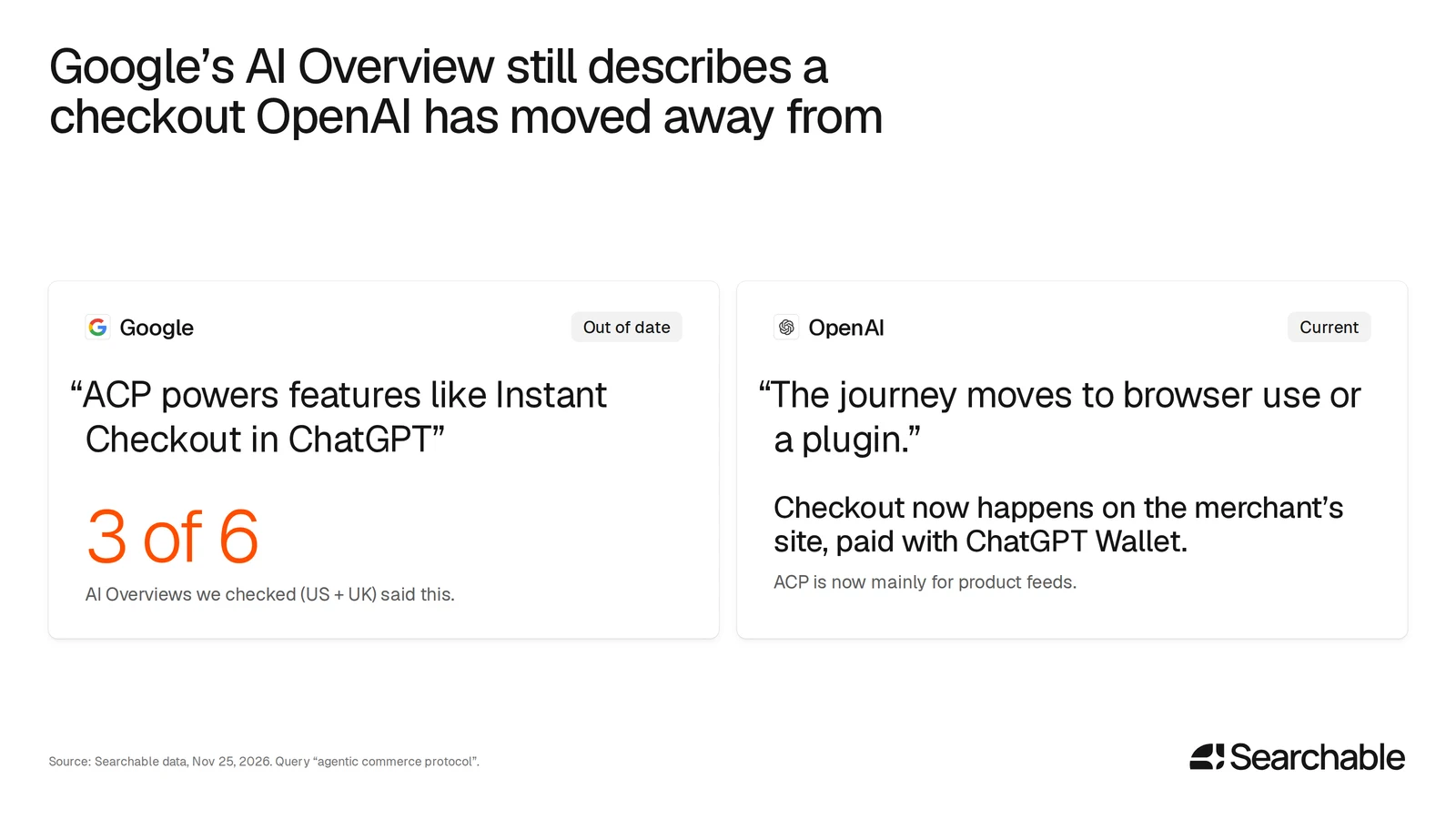
Ask Google what the agentic commerce protocol does, and its AI Overview will tell you ACP "powers features like Instant Checkout in ChatGPT". That stopped being true in March 2026, when OpenAI stepped back from Instant Checkout.
Since then, Meta, OpenAI, and Walmart have each shipped a different way for AI agents to pay. In this article, you'll learn what each protocol does today, which ones get checked on real stores, and what your store should build first.
Key Takeaways
- No single protocol handles a whole purchase. ACP and UCP cover commerce and checkout, AP2 and the Personal Agent Protocol cover identity and consent, and MCP and A2A are the plumbing underneath.
- OpenAI stepped back from in-chat Instant Checkout in March 2026 and now uses ACP mainly for product discovery. The two biggest buying agents, Meta Muse and ChatGPT's dots, now pay on the merchant's own checkout.
- In our traffic data, something requested a UCP discovery file on about half the sites we track in two weeks, mostly audit tools and Meta's crawlers. Google, which created UCP, requested none, and ACP's file was checked on about 1% of sites.
- AI answers lag behind: 3 of 6 Google AI Overviews we checked, and Gemini's answer to "Can ChatGPT buy things for me?", still described Instant Checkout as live.
What is agentic commerce?
Agentic commerce is shopping where an AI agent does part of the work for the buyer: it finds products, compares them, builds a cart, and in some cases pays. The buyer sets the goal and approves the purchase, and the agent handles the steps a person would normally click through on a website.
Until 2026, most agentic commerce stopped before payment. A shopper asked ChatGPT, Google AI Mode, or Gemini for a recommendation, then bought on the merchant's site, with ChatGPT's Instant Checkout and Instacart's ChatGPT app as early exceptions.
That changed in the fall of 2026. Meta Muse (from September) and ChatGPT's agents with Wallet (from November) can now complete purchases on ordinary store checkouts after the shopper approves them.
Interest is rising fast. US monthly searches for "agentic commerce" rose from 330 in December 2025 to an estimated 4,400 in November 2026, according to SE Ranking. Our glossary has a short definition of agentic commerce.
What agentic commerce protocols do
Agentic commerce protocols are open standards that let an AI agent act for a shopper: find a product, build a cart, prove who the agent is and what the shopper approved, and pass a payment credential to the merchant without exposing the card number. The merchant stays the merchant of record, the business legally responsible for the sale.
Without a protocol, an agent has two options. It can drive a browser through your site like a person, which breaks on pop-ups, bot checks, and account walls, or it needs a custom integration with every merchant. Protocols replace both with a shared set of endpoints and data formats, the same way MCP did for connecting AI models to tools.
Each protocol covers a different step of an agentic purchase
No single protocol handles a whole purchase. Each covers one step: discovery, the cart, identity and consent, payment, or orders. The Agentic AI Foundation calls a purchase "a relay race involving discovery, identity, delegated authority, payment and proof", and no single protocol completes the journey.
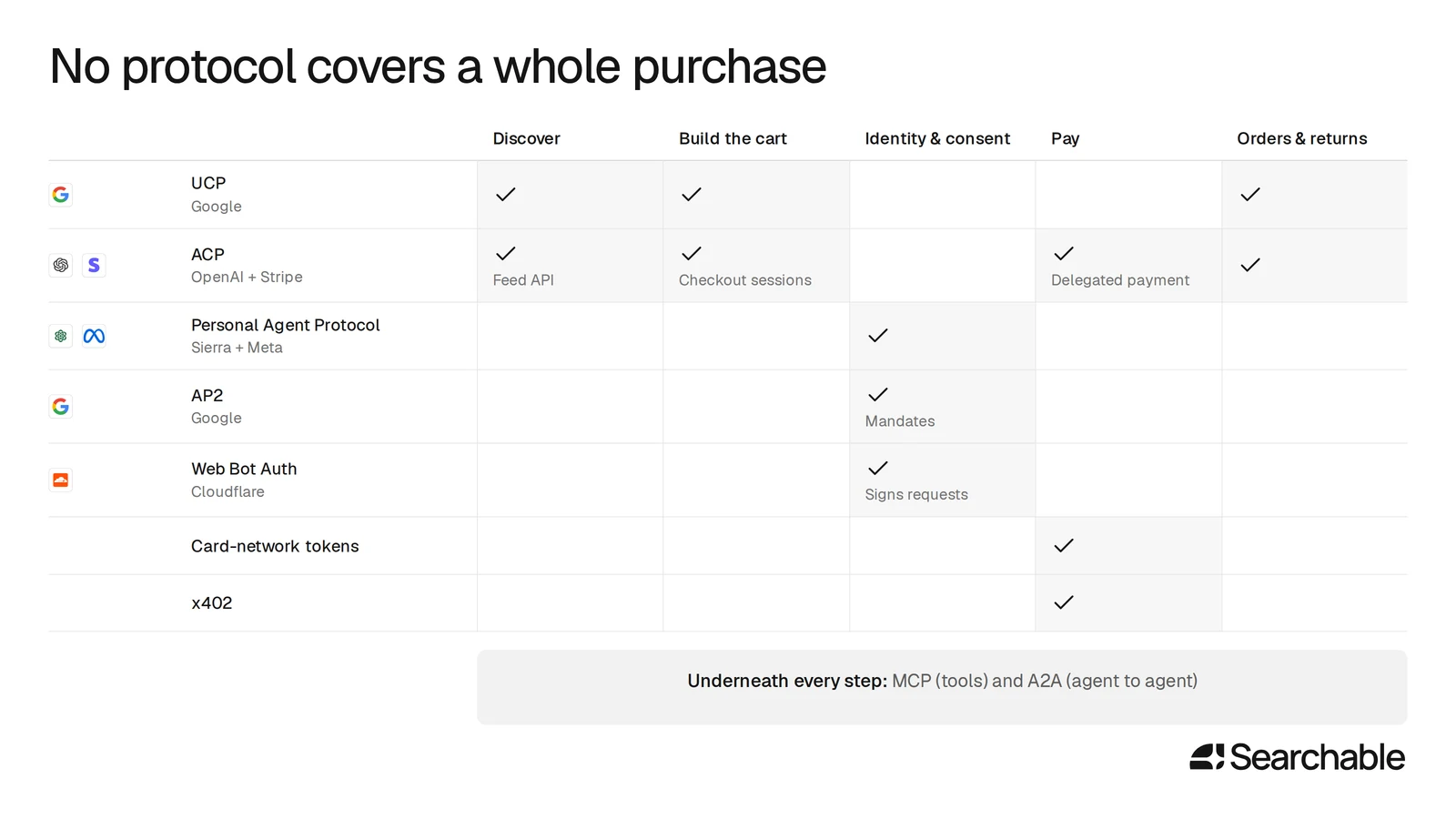
| Protocol | Led by | The job it does | Where you'll meet it |
|---|---|---|---|
| ACP (Agentic Commerce Protocol) | OpenAI and Stripe, with Meta on the steering committee | Product feeds, checkout sessions, delegated payment tokens, carts, and orders | ChatGPT product discovery; ChatGPT apps such as Instacart's; Stripe's payment tokens |
| UCP (Universal Commerce Protocol) | Google and Shopify, with a 10-company Tech Council | A merchant publishes what an agent can do with it: catalog, cart, identity linking, checkout, and orders | Google AI Mode and Gemini; Shopify's agentic checkout |
| AP2 (Agent Payments Protocol) | Signed "mandates" that prove what the shopper authorized, even when the shopper isn't present | Underneath UCP and payment networks | |
| PAP (Personal Agent Protocol) | Sierra and Meta, with partners including Shopify and Stripe | How a company recognizes a personal agent, signs in its user, and limits what the agent can do | New in October 2026; companies publish a /.well-known/poppy.json file |
| MCP (Model Context Protocol) | Created by Anthropic, now at the Linux Foundation | A standard way for a model to call tools and read data | Walmart's Agent Gateway; ChatGPT apps and plugins; ACP and UCP bindings |
| A2A (Agent2Agent) | Created by Google, now at the Linux Foundation | Agents discovering and delegating work to other agents | Multi-agent flows, such as a shopping agent handing off to a merchant's agent |
Card networks also run their own agent programs, such as Mastercard Agent Pay and Visa Intelligent Commerce, and x402 lets software pay for a web resource directly, using the web's long-unused "402 Payment Required" status code.
ACP (Agentic Commerce Protocol): OpenAI and Stripe's commerce standard
ACP launched on September 29, 2025, alongside Instant Checkout in ChatGPT. It's Apache 2.0 licensed and maintained by OpenAI and Stripe, and Meta holds the third seat on its steering committee.
It started with two specs: Agentic Checkout, where the agent runs a checkout session while the merchant keeps the authoritative cart and totals, and Delegated Payment, where a payment provider issues a token that only works for one merchant and amount. Stripe's version is the Shared Payment Token.
ACP has grown well past checkout. Its latest stable release, from April 17, 2026, adds carts, a Feed API for pushing product data to agents, order tracking, a way to run ACP over MCP, and delegated authentication through 3D Secure, the card check behind most bank verification pop-ups. The spec is still labeled beta and still changing.
UCP (Universal Commerce Protocol): Google's commerce capabilities standard
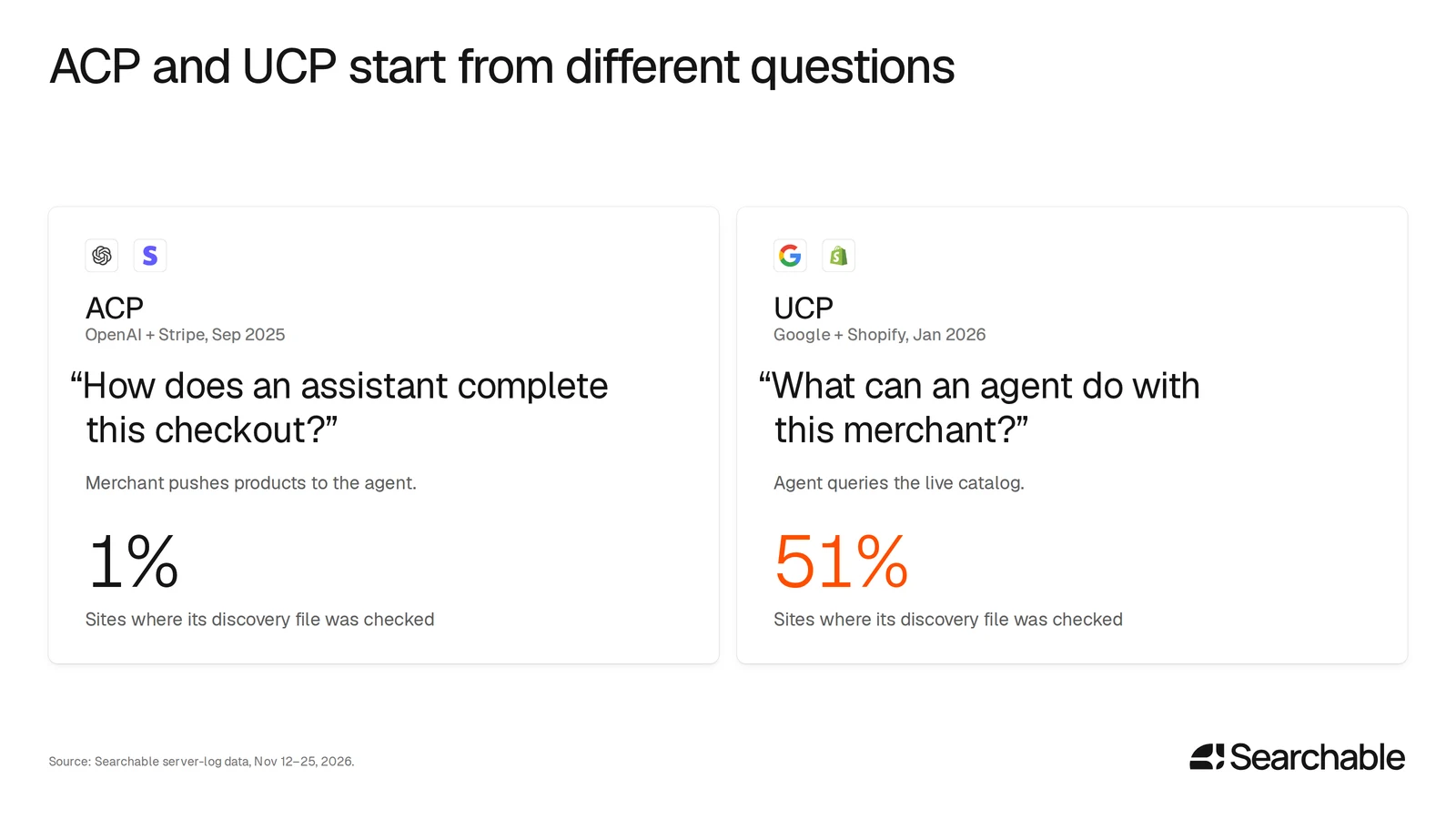
Google launched the Universal Commerce Protocol in January 2026 with Shopify, Etsy, Target, and Wayfair. Where ACP started from how an assistant completes a checkout, UCP starts from everything an agent can do with a merchant: catalog search, cart building, identity linking, checkout, and order management.
On April 24, 2026, Amazon, Meta, Microsoft, Salesforce, and Stripe joined its Tech Council. Our UCP guide covers whether to adopt it.
AP2 (Agent Payments Protocol) and the Personal Agent Protocol: proving who the agent is and what the shopper approved
AP2, announced by Google on September 16, 2025 with more than 60 organizations, proves what the shopper approved. It uses mandates, cryptographically signed records of what the shopper authorized. That matters most when an agent buys later, such as "order more coffee when it drops under $15", and the shopper isn't there to tap a button.
The Personal Agent Protocol handles the step before that: recognizing the agent at all. Sierra announced it on October 6, 2026, with Meta, Shopify, Stripe, Walmart, and others. Today a company either blocks an agent or lets it sign in as the customer and do anything, which its creators call "all or nothing".
It works in three steps. The company publishes a /.well-known/poppy.json file listing its APIs and agent. The shopper signs in on the company's own login page, using OAuth (the standard behind "Sign in with Google"), and picks what the agent may do. The agent signs every request.
Version 1.0 shipped on November 14, and Meta Muse started requesting these files from sites we track the same day (details).
ACP vs UCP: what's the difference?
ACP is OpenAI and Stripe's commerce protocol, which started with checkout and now mostly powers product discovery in ChatGPT. UCP is Google and Shopify's broader standard for describing everything an agent can do with a merchant, and it powers shopping in Google AI Mode, Gemini, and Shopify's agentic checkout.
Both keep the merchant as merchant of record and use payment tokens instead of raw card numbers. The table below compares them side by side.
 ACP
 UCP
 ACP
 UCP
Most coverage frames ACP and UCP as rivals. The governance says otherwise: Stripe co-maintains ACP and sits on UCP's Tech Council, and Meta has a seat on both. You may eventually support both, usually through your commerce platform rather than your own code, so keep one source of truth for product data and let each protocol read from it.
In 2026, ChatGPT stepped back from Instant Checkout and moved to Wallet
On March 24, 2026, OpenAI changed course: "the initial version of Instant Checkout did not offer the level of flexibility that we aspire to provide, so we're allowing merchants to use their own checkout experiences while we focus our efforts on product discovery." OpenAI's merchant page now says: "We're moving away from a standalone Instant Checkout experience in ChatGPT."
OpenAI also changed what ACP is for. It now describes ACP as "the connective layer between merchants and users throughout discovery", and Target, Sephora, Nordstrom, Lowe's, Best Buy, The Home Depot, and Wayfair send their catalogs through it. Retailers that want more control can still build a ChatGPT app, as Instacart and Walmart did.
Then on November 13, 2026, OpenAI launched ChatGPT Wallet. ChatGPT's dots agents can now pay on merchants' websites with a payment token from American Express, Mastercard, or Visa, after the shopper approves with Face ID or a fingerprint.
It's limited to US ChatGPT Pro users for now, and it works on your existing checkout page with no Wallet-specific integration. OpenAI's Partner Playbook asks merchants for:
- Product feeds, if you sell physical goods.
- Cloud browser access. ChatGPT's browser signs its requests with Web Bot Auth, a cryptographic signature that proves the traffic comes from OpenAI, and OpenAI asks merchants not to block it. Cloudflare, Akamai, HUMAN, and Vercel verify the signatures automatically.
- Fraud rules that recognize agents. You receive a network token, a stand-in for the card number issued by the card network, and OpenAI is starting to pass on the shopper's country, locale, and network details in the
Forwardedrequest header. - Plugins, which are MCP servers that expose actions like checking availability.
- Sign in with ChatGPT and a claimed Business Profile in Business Hub.
If your bot protection blocks ChatGPT's cloud browser, a shopper who asked ChatGPT to buy from you will fail at your checkout and may buy from a competitor instead. Ask whoever runs your content delivery network (CDN) or firewall to allow verified ChatGPT agent traffic before you spend time on any protocol work.
Agentic commerce, September 2025 to November 2026
| Date | What happened |
|---|---|
| September 16, 2025 | Google announces AP2 |
| September 29, 2025 | OpenAI and Stripe launch ACP with Instant Checkout in ChatGPT |
| December 8, 2025 | Instacart launches the first checkout inside a ChatGPT app |
| January 2026 | Google launches UCP with Shopify, Etsy, Target, and Wayfair |
| March 24, 2026 | OpenAI steps back from Instant Checkout and refocuses ACP on product discovery |
| April 17, 2026 | ACP's largest release adds carts, feeds, orders, and MCP |
| April 24, 2026 | Amazon, Meta, Microsoft, Salesforce, and Stripe join the UCP Tech Council |
| September 8, 2026 | Meta launches Muse, its personal agent, with Stripe Link checkout |
| September 20, 2026 | Amazon blocks Muse |
| October 6, 2026 | Sierra and Meta announce the Personal Agent Protocol |
| October 21, 2026 | Walmart announces its Agent Gateway for AI agents |
| November 13, 2026 | OpenAI launches ChatGPT Wallet |
| November 14, 2026 | Personal Agent Protocol 1.0 ships, and Muse starts checking sites for it |
| November 23, 2026 | Walmart's Agent Gateway goes live, with Muse as the first agent |
Four live ways AI agents check out today
These are the four agent checkouts that are live today, and how each one pays:
- Meta Muse drives its own browser and pays with Stripe Link, or Shop Pay on Shopify stores. PayPal is announced but not live yet.
- ChatGPT's dots agents pay with ChatGPT Wallet's network tokens through a signed cloud browser.
- Walmart runs an MCP-based Agent Gateway with per-agent spending limits, charged to a card saved in the shopper's Walmart account. Muse was the first agent through it, while Amazon has blocked Muse.
- Instacart checks out inside its ChatGPT app, built on ACP and Stripe.
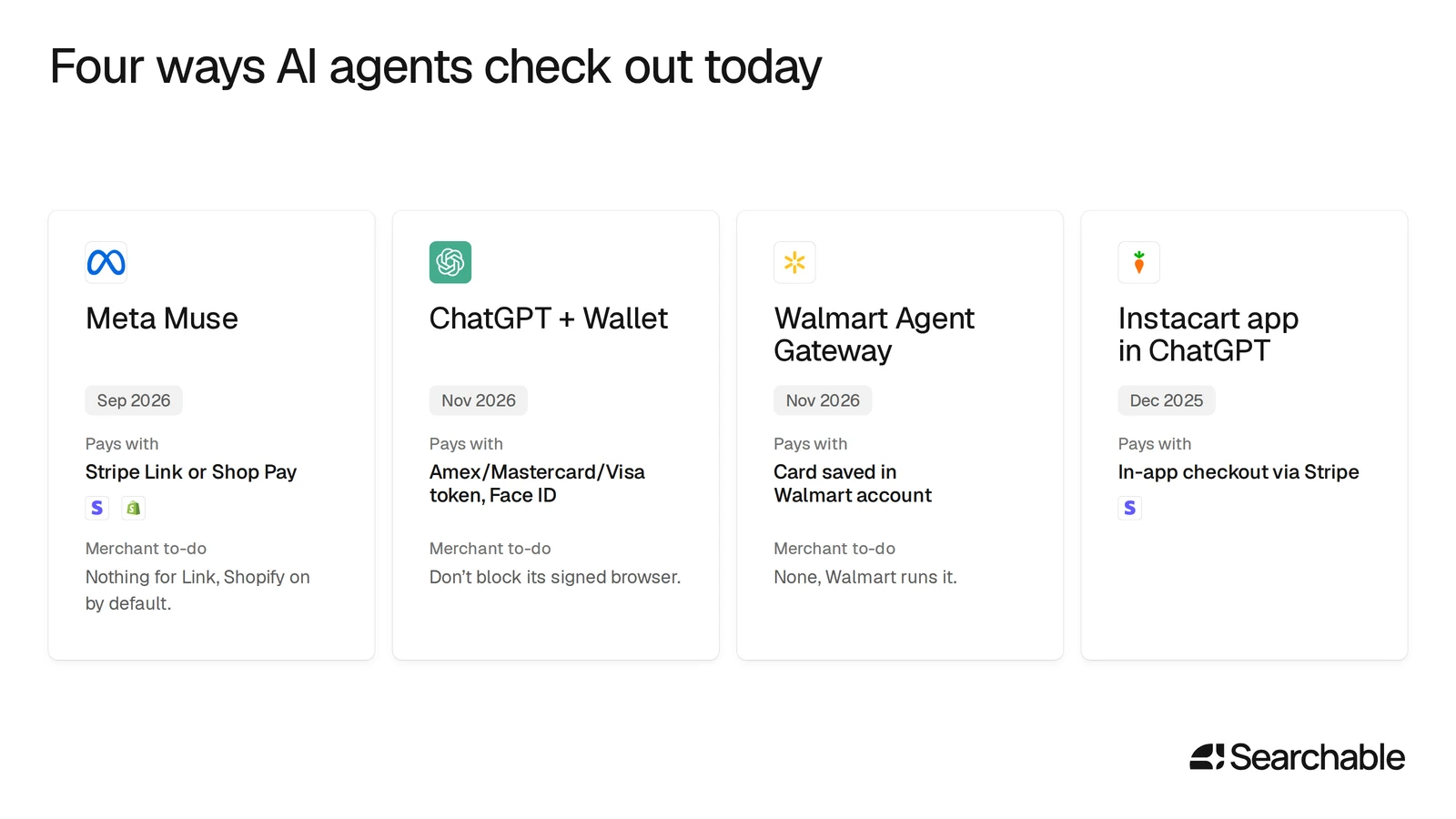
Two of the four pay on a store's ordinary checkout, and the other two are run by the retailer itself. So for most stores, the protocol that matters most right now is whichever one decides which agents you let in. That's the gap the Personal Agent Protocol and Web Bot Auth are trying to close.
Our guide to how Meta Muse shops and pays covers the Walmart and Amazon split in detail.
Only UCP's discovery file gets checked, and Meta is doing the checking
Each protocol publishes a discovery file at a standard address on a store's website, such as /.well-known/ucp for UCP, so agents can tell which protocols a store supports. We checked who requested those files on the sites Searchable tracks.
Method: server-log data from November 12 to 25, 2026, pooled across sites and shown as shares. Demo traffic and our own UCP scanner are excluded, and no site is identified.
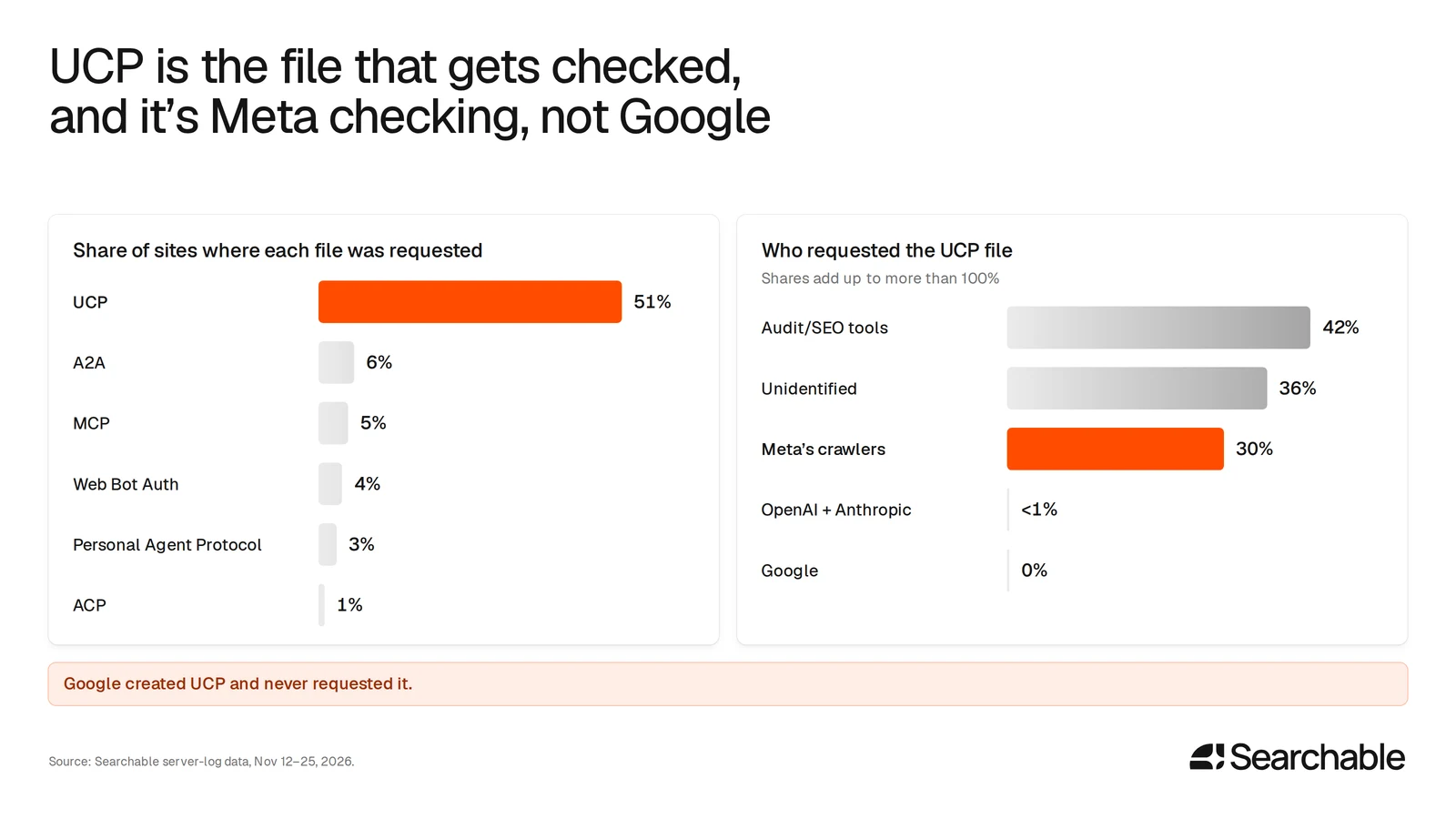
UCP is the only protocol getting real attention. Something requested a UCP file on about half of the sites we track. Every other protocol's file was checked on 6% of sites or fewer, and ACP's on about 1%, which fits OpenAI now using ACP mainly for product feeds.
Meta does most of the checking among the big platforms. Meta's crawlers, mostly its link-preview crawler facebookexternalhit, requested UCP files on 30% of sites, and they were already doing it in August, before Muse launched.
Google, which created UCP, didn't request one on any site we track. Its UCP integration guide sits in its Merchant Center documentation, which suggests Google relies on merchants connecting directly.
The AI assistants themselves barely look. Most of the UCP checking comes from AI visibility and SEO audit tools, and OpenAI's and Anthropic's crawlers requested a UCP file on only a handful of sites each.
The one assistant actively looking for a protocol file is Meta Muse, which started requesting Personal Agent Protocol files the day version 1.0 shipped. See which agents check your own site, and for which files.
If you're deciding which discovery file to publish first, UCP is the one being checked. You can see whether your store is ready with our free UCP Readiness Score.
AI answers still describe Instant Checkout as live
On November 25 and 26, 2026, we asked four questions about agentic commerce in ChatGPT and Google AI Mode in the US and UK, and in Gemini and Perplexity in the US, for 24 answers. We also pulled Google's results and AI Overviews for "agentic commerce protocol", "agentic commerce protocols", and "acp vs ucp" in both countries.
Google's AI Overviews were the most out of date. In 3 of 6 AI Overviews, Instant Checkout was described as a live feature that ACP "powers", and none of the AI answers to our first three questions mentioned it had been scaled back.
The engines also disagreed about what ChatGPT can do. Asked "Can ChatGPT buy things for me?", Gemini described the old Instant Checkout "Buy" button as current, while Google AI Mode in both countries and Perplexity correctly described ChatGPT Wallet. ChatGPT's own US answer said only that "some supported merchants" offer checkout.
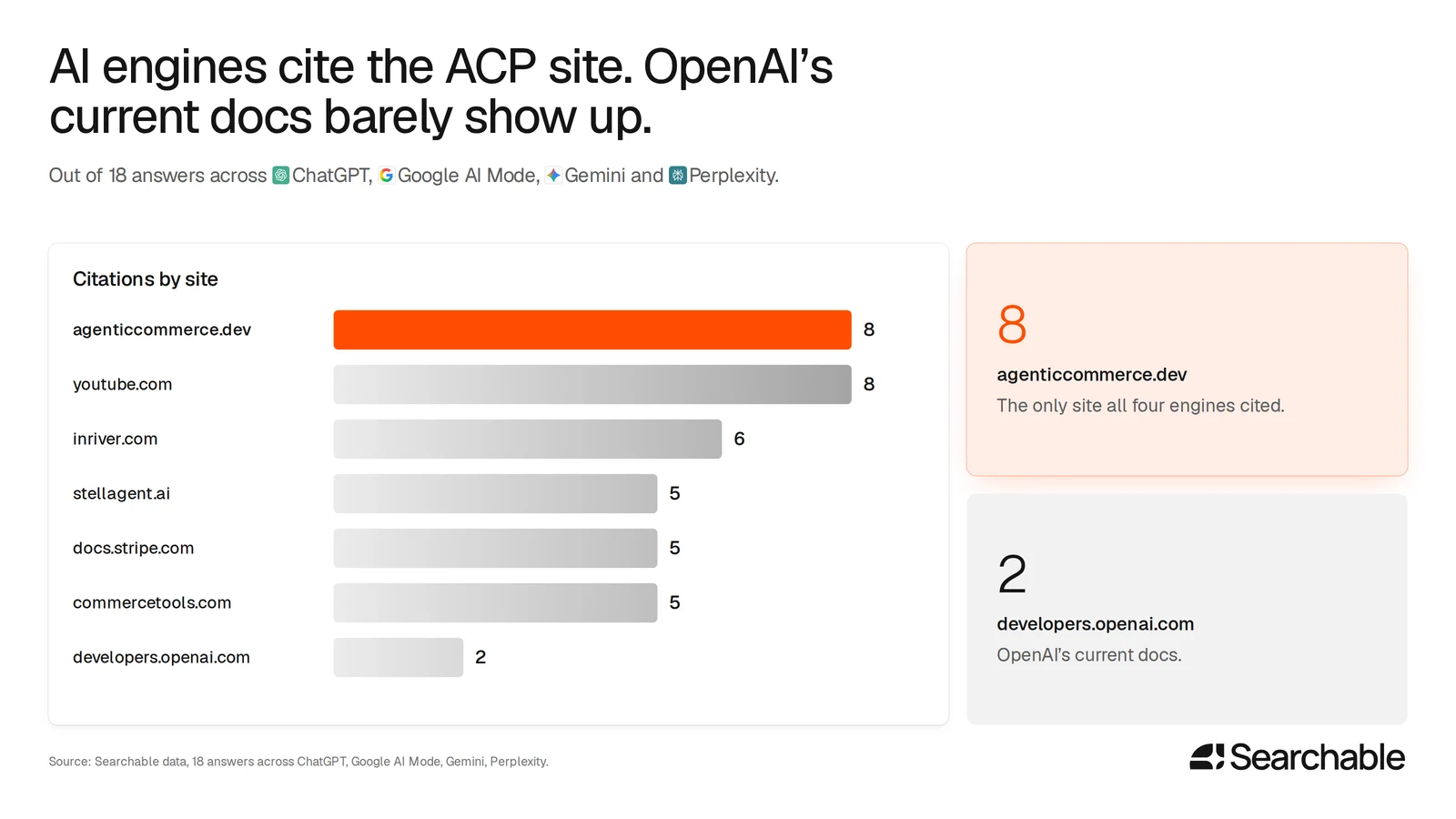
OpenAI's current documentation was barely cited. The official ACP site, agenticcommerce.dev, tied with YouTube as the most cited source, in 8 of 18 answers, and was the only domain all four engines cited. OpenAI's commerce docs, which explain what replaced Instant Checkout, were cited in just 2.
Citations were also spread across 84 different domains, 43 of them cited only once, so a current, well-sourced page can become a reference quickly.
If AI engines still describe a feature OpenAI scaled back eight months ago, they may be describing your prices, stock, and return policy just as wrongly. Checking the shopping prompts your customers use is the quickest way to find out.
14-day free trial
Are AI engines telling buyers outdated facts about you?
See what ChatGPT, Google AI Mode, Gemini, and Perplexity say about your products, prices, and policies, and which sources they cite.
Start with product data and agent access before any protocol work
Most of the revenue risk today is in being found and being let in, because an agent can't buy a product it never recommends or a page it can't load.
Which protocol applies to you
| If you... | Start with |
|---|---|
| Sell on Shopify | UCP through Shopify's agentic checkout, which is on by default for Meta. Check the setting. |
| Process payments with Stripe on your own stack | ACP and Stripe's Shared Payment Tokens, plus product feeds for ChatGPT |
| Are a large retailer with engineering capacity | Your own agent entry point on the Walmart model, and the Personal Agent Protocol |
| Are any other store | Product feeds, a deliberate bot policy, and fraud rules that accept agent payments |
What to do, and who owns it
- Be found and recommended (marketing). Agents pick products from feeds, your site, reviews, and comparison articles. Keep titles, attributes, prices, and stock accurate, submit product feeds, and track which prompts surface you. Our guide to getting listed in ChatGPT shopping covers the feed side.
- Let the agents you want in (security). Allow signed agent traffic, such as ChatGPT's cloud browser, through your CDN and bot protection, and make sure guest checkout works without a login.
- Accept agent payments (payments). Wallet tokens and Link's single-use cards work on a normal checkout, but your fraud rules may decline them. Ask your payment and risk providers how they recognize agent purchases.
- Use your platform's protocol support first (engineering). Build directly against ACP or UCP only if you have the capacity and a platform that will route buyers to it. Start from the ACP GitHub repo and Stripe's agentic commerce docs, or from ucp.dev.
- Watch the Personal Agent Protocol (engineering). If you run customer accounts or your own customer service agent, it's the standard most likely to replace "block or allow everything". If you already maintain an MCP server, you have a head start, because your actions are already described in a form agents can call.
How to check what AI engines say about your store
Ask the AI engines your customers use the shopping questions they'd ask, and check whether your products appear and whether the facts are current. That tells you whether your problem is discovery, access, or checkout. Set up those prompts in a free Searchable trial, or get a one-off snapshot with the free visibility report.
14-day free trial
Find out which AI agents recommend your products
Track your shopping prompts across ChatGPT, Google AI Mode, Gemini, and Perplexity, and see when agents pick your products, a competitor's, or none.
Frequently asked questions about agentic commerce protocols
Agentic commerce is shopping where an AI agent does part of the work for the buyer, such as finding products, comparing them, building a cart, and sometimes paying. The buyer sets the goal and approves the purchase. Agents such as Meta Muse and ChatGPT's dots can now complete purchases after the shopper approves them.

