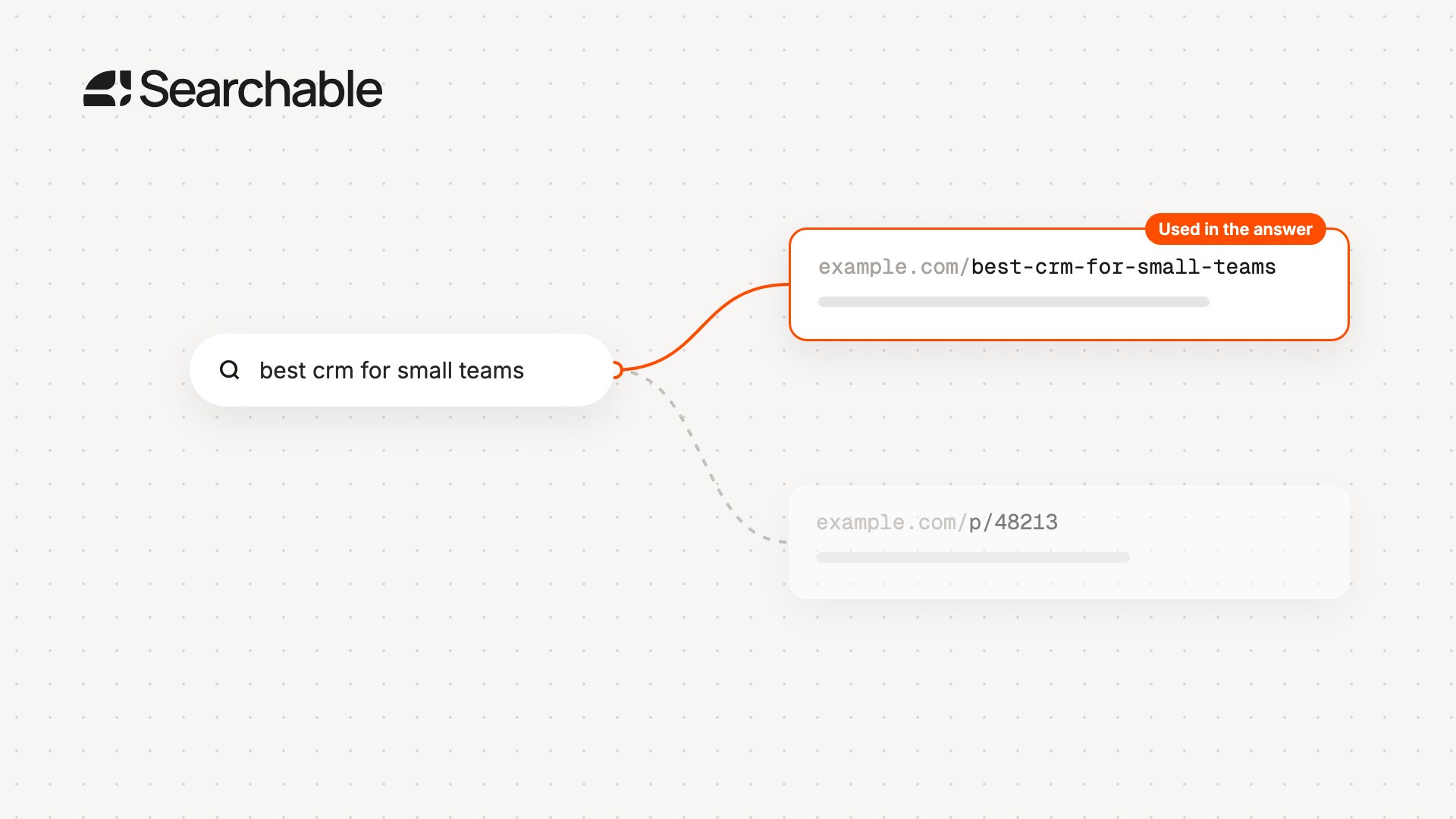
Pages whose URL is close in meaning to the question are used 21% more often in AI answers, with page titles held equal. We tested it across six AI engines in October 2026.
When an AI engine answers a question, it picks from search results where it sees little more than each page's title, URL and a short snippet. That makes the URL one of the few things about a page the engine can read before it decides.
To test whether it matters, we took ten days of repeat answers to the same questions on ChatGPT, Perplexity, Google's AI Overviews and AI Mode, Gemini and Microsoft Copilot. For each question, we asked whether a page whose URL reads like the question gets used more often than one whose URL does not.
- AI search uses a page a fifth more often (21%) when its URL is close in meaning to the question: for the same question on the same engine, pages with the closest-matching URLs turned up in 21% more of the repeat answers than pages whose URLs matched least, with page titles held equal.
- It holds on all six AI engines tested: Perplexity shows the biggest gap, using closely matched pages 31% more often, and Gemini and Copilot the smallest (15%).
- The page title counts as much as the URL: without holding titles equal, the gap more than doubles to 47%, because a URL that matches the question usually sits on a page whose title says the same thing.
Table of Contents
AI search favors pages whose URL reads like the question
For each question, we ranked every page an engine used by how close its URL is in meaning to the question. At one end are URLs that read like the question, such as /blog/best-crm-for-small-teams for a question about CRMs for small teams. At the other are IDs, dates and generic paths such as /p/48213. Then we measured how often each page came back across repeat answers to that question.
Pages in the closest-matching fifth were used in 24% of repeat answers, against 20% for the furthest fifth. Measured within each question and engine, with page titles and URL length held equal, the closest fifth is used 21% more often. The rise is steady, with no single jump, so each step closer in meaning comes with a little more use.
How often AI engines use a page, by how closely its URL matches the question
= 1% of pages analyzed

This holds with the page's title held equal, and when we compare pages on the same website (27% more often), so it is not simply stronger websites having tidier URLs.
The page title matters as much as the URL
Without holding titles equal, the gap more than doubles, to 47%. A URL that matches the question usually sits on a page whose title says the same thing, and the two travel together.
Hold the URL equal instead and a matching title on its own comes with 30% more use. In our data the title is at least as closely tied to how often a page is used as the URL is.
Since the two go together on the pages AI engines use most, the safe move is to write both for the question the page answers: a readable slug in plain words, and a title that agrees with it. An ID or a date path carries none of that meaning.
Every AI engine we tested shows it
Every engine we tested shows the same direction. Perplexity shows the biggest gap, using closely matched pages 31% more often, and Gemini and Copilot the smallest, at 15%.
How much more often each AI engine uses pages whose URL matches the question
Closest-matching fifth of URLs against the furthest, same question and engine, page titles held equal. All six engines: +21%.
Treat the order as a guide rather than a ranking: Gemini and Copilot are tracked by fewer accounts, and their figures move most when we change the method.
Method: how we measured this
- Data: the pages six AI engines used to answer unbranded English questions tracked by Searchable, October 17 to 26, 2026, with each question asked repeatedly over the ten days. Internal and test accounts are excluded, and no single account supplies more than a small share of any engine's data.
- URL match: a sentence-embedding model scores how close each URL path, read as words, is in meaning to the question. The same model scores the page title. Home pages and paths with no words are left out.
- Comparison: within the same question and engine, the share of repeat answers that used each page, closest fifth of URLs against furthest fifth, with title similarity and URL length held equal. Engines are weighted equally in the combined figure.
- Checks: shuffling URLs between pages of the same question removes the effect; scoring URLs against an unrelated question shows none; comparing pages on the same website keeps it (27%); a second embedding model gives 19%; dropping any single account leaves it at 21% to 22%.
- What it does not show: a URL that matches the question usually comes with content that matches it too, so this is an association, not proof that renaming a URL wins citations.
- Charts: in the dot chart, each dot is 1% of the pages analyzed, ranked within each question by how closely the URL matches it, and darker dots are closer matches; its height is the share of repeat answers using those pages, with titles held equal. The dots come from a finer 100-step version of the same model, so their end fifths sit slightly further apart than the 21% headline. The bar chart shows each engine's closest fifth against its furthest fifth.
Source: Searchable.com. Between October 17 and 26, 2026, we analyzed the pages six AI engines used to answer unbranded English questions tracked by Searchable, to show how often a page is used depending on how closely its URL matches the question.
See which of your pages AI engines use
Searchable shows the pages AI engines use when your customers ask about your category, and tracks your brand across every major engine.
- See which pages AI engines use for your customers’ questions
- Find the pages on your site that AI passes over
- Track your brand across every major AI engine
Want to chat with an expert? Book a demo
Trusted by over 2,000 marketing professionals and agencies.