
Copilot's consumer share is just 1.1%, but 70% of Fortune 500 firms use it. This guide compares 12 Copilot rank tracking tools with honest reviews, real pricing, and a decision framework to help you choose between Copilot-specific trackers and unified AI visibility platforms.
AI platforms sent 1.13 billion visits in June 2025, up 357% from the year before (Semrush), and that growth is still accelerating. Buried inside it is a channel most teams barely track: Microsoft Copilot.
Copilot's consumer market share sits at roughly 1.1%, according to First Page Sage. Easy to dismiss, but that headline figure hides the real story.
70% of Fortune 500 firms have deployed Copilot, and M365 has over 400 million paid seats. Big buyers are using Copilot to research products and pick vendors right now, and most brands have no idea if they show up in those answers.
The best copilot rank tracking tools fix that blind spot, but they don't all work the same way. Some focus only on Copilot; others track every major AI engine (ChatGPT, Perplexity, Gemini, Claude, AI Overviews) and fold Copilot into a wider plan.
That distinction matters more than most articles admit. Before picking a tool, the first question is whether you need a Copilot-only tracker or a unified platform that covers the full AI landscape. This guide covers both, with honest pricing, genuine limits, and a framework to help you decide.
All tools were checked in February 2026: no fluff, no marketing copy, just real analysis from people who work in this space every day.
Key Takeaways
On the same prompts, Copilot mentioned at least one brand in 76% of unbranded answers versus 69% for ChatGPT, yet most tracked brands appeared slightly less often on Copilot (Searchable data, August to September 2026)
Most teams do best starting with a unified AI platform, not a Copilot-only tool
Copilot's reach (70% of Fortune 500, 400M+ M365 seats) makes it key for B2B even with low consumer share
Free Copilot tracking barely exists, and Ahrefs Brand Radar (included with an Ahrefs subscription) is the closest option
Tools give different results for the same queries because their methods and prompts vary
Do You Need a Copilot-Specific Tool or a Full AI Visibility Platform?
Whether you need a Copilot rank tracker or a full AI platform depends on your audience. B2B brands have a strong case for Copilot because 70% of Fortune 500 firms use it (Business of Apps), but most teams get more value from a platform that covers all major AI engines, then adding Copilot depth when the data backs it up.
Most comparison articles skip this question and jump straight to a tool list. It's the first decision that matters, though, because it shapes your budget, your workflow, and how many tools you end up paying for.
The case for Copilot-specific tools:
- Deep Copilot data. Tools like AIclicks offer prompt-level tracking, citation analysis, and Bing index overlap reports that broader platforms may not match.
- Enterprise audience. If your buyers live in the Microsoft world (M365, Teams, SharePoint), Copilot is likely their main AI channel, and depth beats breadth here.
- Lower entry cost. Some Copilot-focused tools start cheaper than full-platform options.
The case for unified AI visibility platforms:
- Copilot holds just 1.1% consumer share (First Page Sage, January 2026), while ChatGPT holds 64.5% and Gemini plus AI Overviews account for 21.5%. Tracking Copilot alone means ignoring where most AI search actually happens.
- One dashboard, one budget. Unified tools track ChatGPT, Perplexity, Gemini, Claude, AI Overviews, and Copilot together, which means less tool sprawl and lower total spend.
- Cross-engine patterns. A brand visible in ChatGPT but absent in Copilot tells a different story from one that's invisible everywhere; unified data reveals which problem you actually have.
The practical call: Start with a unified platform that includes Copilot. If the data shows Copilot drives real traffic for your audience (common in B2B, finance, and enterprise tech), add a specialist tool for deeper Copilot analysis. Don't start Copilot-only unless you have clear proof it's your top AI channel. To compare unified platforms, see our ranking of the best AEO tools.
Copilot-Specific
Deep single-engine trackingBest for B2B and enterprise teams with heavy M365 usage. Offers granular prompt-level Copilot data and Bing index overlap analysis. Typical cost: $79-$149/mo. Risk: misses 98%+ of the AI search landscape outside Copilot.
“Your enterprise buyers live in Teams and SharePoint. Copilot is their default AI. You need prompt-level depth, not breadth.”
The Business Case: Why AI Visibility Tracking Pays for Itself
Visitors who arrive from an AI answer have usually seen a recommendation before they click, so they tend to arrive further along in their research than a typical search visitor. McKinsey projects that $750 billion in US revenue will flow through AI-powered search by 2028, so brands that don't track AI visibility can't see how much of that demand they're missing.
So the useful question for most B2B teams is how much Copilot visibility they're missing today.
The revenue evidence is specific and growing:
- Early adopters already attribute 10.8% of annual revenue to AI-led leads (Morningstar/PR Newswire, January 2026); many teams are labelling this as "Direct Traffic" because they don't have the tools to spot AI referral sources.
- 1 in 5 global firms are fully invisible in AI answers (Morningstar/PR Newswire, January 2026), not ranking poorly but absent entirely, and without tracking they don't even know it.
- Only 45% overlap exists between brands that rank well on Google and those that AI platforms recommend (PR Newswire, 2026). Strong Google rankings don't guarantee AI visibility.
76%
Copilot answers mentioning a brand
Compared with 69% for ChatGPT on the same unbranded prompts. Source: Searchable, August 23 to September 26, 2026.
10.8%
Revenue from AI-led leads
Early adopters already attribute this share of annual revenue to AI discovery.
1 in 5
Firms fully invisible in AI
Absent from AI answers entirely: not ranking poorly, just missing.
Copilot also answers the same prompts differently from ChatGPT. When we ran the same unbranded prompts through both engines between August 23 and September 26, 2026, Copilot mentioned at least one brand, product, or company in 76% of its answers, against 69% for ChatGPT. It also mentioned more of them per answer (5.6 versus 4.4), and did so for 120 of the 162 brands compared.
For 101 of the 162 brands, though, the brand's own name showed up slightly less often on Copilot than on ChatGPT, typically by one or two percentage points. More brand mentions per answer means more competitors share each answer, so a Copilot tracker that shows which competitors appear alongside you is more useful than one that only reports your own mentions.
A note about the data: these figures come from brands tracked in Searchable, comparing each engine's consumer app answers to the same unbranded prompts between August 23 and September 26, 2026, about 460,000 Copilot answers and 511,000 ChatGPT answers.
The comparison covers 162 brands with at least 30 answers on each engine. The per-answer count includes every brand, product, or company the answer mentions. Branded prompts were excluded. Source: Searchable, August 23 to September 26, 2026.
The misattribution problem is real. If your dashboard shows growing "Direct Traffic" you can't explain, some of it is likely AI referrals. Users who find a brand through Copilot or ChatGPT often type the URL into their browser later, and that visit shows as direct, not AI.
The Copilot angle makes this worse. Microsoft reports 15 million paid M365 Copilot seats, 160% growth year over year. Enterprise buyers researching vendors inside Copilot are high-intent, high-value traffic, and if your brand is invisible there, you're losing deals you never knew existed.
The tools in this guide exist to close that gap. The real question isn't whether AI tracking is worth it (the data settles that); it's which tool fits your strategy and budget.
See How Your Brand Shows Up in Copilot
Track your AI visibility across Copilot, ChatGPT, Perplexity, and more, with competitive benchmarking built in.
All 12 Copilot Rank Tracking Tools at a Glance
The tools below range from free (with Ahrefs) to $399/mo. We scored each on Copilot tracking accuracy, multi-engine coverage, pricing clarity, actionable data, integrations, and onboarding ease. Prices were checked in February 2026.
All 12 Copilot Rank Tracking Tools at a Glance
78

Best Categorisation
5 engines, citation + mention + rank position tracking
$189/mo
74

Best Add-on
6 engines, free with Ahrefs subscription
With Ahrefs
72

Best Copilot Depth
7 engines, deepest Copilot-specific features, Bing overlap
$79/mo
68

Best Sentiment
5 engines, sentiment and brand perception tracking
EUR 89/mo
65

Enterprise Choice
5 engines, board-ready reporting and strategic guidance
$399/mo
63

Budget Friendly
4 engines, white-label reports, lowest entry price
$29/mo
61

SEO + AI Hybrid
4 engines, SERP tracking and AI visibility combined
$138/mo
59

Best Prompt Intel
5 engines, prompt-level monitoring and competitive intel
$300/mo
56

Pay As You Go
5 engines, no subscription, pay per check
Per check
54

Widest Coverage
11 engines, broadest AI engine coverage available
$79/mo
52

SEO + AI
5 engines, traditional SEO and AI tracking combined
$149/mo
How We Evaluated These Tools
These 12 tools were tested against six criteria designed to separate the ones that help day to day from those that look great in a demo but fall flat in practice. The criteria cover accuracy, coverage, pricing, actionability, integration, and ease of setup.
The six evaluation criteria:
- Copilot tracking accuracy. Does the tool reliably spot your brand in Copilot answers, and how does it handle the fact that AI answers shift from one minute to the next?
- Multi-engine coverage. Copilot is one engine of many; tools that also track ChatGPT, Perplexity, Gemini, Claude, and AI Overviews give a much fuller picture.
- Pricing clarity. Are costs clear on the website? Are there hidden per-query charges? Can you estimate your real monthly bill before committing?
- Data you can act on. There's a gap between showing data and telling you what to do with it; graphs without next steps don't help.
- Integration. Does it plug into GA4, Search Console, Ahrefs, or Semrush, or does it sit in a silo?
- Onboarding ease. How fast can a new user get useful data? Some tools need heavy setup; others give insights in minutes.
The six criteria we used to evaluate every tool
Tracking accuracy
Does the tool reliably catch your brand in Copilot answers? AI results shift minute to minute, so the best tools run multiple checks and report the trend across them.
Multi-engine coverage
How many AI engines beyond Copilot does it track? ChatGPT holds 64.5% of AI search, Gemini and AI Overviews 21.5%. Copilot-only tools miss most of the picture.
Pricing clarity
Can you estimate your real monthly bill before committing? Hidden per-query charges and opaque tier limits are common, so we checked whether pricing pages tell the full story.
Actionable data
Does it tell you what to fix, not just what's broken? Graphs without next steps don't help. We looked for tools that surface specific recommendations, not just dashboards.
Integration
Does it plug into GA4, Search Console, Ahrefs, or Semrush, or sit in a silo? The best tools connect AI visibility to organic traffic and conversion data you already have.
Onboarding ease
How fast can a new user get useful data? Some tools need heavy setup; others give insights in minutes from a URL. Speed to first insight matters, especially during trials.
No tool scored well on all six. Every platform here has real strengths and real limits, and both are covered honestly in the reviews below.
The 12 Best Copilot Rank Tracking Tools for 2026
The best Copilot rank tracking tools for 2026 are Searchable, SE Visible, Ahrefs Brand Radar, AIclicks, Peec AI, Profound AI, Otterly AI, Nightwatch, Scrunch AI, AI Rank Checker, LLMrefs, and Rankability. Each offers a different mix of Copilot depth, engine coverage, and price, so the right choice depends on your team, budget, and goals.
All 12 Copilot Rank Tracking Tools at a Glance
78
Best Categorisation
5 engines, citation + mention + rank position tracking
$189/mo
74
Best Add-on
5 engines, integrated into Ahrefs suite
With Ahrefs
72
Best Copilot Depth
7 engines, deepest Copilot-specific features
$79/mo
68
Best Sentiment
5 engines, sentiment analysis and perception tracking
EUR 89/mo
65
Enterprise Choice
5 engines, enterprise analytics and deep insights
$399/mo
63
Budget Friendly
3 engines, white-label reports, multi-brand management
$29/mo
61
Best Transition
3 engines, traditional to AI tracking transition
$39/mo+
59
Best Monitoring
5 engines, prompt-level monitoring, competitive intel
$300/mo
56
Pay-Per-Use
5 engines, no commitment, pay-as-you-go access
Pay per check
54
Widest Coverage
11 engines, broadest AI engine coverage available
$79/mo
52
SEO + AI
5 engines, traditional SEO and AI tracking combined
$149/mo
- Searchable
Searchable is a full-stack AI visibility platform that tracks brand mentions across Copilot, ChatGPT, Perplexity, Gemini, Claude, DeepSeek, and AI Overviews. It also provides content optimisation tips and runs technical audits built for AI search.
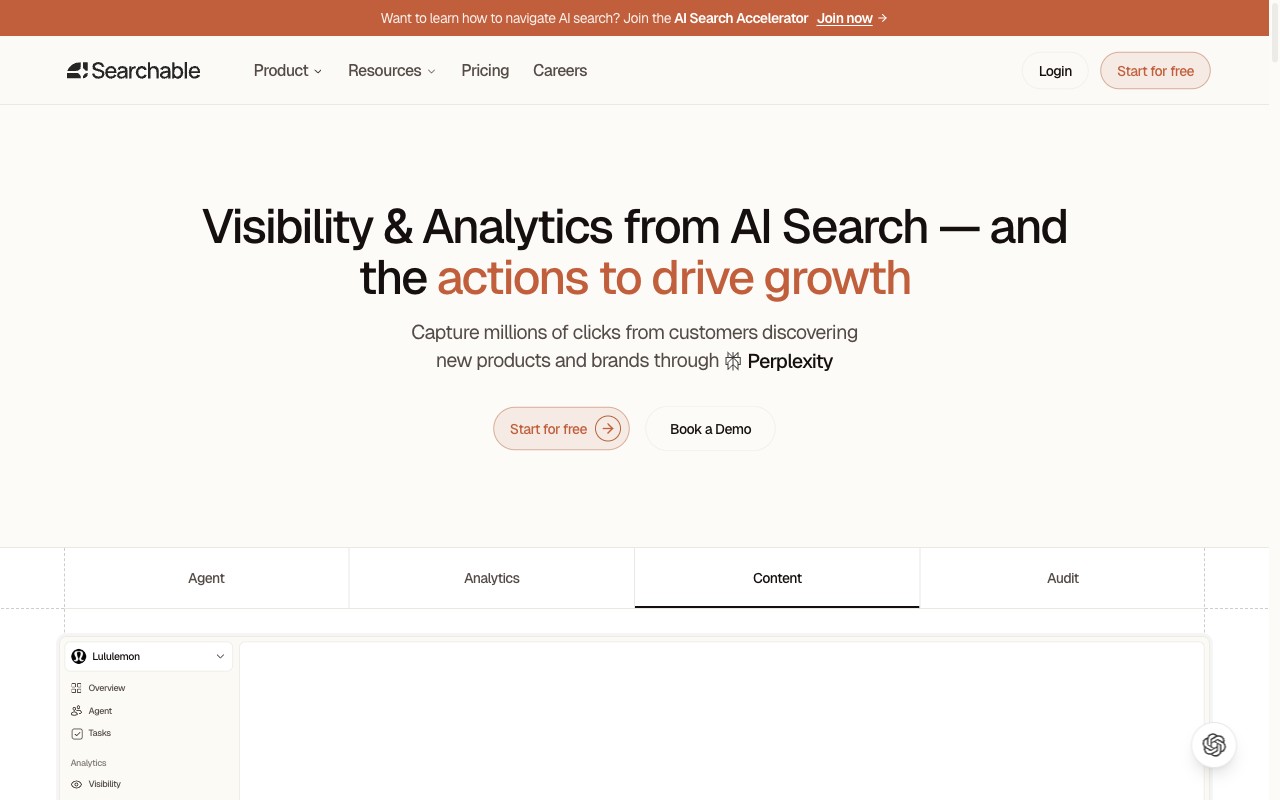
Tracks your brand across Copilot, ChatGPT, Perplexity, Gemini, Claude, DeepSeek, and AI Overviews from one dashboard. Pairs monitoring with a built-in AI content engine, technical audits, and competitive benchmarking. It also tells you what to do about what it finds.
7 engines including Copilot and Claude in the base plan
Content engine, tech audits, and competitive benchmarking built in
- Newer platform; Copilot depth is part of a unified suite, not a specialist product
Best for: Teams wanting one platform for AI visibility across all major engines, with competitive intel and actionable next steps.
Why Searchable covers Copilot better than specialist tools
7-engine tracking
Copilot, ChatGPT, Perplexity, Gemini, Claude, DeepSeek, and AI Overviews tracked together. B2B buyers don't use just one AI engine, and neither should your monitoring.
Competitive benchmarking
See which rivals appear in Copilot answers for your target queries and how that shifts over time. Many tools only report your own brand, while Searchable shows which competitors appear alongside you.
Actionable visibility tips
Surfaces specific recommendations for improving how each AI engine sees your content, so you know which gaps to fix first.
AI content engine
Generates content structured for AI citation across all 7 engines, including Copilot's Bing-backed retrieval patterns.
GA4, GSC & CRM integrations
Connect Copilot visibility data to revenue through GA4, HubSpot, and Salesforce. See which AI-driven sessions convert and tie pipeline to specific prompts.
Why use Searchable for Copilot tracking?
Specialist Copilot tools give you depth in one engine, but most AI search happens elsewhere. Searchable tracks Copilot alongside six other engines, adds competitive benchmarking, and suggests specific content fixes.
70% of Fortune 500 firms use Copilot, but B2B buyers also use ChatGPT, Perplexity, and Claude. Track all of them in one place.
Free Copilot Visibility
See where your brand appears in Copilot and six other AI engines, and where it's missing.
2. SE Visible (by SE Ranking)
SE Visible separates AI visibility into three layers: citations (linked URLs), mentions (brand name only), and rank position.
Where it excels
Three-layer tracking (citation, mention, rank position) is genuinely useful for stakeholder reporting. Clean pricing page with no hidden costs. Solid Copilot coverage across 5 engines.
Where it falls short
At $189/mo it's pricier than many rivals. Copilot depth doesn't match dedicated Copilot tools. Still a young product: features are being added fast but the roadmap is unpredictable.
Pricing
From $189/mo
Best for
Mid-market and enterprise SEO teams that need structured reporting where stakeholders care about the difference between a citation and a mention.
3. Ahrefs Brand Radar
Ahrefs Brand Radar is included at no extra cost with any Ahrefs subscription, making it the fastest way for existing Ahrefs users to add AI visibility tracking.
Where it excels
Free for Ahrefs subscribers. Integrates with Ahrefs' keyword, backlink, and content data in one place. Tracks 6 engines including Copilot. Strong community reputation on SEO forums.
Where it falls short
It's an add-on rather than a standalone product, so Copilot-specific depth is limited. It's still new, and its AI tracking features are less mature than dedicated platforms.
Pricing
Included with Ahrefs (from $129/mo)
Best for
Teams already on Ahrefs that want AI visibility without adding another subscription. The best free starting point in this category.
4. AIclicks
AIclicks is the Copilot specialist in this list: prompt-level tracking, citation breakdowns, and a Bing-Copilot overlap view you won't find elsewhere.
Where it excels
Deepest Copilot-specific features of any tool here. Prompt-level tracking, Bing-Copilot overlap data, and a practical playbook for improving Copilot visibility. Covers 7 engines.
Where it falls short
Heavy self-promotion makes it hard to separate features from marketing. Blog comparisons are outdated, missing major tools. At $79/mo a broader unified platform may offer better overall value.
Pricing
From $79/mo
Best for
B2B and enterprise teams with clear evidence Copilot is their primary AI discovery channel. Best paired with a broader platform for other engines.
Copilot enterprise reach: why B2B can't ignore it
70%
ChatGPT enterprise adoption (est.)
~45%Gemini for Workspace adoption (est.)
~30%Sources: Business of Apps (Copilot); estimates for others based on public deployment data. Paid M365 Copilot seats: 400M+.
5. Peec AI
Peec AI tracks how AI answers describe your brand as well as whether you appear, with sentiment analysis across Copilot, ChatGPT, Perplexity, Gemini, and AI Overviews.
Where it excels
Sentiment and brand perception analysis sets it apart. It shows whether Copilot recommends you positively or with caveats, which is useful for reputation monitoring and regulated industries.
Where it falls short
Core rank tracking and citation features are thinner than pure tracking tools. Euro pricing causes billing friction for US teams. Sentiment focus narrows appeal to specific use cases.
Pricing
From EUR 89/mo
Best for
Brand managers and PR teams focused on how AI describes their brand. Regulated sectors and brands with active reputation management needs.
6. Profound AI
Profound AI is the enterprise option: $399/mo buys board-ready reporting, strategic guidance, and deep analysis across five engines.
Where it excels
Board-ready reporting and strategic guidance, more analyst than dashboard. Deep competitor reports and AI visibility audits that enterprise teams can take straight to leadership.
Where it falls short
$399/mo is out of reach for most teams. Heavy onboarding makes it a poor fit for teams wanting quick, lightweight tracking. Engine coverage (5) is narrower than cheaper alternatives.
Pricing
From $399/mo (demo only)
Best for
Enterprise brands managing AI visibility across many products, regions, or brand names. Worth the cost if leadership-ready reports matter more than self-serve dashboards.
7. Otterly AI
Otterly AI is the cheapest dedicated AI visibility tool in this list at $29/mo, covering the four core engines: Copilot, ChatGPT, Perplexity, and Gemini.
Where it excels
Best price-to-value ratio in this comparison. Clean, intuitive UI that comes up consistently in user reviews. White-label reporting and multi-brand management built in.
Where it falls short
Lower price means less depth. Copilot tracking is basic versus specialist tools. Fewer integrations, limited competitive features, and only 4 engines tracked.
Pricing
From $29/mo
Best for
Solo SEO practitioners, small agencies, and teams starting AI tracking on a tight budget. A solid first tool before scaling up to a more feature-rich platform.
8. Nightwatch
Nightwatch blends traditional SERP rank tracking with AI visibility. The base plan is $39/mo and the AI add-on is $99/mo, so teams can layer AI tracking on top of existing workflows.
Where it excels
SERP tracking and AI visibility in one place, the cleanest bridge between legacy rank tracking and AI monitoring. Low entry cost with an optional AI add-on for gradual adoption.
Where it falls short
Full price ($138/mo) approaches mid-tier platforms with wider AI coverage. The AI add-on is still maturing compared to AI-first tools. It covers only four engines (no Claude, Gemini, or DeepSeek).
Pricing
$39/mo base + $99/mo AI addon
Best for
Teams rooted in traditional rank tracking that want to add AI visibility without overhauling their existing setup. Good for gradual adoption.
9. Scrunch AI
Scrunch AI tracks at the prompt level (which exact queries trigger your brand or rivals in AI answers), with strong competitive intelligence across five engines.
Where it excels
Prompt-level monitoring shows which questions trigger your brand, and which trigger competitors. Strong competitive intel for teams that need to understand why they're losing specific queries.
Where it falls short
$300/mo is a significant ask. Better for teams with an existing AI visibility strategy than those just starting out. Engine coverage (5) is narrower than cheaper alternatives.
Pricing
From $300/mo (demo only)
Best for
Competitive intel teams and brands that know they're invisible for certain prompts and need to understand exactly why.
10. AI Rank Checker
AI Rank Checker charges per check rather than per month, which is useful for agencies doing periodic audits or teams testing before committing to a subscription.
Where it excels
No subscription commitment: run a batch of Copilot visibility checks for under $10. Covers five engines. Good for one-off audits and reports without locking into a monthly plan.
Where it falls short
Pay-per-use gets expensive fast if you want daily monitoring. No ongoing dashboard, so each check is a single snapshot with no trend line. Competitive features are minimal.
Pricing
Pay per check (no subscription)
Best for
Agencies doing periodic AI audits for clients, consultants building one-off reports, and teams testing AI tracking before committing to a subscription.
11. LLMrefs
LLMrefs tracks 11 AI engines (the widest coverage in this comparison), including Copilot, ChatGPT, Perplexity, Gemini, Claude, and DeepSeek, at $79/mo.
Where it excels
It covers 11 engines, the broadest coverage in this comparison, with no meaningful gaps. Good value at $79/mo for teams that need to monitor niche AI engines alongside the majors.
Where it falls short
Breadth trades off with depth. Per-engine data is thinner than specialist tools. Dashboard feels noisy with 11 engines active. Copilot features lag behind dedicated Copilot tools.
Pricing
From $79/mo
Best for
Enterprise brands and agencies that need to track every AI channel. Teams where a blind spot on even a niche engine isn't acceptable.
12. Rankability
Rankability blends SEO content analysis with AI visibility tracking: content quality, keyword use, and on-page SEO alongside Copilot and AI search visibility in one tool.
Where it excels
Content analysis and AI visibility in one tool. It shows why your content does or doesn't get cited, as well as where you show up, and a dedicated Copilot tracker page suggests real investment in this area.
Where it falls short
Covering both SEO analysis and AI tracking means neither is as deep as specialist tools. Their blog lists 22 tools, a breadth-first approach that suggests thin editorial depth.
Pricing
From $149/mo
Best for
Content teams wanting to connect content quality to AI visibility. Teams that see AI tracking as part of SEO, not a separate standalone function.
How Copilot Rank Tracking Actually Works
Copilot rank tracking tools send queries to Copilot and scan the answers for brand names, URL citations, and source links. Most tools combine prompt monitoring, citation detection, and NLP-based mention scanning. Because Copilot runs on Bing, good Bing SEO directly helps your brand show up in Copilot answers.
Understanding how it works also explains why tools give different results, which is a common frustration in SEO communities on Reddit and LinkedIn.
The Three Layers of Copilot Tracking
The most concrete signal. When Copilot cites a URL in its answer, tools log it. This is the closest thing to a ranking: your link shows up, users can click. Not all Copilot answers include citations, so this data tends to be sparse.
Why the Bing backbone matters. Copilot uses Bing's search index as its knowledge base, so content that ranks well in Bing is far more likely to appear in Copilot answers. That means Bing SEO (proper indexing, strong backlinks, schema markup, and fresh content) feeds Copilot visibility directly. Tools that show both Bing rankings and Copilot citations (like AIclicks) help teams connect SEO effort to AI results.
Why accuracy varies. Each tool uses different prompts, checks at different times, and classifies mentions differently. A brand might show up in 8 of 10 checks from one tool and 5 of 10 from another; neither is wrong, they're measuring slightly different things.
This variability frustrates many teams, according to the r/SEO_for_AI community on Reddit. The practical answer: pick one tool, trust its trends over time, and don't compare raw numbers across platforms.
What to Look for When Choosing a Copilot Rank Tracker
When choosing a Copilot rank tracker, focus on five things: how many engines it covers, how it handles accuracy across shifting AI answers, what the pricing model looks like, how it plugs into your current tools, and how well it reports to stakeholders. Larger teams should lean toward depth; smaller teams should focus on value and ease of use.
The right pick also depends on who you are. Here's a practical framework:
Decision tree by team type:
- Solo or freelancer. Start with Otterly AI ($29/mo) or AI Rank Checker (pay-per-use) and keep costs low while you build baseline data.
- Small to mid-size agency. AIclicks ($79/mo) or LLMrefs ($79/mo) give solid coverage at fair prices; LLMrefs' 11-engine breadth helps if you manage many clients across different sectors.
- In-house SEO (mid-market). Searchable or SE Visible offer unified platforms with competitive data. If you already have Ahrefs, start with Brand Radar at no extra cost.
- Enterprise. Searchable, Profound AI, or SE Visible for depth and reporting. Profound at $399/mo makes sense if you need board-ready analysis.
- Already on Ahrefs. Start with Brand Radar; it's free with your plan. Add a specialist tool only if the data shows you need deeper Copilot analysis.
Which approach fits your team?
Follow the decision path based on your situation
Does GA4 show bing.com or copilot.microsoft.com as a referral source?
No
Is your audience primarily B2B or enterprise?
No
Multi-Engine Platform
Copilot is lower priority. Cover all engines for $79–149/mo and track Copilot as part of the mix.
Yes
Multi-Engine + Trial Copilot Tool
B2B buyers use Copilot heavily. Baseline with multi-engine, trial AIclicks alongside.
Yes
Is it a top-10 referral source?
No
Multi-Engine Platform
Track Copilot, but don't over-invest. $79–149/mo covers it.
Yes
Dedicated Copilot Tracking
Multi-engine + Copilot-specific tool. The data justifies the $149+/mo add-on.
Multi-engine: $79–149/mo
Multi + Copilot-specific: $228–298/mo
Start simple, then upgrade when the data demands it
Before committing to any tool, it's worth running a quick evaluation. The checklist below covers the six things that actually separate good Copilot trackers from ones that look good on a demo but fall flat in practice.
Engine Coverage
0/2Pricing Model
0/2Methodology Transparency
0/2Actionability
0/2Integration & Workflow
0/2Free and Budget-Friendly Copilot Rank Tracking Options
The best free Copilot rank tracker is Ahrefs Brand Radar, which comes at no extra cost with an Ahrefs plan. On a tight budget, Otterly AI starts at $29/mo and AI Rank Checker lets you pay per check with no subscription. Truly free tools with lasting free tiers are rare in 2026; most offer trials, not free plans.
Search for "free copilot rank tracker" and you'll find articles that stretch the word "free" pretty thin. Here's what actually exists:
Genuinely free (with conditions):
- Ahrefs Brand Radar: free with an Ahrefs plan (from $129/mo for Lite). If you already pay for Ahrefs, Brand Radar costs nothing extra; many SEO teams do, making it the easiest starting point. The catch: you need the Ahrefs subscription first.
Budget-friendly (under $100/mo):
- Otterly AI ($29/mo): cheapest dedicated AI tool. Covers Copilot, ChatGPT, Perplexity, and Gemini; depth per engine is basic, but the cost-to-value ratio is hard to beat.
- AIclicks ($79/mo): most granular Copilot tracking under $100. The trade-off: you're paying for Copilot depth, not broad engine coverage.
- LLMrefs ($79/mo): 11 engines at the same price as AIclicks. If breadth matters more than Copilot depth, this is better value.
- AI Rank Checker (pay per check): no subscription. Run a batch of Copilot checks for under $10 to test whether AI tracking is useful before committing.
Best budget options for Copilot tracking
Ahrefs Brand Radar
Free with Ahrefs
No extra cost for existing Ahrefs users. Tracks mentions and citations across Copilot, ChatGPT, Perplexity, Gemini, Claude, and AI Overviews using Ahrefs' web index. The easiest starting point if you already pay for Ahrefs.
Otterly AI
From $29/mo
Cheapest dedicated AI visibility tool. Covers Copilot, ChatGPT, Perplexity, and Gemini. Depth per engine is basic, but the cost-to-value ratio beats everything else at this price point for teams just starting out.
AIclicks
From $79/mo
Most granular Copilot-specific features under $100. Prompt-level analysis, citation breakdowns, and Bing overlap data. The trade-off: you pay for Copilot depth, not broad engine coverage.
AI Rank Checker
Pay per check
No subscription, no commitment. Run a batch of Copilot checks for under $10 to test whether AI tracking is useful before committing to a monthly plan. Ideal for agencies doing spot-checks.
Start with Ahrefs Brand Radar (if you have Ahrefs) or AI Rank Checker (if you don't). Get baseline data first, and if it shows your brand is invisible while rivals show up, that's the justification for a bigger tool.
Free trials from Searchable, SE Visible, and Otterly AI let you test risk-free. Use them, and run the same queries across tools during trial periods to see how results compare.
Why Copilot Rank Tracking Matters in 2026
Copilot rank tracking matters in 2026 because Copilot sits at the centre of the enterprise world where big buying decisions happen. 70% of Fortune 500 firms use it, and 400 million paid M365 seats give it enormous reach in business (Business of Apps). Consumer share is just 1.1%, but for B2B brands, the enterprise angle is what counts.
Copilot isn't fighting ChatGPT for consumer search. It's winning the enterprise channel, where procurement teams, IT directors, and C-suite leaders research and shortlist vendors. Microsoft reports 15 million paid M365 Copilot seats with 160% year-over-year growth.
Enterprise traffic converts at higher rates and higher deal values than consumer search. A B2B brand invisible in Copilot isn't just missing clicks; it's missing from the shortlist.
Three reasons Copilot tracking matters for B2B brands:
-
The Bing link. Copilot runs on Bing's index, so every Bing ranking gain cascades into Copilot visibility. Tracking both shows how SEO effort feeds AI results directly.
-
The Windows tie-in. Windows 11 runs on over one billion devices (Microsoft), and Copilot is built into the OS, Edge, and M365. Enterprise users encounter Copilot without seeking it out; it's the default AI in their daily work.
-
The buyer shift. Enterprise buyers are increasingly using AI for vendor research and shortlisting. McKinsey projects $750 billion in US revenue will flow through AI search by 2028, and a significant share of that will move through Copilot in business settings.
15M
Paid M365 Copilot seats
Growing 160% year-over-year, the fastest enterprise AI rollout Microsoft has ever seen.
1B+
Windows 11 devices
Copilot is built into the OS, Edge, and M365, so enterprise users encounter it daily without seeking it out.
$750B
AI search revenue by 2028
McKinsey's projection for US revenue flowing through AI search channels, with B2B a major share.
The honest caveat: for consumer brands, Copilot is less urgent. ChatGPT (64.5% share) and Gemini/AI Overviews (21.5%) lead consumer AI search (First Page Sage, February 2026). If your buyers are consumers, track those engines first and treat Copilot as secondary. The unified tools in this guide handle both.
One thing that applies regardless of tool choice: pages not updated quarterly are 3x more likely to lose AI citations (Semrush). Regular monitoring and fresh content matter more than which platform you pick.
Frequently Asked Questions
Copilot rank tracking tools send automated queries to Copilot and analyse the responses for brand mentions, URL citations, and source links. They combine prompt monitoring, citation detection, and NLP-based brand mention analysis. Because Copilot runs on Bing's index, strong Bing SEO directly boosts Copilot visibility.
Making the Right Choice
The AI visibility space is moving fast, and it's still early enough that the tools ranking highest today might look quite different in six months as features mature and new players arrive. No tool here is perfect across every area.
Two things are unlikely to change: AI search traffic is growing, and AI-referred visitors tend to arrive further along in their research. Teams that start tracking now will have months of baseline data when they need to make the case for more investment.
For most teams, the right starting point is a unified platform covering Copilot alongside ChatGPT, Perplexity, and Gemini. If Copilot proves important for your audience (as it often does in B2B), add a deeper Copilot-specific tool from there. Don't start Copilot-only without data that justifies it.
Get baseline data first. Build your strategy from knowledge, not guesswork.
Start Tracking Your AI Visibility Today
See how your brand appears across Copilot, ChatGPT, Perplexity, Gemini, and more, with competitive benchmarking and actionable recommendations.


