
AEO tools split into four categories: visibility trackers, full-stack platforms, content optimizers and crawler-log analytics. Check engine coverage first, then divide the price by the prompt allowance. Entry tiers in this guide run from $1.25 to $4.76 per tracked prompt, and the cheapest headline price is rarely the cheapest per prompt.
Answer engine optimization (AEO) tools help your brand appear in AI engines such as ChatGPT, Perplexity, and Google’s AI Overviews. The trouble is that the term "AEO tool" now covers four very different kinds of software with different capabilities and price points.
Others who cover these tools tend to group them together without explaining what each tool is actually designed to do.
Our guide takes a deeper dive. We’ll look at the 13 best AEO tools, what each one is best suited for, and cover other useful information for each.
Key takeaways
Key Takeaways
AEO tools generally fall into four categories: visibility trackers, full-stack platforms, content optimizers, and crawler-log analytics. The best fit depends on whether you need to measure visibility, optimize content, analyze competitors, or take action on recommendations.
Engine coverage should be the first thing you evaluate. There are the big 3 engines (ChatGPT, Perplexity, and Google AI Overviews), so a tool that watches only ChatGPT gives you an incomplete view of your AI search visibility.
Pay close attention to pricing structures. Several popular tools advertise a $99 tier that only tracks ChatGPT, then charge 4x that for the plan covering all three major engines.
Read the prompt count next to the price. Most entry tiers in this guide land between $1.25 and $4.76 per tracked prompt, and several cap you at 15 to 25 prompts, which is not enough to cover a single product category properly.
These four tool categories have two jobs. Some help you understand where you currently stand, while others go further by showing you what to improve and helping you take action.
Quick comparison: Which AEO tool is the best?
Here are the thirteen tools worth evaluating, ranked and categorized by type so you can match them to the problems you want to solve. Pricing changes frequently, so confirm current plans before you buy. Each entry focuses on scope and fit, with entry prices included as a reference point rather than a fixed quote.
Tool | Type | Engine coverage | Tracking to action | Entry price (monthly) |
|---|---|---|---|---|
| Searchable | Full-stack platform |         All major engines + Grok, Claude | Full: track, diagnose, fix, report | $125 |
| Profound | Full-stack platform | Up to 9 engines (3 majors on Growth) | Analytics + agents | $99 (ChatGPT only) / $399 |
| OtterlyAI | Visibility tracker | 3 majors + Copilot (Gemini add-on) | Tracking only | $29 |
| Peec AI | Visibility tracker | 3 majors (base) | Tracking only | $95 |
| Rankscale AI | Visibility tracker | 17+ engines | Tracking only | €20 (credit-based) |
| Evertune | Full-stack platform | ~11 models | Analysis + ad activation | ~$800 |
| Athena | Full-stack platform | 5 engines (9 on Starter) | Partial (predictive) | Free (very limited) / $295 |
| Writesonic | Content optimizer | Up to 10 platforms | Content fixes | $79 |
| Surfer | Content optimizer, higher plans have tracking | 5 engines (on higher plans) | Content fixes | $119 Standard Plan (or $95 for 50 prompts on their separate AI analytics tracker) |
| Semrush | SEO suite + AI | 4+ engines | Partial (SEO-led) | $99/domain add-on |
| Conductor | Full-stack platform | 3 majors + more | Full (enterprise) | Custom |
| Nightwatch | SEO suite + AI | 5 engines | Tracking only | €99 |
| HubSpot AEO | CRM suite + AI | 3 engines (no AI Overviews) | Tracking + content briefs | $50 (25 prompts) |













Pricing and plans verified August 13, 2026. Prices in the chart are in euro and USD.
What entry tiers actually cost per prompt
So, some of those prices look like a great offer. However, what matters is how many prompts that price tracks. One prompt is one question you can watch across the engines. If you run the entry tiers through that lens, the tools look quite different from the headline prices.
Cost per tracked prompt at each tool’s entry tier
Monthly price divided by the prompt allowance the tier includes. Lower is better.
Tool (entry tier) | Monthly price | Prompts included | Cost per prompt |
|---|---|---|---|
| Searchable Pro | $125 | 100 prompts | $1.25 |
| Writesonic | $79 | 50 prompts | $1.58 |
| Peec AI Starter | $95 | 50 prompts | $1.90 |
| OtterlyAI Lite | ~$29 | 15 prompts | ~$1.93 |
| Profound Starter | $99 | 50 prompts (ChatGPT only) | ~$1.98 |
| Nightwatch Starter | €99 | 50 prompts (plus 500 keywords) | €1.98 |
| HubSpot AEO Standalone | $50 | 25 prompts | $2.00 |
| Semrush AI Visibility | $99 | 25 prompts | ~$3.96 |
| Surfer Standard | $119 | 25 prompts (ChatGPT only) | ~$4.76 |
Verified August 13, 2026. Rankscale AI, Athena, Evertune, and Conductor are missing from the table because they either sell credits rather than prompts or do not publish an allowance at their entry tier.
One thing that is clear from this table is that cheap tiers are not cheap per prompt. OtterlyAI's $29 Lite plan and Semrush's $99 toolkit sit at the small end of the allowance range, and Semrush works out at roughly $4 per prompt, which is the second-most expensive entry point in this guide.
If you have 15 to 25 prompts, that covers one narrow product category. If you also want to watch five competitors across five questions each, you have spent the entire quota before tracking a single question of your own.
What to look for in an AEO tool
The best AEO tools share six key traits, starting with engine coverage. Everything else builds from there, but your tool needs to monitor the engines that actually drive citations. The remaining capabilities build on that foundation and help you dig deeper with prompt-level insights, competitor intelligence, and a clear path from identifying opportunities to making improvements.
Use these criteria as your checklist as you evaluate the tools in this list.
Coverage and capacity
0/2Depth of insight
0/3Action and honesty
0/2The four types of AEO tools
Before comparing tools, it helps to understand the four categories they fall into. Many buyers treat all AEO tools as though they do the same job, but they don't.
Citation trackers and full-stack platforms solve very different problems and come at very different price points. Knowing which category fits your needs makes it easier to compare your options.
Visibility trackers & monitors
Tell you where you stand across AI engines over time.
They measure share of voice, mentions, and citations, showing where you appear, how often, and how that changes. They typically provide less guidance on how to improve those results.
Full-stack AEO platforms
Combine monitoring with diagnostics and recommendations.
Alongside tracking visibility, they audit pages for AI readiness, show which AI crawlers visit your site, recommend improvements, and generate client-ready reports. They offer the broadest set of capabilities. (e.g. Searchable, Profound, Conductor)
Content & GEO optimizers
Improve the chances an individual page gets cited.
They score drafts for citability, suggest content structure and schema improvements, and help you write passages that AI engines can quote or cite more easily. (e.g. Writesonic, Surfer)
Crawler-log & AI-traffic analytics
Show what happens after AI systems discover your site.
They show which AI crawlers visit your pages, what they access, and which AI referrals turn into meaningful visits. It is a layer of measurement that many teams overlook. (e.g. Searchable LLM Analytics)
You do not need every type of tool. The better question is which capabilities matter most for your goals, and whether you need a focused solution or a platform that covers multiple parts of the process.
The 13 best AEO tools for 2026
- Searchable: best full-stack AEO platform
Type: full-stack platform. Searchable is a full-stack AEO platform that spans all four types of AEO tools in a single workspace.
The Searchable AEO Insights module tracks visibility across every major answer engine (ChatGPT, Perplexity, Claude, Gemini, Copilot, Google AI Overviews and AI Mode, and Grok) and breaks results into seven views: share of voice, your average position inside answers, mentions and citations, sentiment, the sources engines cite, topic rankings, query fan-out, and location. A "view as competitor" mode redraws every dashboard from a competitor's point of view.
Where most tools stop at tracking, Searchable goes further by connecting visibility data with the actions needed to improve it. The Searchable LLM Analytics tool reads your own server logs to show which AI bots crawl your site, how much of your sitemap they have reached, and how that crawling leads to human referrals.
On-page auditing scores each page for technical and AEO readiness, then provides specific recommendations, such as schema markup improvements and pages that need attention.
An “Opportunities” queue turns these insights into a prioritized list of actions, while agencies can use white-label reports that run on their own domain.
One of the best aspects of Searchable is that its measurement, diagnosis, and execution happen in one place rather than across multiple disconnected tools. Pricing starts at $125 per month for 100 prompts across three engines, or $100 per month billed annually. If you’re not ready to commit, Searchable offers a 14-day free trial as well.
Key features
-
AEO Insights: tracks share of voice, answer position, mentions, citations, and sentiment across every major engine in one dashboard.
-
View as competitor: redraws each report from a rival's perspective so you can see the category the way they see it.
-
LLM Analytics: reads your server logs to show which AI crawlers reach your pages and how that crawling turns into human referrals.
-
On-page audits: score each page for technical and AEO readiness and name the specific schema and content fixes to make.
-
Opportunities queue and white-label reports: turn findings into a prioritized task list and client-ready reporting on your own domain.
Quick breakdown
-
Best for: in-house teams and agencies that want to measure AI visibility, understand why it is what it is, and act on it without needing a wide array of AEO tools to supplement each other.
-
Good to know: Searchable offers a broader set of capabilities than teams looking only for basic citation tracking may need. For those use cases, a simpler, cost-effective tracking tool may be enough.
-
Pricing: $125 is not the cheapest entry point in this guide, and it is more than four times OtterlyAI's Lite plan. If you only want to track a couple dozen prompts and not go too in depth, there are more affordable options on this list. If you want a thorough outlook of you and your competitors, Searchable makes the most sense.
See where AI engines mention you today
Searchable tracks your brand across ChatGPT, Perplexity, Google AI Overviews, and every other major engine, then shows you the pages and gaps to fix.
- Profound: broadest enterprise feature set
Type: full-stack platform. Profound is the enterprise heavyweight of the category, named a Leader in G2's inaugural AEO grid. The platform goes beyond visibility monitoring with features like Prompt Volumes, which estimates weekly query demand across answer engines to help teams understand market opportunity. Profound also has an Agents feature, which automates multi-step workflows across research, content creation, optimization, and publishing.
The lower-priced plan comes with a major limitation. Starter (around $99 per month) tracks ChatGPT only with a 50 prompt cap. Growth (around $399 per month) covers ChatGPT, Perplexity, and Google AI Overviews together, with the full nine-engine roster reserved for Enterprise. So, the headline price is real, but the plan that clears the three-engine bar costs 4x as much.
Key features
-
Prompt Volumes: estimates weekly query demand across answer engines so you can size a topic before you invest in it.
-
Agents: automate multi-step workflows spanning research, content creation, optimization, and publishing.
-
Answer Engine Insights: monitor mentions, citations, and share of voice across up to nine engines on Enterprise.
-
Citation and source analysis: show which domains the engines lean on when they answer prompts in your category.
Quick breakdown
-
Best for: enterprises and large brands that want prompt-volume data, agentic workflows and will pay for multi-engine coverage.
-
Good to know: the advertised entry price is single-engine, so budget for Growth or Enterprise if coverage matters.
-
Pricing: Starter is close to $2 per prompt for answers from one engine, which makes it the weakest value on the page rather than an affordable way in. The $399 per month Growth plan provides a more comprehensive set.
-
Compare: we break down the differences in our Searchable vs Profound comparison.
- OtterlyAI: cheapest credible entry point
Type: visibility tracker. OtterlyAI is an independent, self-serve monitoring tool designed for SMBs and agencies that need a straightforward way to track AI visibility. It runs your prompts daily and reports brand mentions, the specific URLs that get cited, sentiment, and competitor benchmarks. It also includes a GEO Audit that checks whether AI bots can access and extract information from your pages, adding a crawlability layer that many trackers at this price point overlook. Higher tiers add API and MCP access.
Every plan covers ChatGPT, Google AI Overviews, Perplexity, and Copilot, while Claude, Gemini, and Google AI Mode are available as paid add-ons. Pricing is the most transparent and the lowest here: Lite at around $29 per month (15 prompts), Standard at around $189 (100 prompts, plus API and MCP), and Premium at around $489 (400 prompts). Annual plans are discounted by roughly 15%. This makes OtterlyAI a practical starting point for teams that want to begin measuring AI visibility before investing in a broader platform.
Key features
-
Daily prompt monitoring: runs your prompt set every day and reports brand mentions, cited URLs, and sentiment.
-
Competitor benchmarks: compare your mention rate against rivals over the same prompts.
-
GEO Audit: checks whether AI bots can reach your pages and extract information from them.
-
API and MCP access: available from the Standard tier for piping results into your own reporting stack.
Quick breakdown
-
Best for: budget-conscious SMBs and agencies that want to start tracking without a big commitment.
-
Good to know: it reports well but does little to diagnose or fix, and the extra engines cost more on every tier.
-
Pricing: the $29 headline is the lowest here but not the best value. Their 15 prompts work out to roughly $1.93 each, more per prompt than plans costing four times as much, and fifteen questions is barely a pilot. The tier that supports a real prompt set is Standard at $189.
-
Compare: see the feature-by-feature view in our Searchable vs OtterlyAI comparison.
- Peec AI: clean competitor benchmarking
Type: visibility tracker. Peec AI is a Berlin-built analytics platform designed for marketing teams and agencies, with a strong focus on competitor benchmarking. It tracks AI Visibility Score, share of voice against your competitor set, citation intelligence with response-position analysis, and content-gap findings. On the higher-tier plans, Peec AI connects with existing reporting workflows through API access and a Looker Studio integration. Seats are unlimited, which many agencies see as a plus.
Coverage spans ChatGPT, Perplexity, Google AI Overviews and AI Mode, Gemini, and Copilot. There’s a per-plan cap on how many models are included in each plan, and add-on fees. The Starter, Pro, and Advanced plans offer your choice of three AI models to track, and then you pay an extra add-on fee if you want to track more than three models. Pricing sits around $95 per month for Starter (50 prompts, one project), roughly $245 for Pro, and about $495 for Advanced (which adds the Looker Studio connector), with enterprise above that. Its strongest capability is share-of-voice reporting, which gives teams a clear way to track performance over time and communicate results to stakeholders.
Key features
-
AI Visibility Score: a single trended measure of how often engines surface your brand across your prompt set.
-
Share-of-voice benchmarking: tracks your position against a named competitor set over time.
-
Citation intelligence with response-position analysis: shows which sources get cited and where you land inside the answer.
-
Content-gap findings: surface the topics rivals are cited for and you are not.
-
Looker Studio connector and API: push results into the reporting your stakeholders already read, with unlimited seats. Need higher-tier plans for access.
Quick breakdown
-
Best for: agencies and mid-market marketing teams that need to understand their AI visibility compared with specific competitors.
-
Good to know: Peec AI is primarily focused on tracking rather than recommendations or execution. Teams that need help identifying and applying fixes may need to pair it with another tool.
-
Pricing: $95 for 50 prompts is about $1.90 each, and the Starter tier restricts you to one project and three models. Agencies attracted by the unlimited seats should check the economics on that, because a second client means a second project and the per-prompt cost never improves as you scale.
-
Compare: the two go head to head in our Searchable vs Peec AI comparison. If you already use Peec AI and have hit a plan limit, our guide to Peec AI alternatives compares the cost of upgrading with the cost of switching.
- Rankscale AI: the widest engine list
Type: visibility tracker. Rankscale AI, a Vienna startup founded in late 2024, offers the broadest engine coverage in the category (17 or more). Pricing is pretty competitive, especially considering Rankscale AI pairs with features like query fan-out tracking, source and citation analysis, sentiment, a "Scout" recommendations layer, shopping analysis, white-labeled dashboards, a Looker Studio integration, and REST API.
Rankscale AI uses a credit-based pricing model: Essentials start at around €20 per month (120 credits), Pro at €99 (1,200 credits), Growth at €385 (5,500 credits), and Enterprise at roughly €780 (12,000 credits). The credit model offers flexibility, but costs can vary based on usage. Engines such as Claude consume more credits than others, so teams tracking a wider range of engines may go through their allowance faster. In return, Rankscale offers unusually broad coverage for its price.
Key features
-
17+ engine coverage: the widest engine list of any tool here, on a credit budget you control.
-
Query fan-out tracking: shows the follow-on questions an engine generates from a single prompt.
-
Scout recommendations: a layer that turns tracking data into suggested actions.
-
Shopping analysis: tracks how your products surface in AI shopping answers.
-
White-labeled dashboards, Looker Studio, and REST API: package results for clients or pipe them elsewhere.
Quick breakdown
-
Best for: agencies and SMBs that want affordable wide engine coverage and can manage a credit budget.
-
Good to know: the credit-pool model makes monthly spend harder to predict than a fixed plan.
-
Pricing: the €20 headline cannot be compared with anything else on this page, because credits are not prompts and the 17-engine coverage that makes Rankscale interesting is exactly what drains them fastest. Work out how many prompts your credit pool actually buys across the engines you care about before you take the entry price at face value.
- Evertune: enterprise brand-model analysis
Type: full-stack platform. Evertune, founded in 2024 by former Trade Desk executives, takes a research-focused approach to AEO measurement. Rather than sampling a handful of answers, it simulates thousands of prompt runs per report to produce an AI Brand Index, category analysis, and AI bot analytics (available on Enterprise.) It also adds two things few rivals have: AI retargeting, which reaches AI users through programmatic ads beyond the chat window, and a Shopping Intelligence module launched in early 2026.
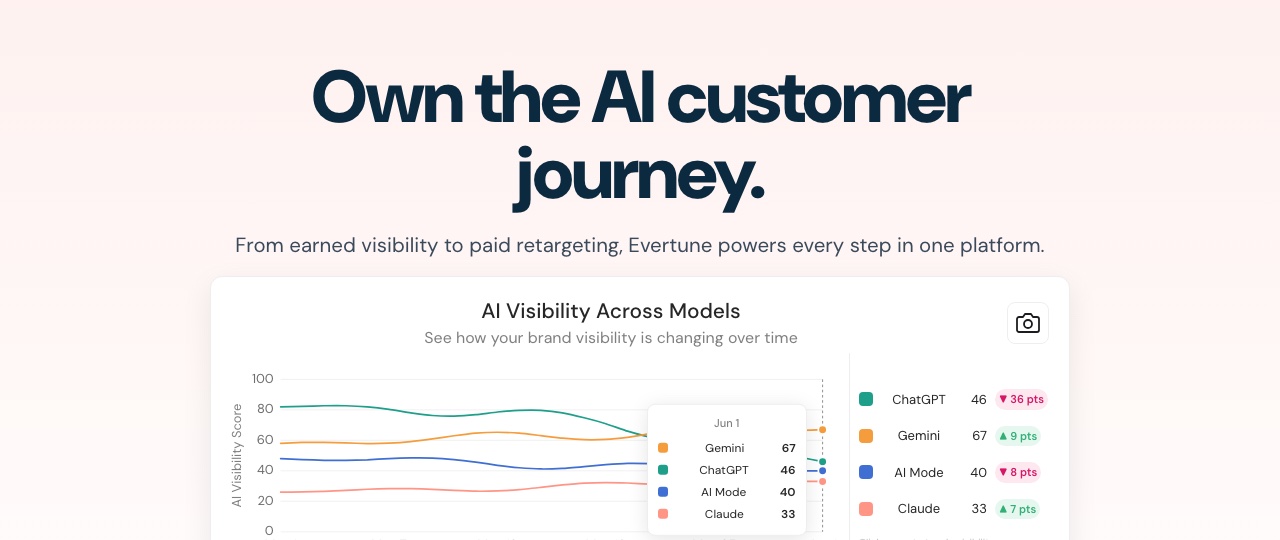
Its pricing page references eleven AI models, though the full named roster is not published. Plans are enterprise-leaning: a Pro tier around $800 per month (100,000 prompts, 25 articles a month) and custom Enterprise pricing above it, with limited self-serve. The large-sample methodology is the differentiator and gives brand leaders a statistically defensible read on how models describe them rather than an anecdotal one.
Key features
-
AI Brand Index: built from thousands of simulated prompt runs per report rather than a handful of sampled answers.
-
Category analysis: shows how models rank and describe every brand in your market, not just yours.
-
AI bot analytics: reports which AI crawlers are reaching your site (Enterprise only).
-
AI retargeting: reaches AI users through programmatic ads outside the chat window.
-
Shopping Intelligence: a 2026 module covering how models handle product and purchase questions.
Quick breakdown
-
Best for: large brands and agencies that want rigorous, sampled measurement plus a paid activation layer.
-
Good to know: it is enterprise-priced with little self-serve, making it a poor fit for small teams just testing the water.
-
Pricing: Evertune is the one tool here where volume is not the constraint, since 100,000 prompt runs at $800 is a fraction of a cent each. The main issue is you cannot buy a more affordable version of it. So, the question is whether you need statistical depth on a narrow brand question badly enough to justify a $9,600 annual commitment.
- Athena: predictive citation intelligence
Type: full-stack platform. Athena targets marketing and growth teams and focuses on helping teams predict and improve citation opportunities before publishing. Its Athena Citation Engine (ACE) scores a URL's citation probability ahead of time, Oracle flags discrepancies in how models describe you, and a Knowledge Base lets you review and correct the claims engines make about your brand. A content-optimization agent and persona targeting round it out.
Essential is free (a $25 credit, covering ChatGPT, Perplexity, Google AI Overviews, Gemini, and Claude), Starter is around $295 per month (adding AI Mode, Copilot, and Grok for nine models, with unlimited seats), and Enterprise adds SSO, audit logs, and a dedicated GEO specialist. The predictive ACE scoring is genuinely rare in the field, though the most powerful features (ACE, Oracle, the Knowledge Base) are gated to the top tiers.
Key features
-
Athena Citation Engine (ACE): scores a URL's probability of being cited before you publish it.
-
Oracle: flags discrepancies between how you describe your brand and how models do.
-
Knowledge Base: lets you review and correct the claims engines make about you.
-
Content-optimization agent: rewrites pages toward the structures engines quote from.
-
Persona targeting: runs prompt sets as different buyer types to see who you show up for.
Quick breakdown
-
Best for: mid-market to enterprise teams that want to predict and shape citations, not just count them.
-
Good to know: the headline features sit on Enterprise, and lower tiers run on credit caps.
-
Pricing: the free tier is a $25 credit rather than a plan, so it will run dry in days rather than months, and Athena does not publish a prompt allowance for the $295 Starter tier.
-
Compare: we line them up in our Searchable vs Athena comparison.
- Writesonic: tracking tied to content fixes
Type: content optimizer. Writesonic bolts an AI-visibility layer onto its content platform and pitches "visibility, not rankings." Its Action Center is the standout feature: Missing Prompts surfaces queries where competitors appear and you do not, Citation Opportunities lists outreach targets, Technical Fixes flags robots.txt, schema, and crawler-block issues, and Content Refresh points to pages that have dropped out of citations. The only downside is, the Action Center is only available on their Growth plan ($399 per month). The platform also includes AI Visibility Score tracking, share-of-voice reporting, and location-based prompt tracking.
Standard tiers track ChatGPT, Gemini, and Google AI Overviews. The full 10-engine set (adding Perplexity, Claude, Grok, DeepSeek, Copilot, Meta AI, and Google AI Mode) unlocks on Enterprise. Plans start around $79 per month and step up through roughly $199 and $399. Its real strength is the ability to analyze missing prompts and generate a drafted page to help fill any gaps.
Key features
-
Missing Prompts: surfaces the queries where competitors appear and you do not, then drafts a page to close the gap.
-
Citation Opportunities: lists the third-party sources worth pitching for a mention.
-
Technical Fixes: flags robots.txt rules, schema problems, and crawler blocks that keep engines out.
-
Content Refresh: points to pages that have dropped out of citations and need updating.
-
Location-based prompt tracking: runs the same prompts from different markets.
Quick breakdown
-
Best for: content teams that want monitoring and execution in the same tool.
-
Good to know: broad engine coverage is Enterprise-gated, so treat lower tiers as a three-engine content tool. The key features above that make it stand out are only available on the $399 plan.
-
Pricing: the $79 entry point includes 50 prompts, or about $1.58 each, which is competitive on paper. The catch is that the tracking sits inside a broader content subscription you may already be paying for, and the Action Center that makes Writesonic distinctive only arrives on the $399 Growth plan.
- Surfer: AEO inside a mature content suite
Type: content optimizer. Surfer added an AI Tracker to its established content-optimization suite, connecting AI visibility insights directly with the Content Editor workflow many writers already use. The tracker reports a Visibility Score, Mention Rate, Average Position, share of voice, Brand Sentiment, Top Sources, and Mention Gaps (prompts that cite rivals but not you). A 2026 update added a button that turns a gap directly into a Content Editor brief, plus Looker Studio export.
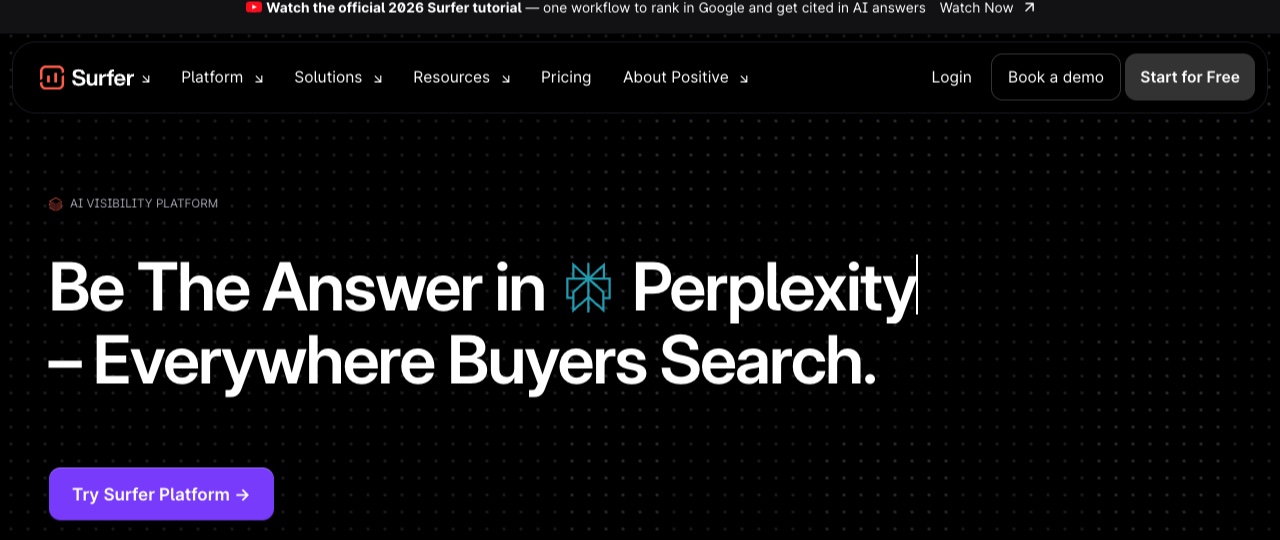
It covers five engines: ChatGPT, Perplexity, Google AI Overviews, Google AI Mode, and Gemini. Its standard plan ($119 per month) only covers ChatGPT though. For teams already creating content in Surfer, the advantage is the direct connection between visibility insights and content updates. Additional AI tracking is sold as an add-on, starting at around $95 for 50 prompts, and can be flexible based on how many prompts you want to track.
Key features
-
AI Search Analytics: a standalone or add-on feature. It reports Visibility Score, Mention Rate, Average Position, and Brand Sentiment across five engines.
-
Mention Gaps: isolates the prompts that cite rivals but not you.
-
Gap-to-brief: turns any gap into a Content Editor brief with one click.
-
Content Editor integration: keeps visibility data in the same workflow your writers already use.
Quick breakdown
-
Best for: teams already running a Surfer-based content workflow.
-
Good to know: no Claude, Copilot, or Grok coverage, and the tracker is an add-on on top of the base plan.
-
Pricing: The $119 a month entry point plan for tracking 25 prompts in ChatGPT is the most expensive pricing available with little insight. At that rate, you’re spending roughly $4.76 per prompt.
- Semrush: AI layered onto a full SEO stack
Type: SEO suite with AI features. Semrush, one of the largest SEO and competitive-analytics companies, sells a dedicated AI Visibility Toolkit separate from its core suite (with a larger Enterprise AIO offering above it). It provides an AI Visibility overview, brand-performance tracking, custom prompt tracking with daily AI rankings, AI competitor analysis, prompt research, and a site audit for AI readiness. These features all build on Semrush’s existing keyword and competitive intelligence data.
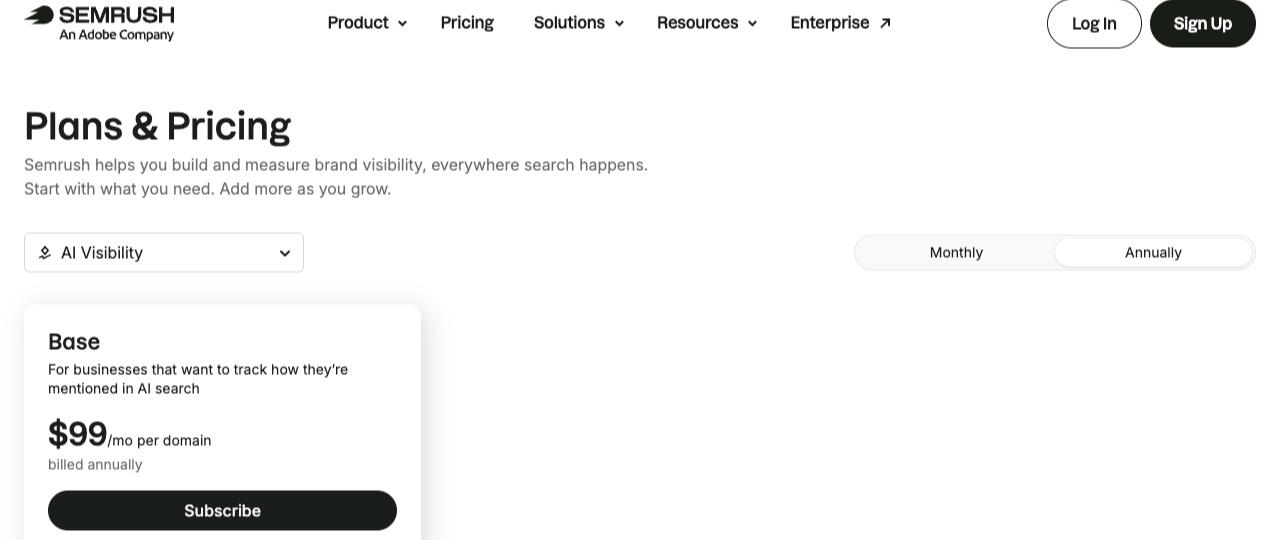
Semrush’s AI toolkit engine coverage includes ChatGPT, Google AI, Gemini, and Perplexity. Pricing starts at around $99 per month (annual) for one domain, one user, and 25 prompts. Costs increase as teams add more prompts, domains, and users. Additional domains are $99 each, and users $45 each. Larger setups can quickly move into the $300 to $1,000-plus range. Semrush One is a combination bundle that folds its AI visibility function in with the standard SEO toolkit, and that starts at around $199.
Key features
-
AI Visibility overview: a single view of brand performance across the engines Semrush tracks.
-
Custom prompt tracking: monitors your own prompts with daily AI rankings.
-
AI competitor analysis: compares your mentions and citations against named rivals.
-
Prompt research: suggests the queries worth tracking, grounded in Semrush's keyword data.
-
AI readiness site audit: checks the technical foundations that let engines crawl and quote your pages.
Quick breakdown
-
Best for: existing Semrush users who want AEO reporting alongside the SEO tools they already use.
-
Good to know: the per-domain, per-prompt, per-seat add-ons stack up fast across a portfolio.
-
Pricing: this is the second-most expensive entry tier in the guide on a per-prompt basis. Around $99 for 25 prompts is close to $4 each, and that is the rate when billed annually, for a single domain and a single seat.
-
Compare: see where a dedicated AEO platform pulls ahead in our Searchable vs Semrush comparison.
- Conductor: enterprise system of record
Type: full-stack platform. Conductor is an enterprise SEO and content platform that has repositioned itself around "winning in AI search," with AEO living in its AI Search Performance module alongside its Creator and Monitoring products. It tracks mentions and citations, brand sentiment, and competitive market share, and its Topic and Prompt Analysis generates synthetic prompts grounded in your historical keyword data. A 2026 AgentStack launch adds turnkey AEO agents, and the whole thing is SOC 2 Type 2 compliant.
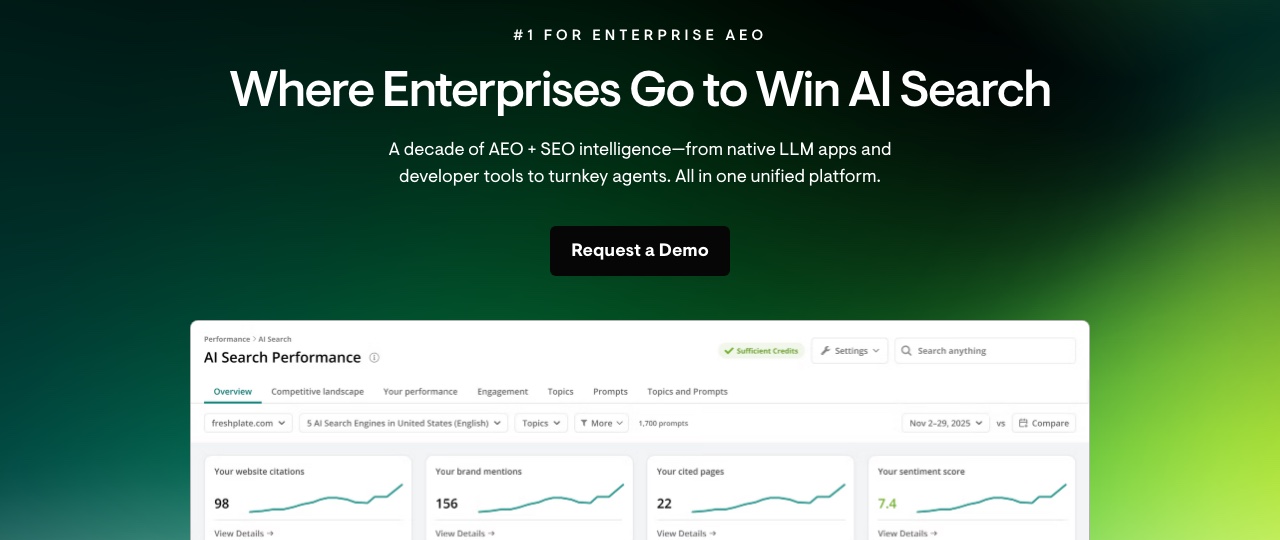
It officially names ChatGPT, Perplexity, and Google AI Overviews, with broader coverage claimed but not fully detailed. Pricing is not published: it runs on an enterprise, usage-based "AI Response Credits" model and is effectively contact-sales. The pitch is governance, AI visibility sitting in the same system of record as your traditional SEO, content workflows, and site monitoring.
Key features
-
AI Search Performance module: tracks mentions, citations, brand sentiment, and competitive market share.
-
Topic and Prompt Analysis: generates synthetic prompts grounded in your own historical keyword data.
-
AgentStack: turnkey AEO agents introduced in 2026 to run recurring optimization tasks.
-
Enterprise governance: SOC 2 Type 2 compliance, with AEO sitting in the same system of record as SEO and site monitoring.
Quick breakdown
-
Best for: large organizations that want AEO governed inside a full enterprise SEO suite.
-
Good to know: no transparent pricing and an enterprise commitment make it less practical for smaller teams.
-
Pricing: a usage-based credit model with no published rate is the least comparable pricing on this page.
- Nightwatch: LLM answers plus the queries behind them
Type: SEO suite with AI features. Nightwatch is a self-serve rank tracker that has grown as a real AI-search layer, rather than an AEO-first platform. On the AI side it tracks linked and unlinked citations, citation-level sentiment, share of voice, prompt research, and generative rankings, with real-time alerts and historical trends.
One of its more distinctive capabilities is showing not only the AI answers themselves, but also the queries that influence those responses. It also still does classic rank tracking across Google, Bing, YouTube, and Maps, and integrates GSC, Google Analytics, and Looker Studio.
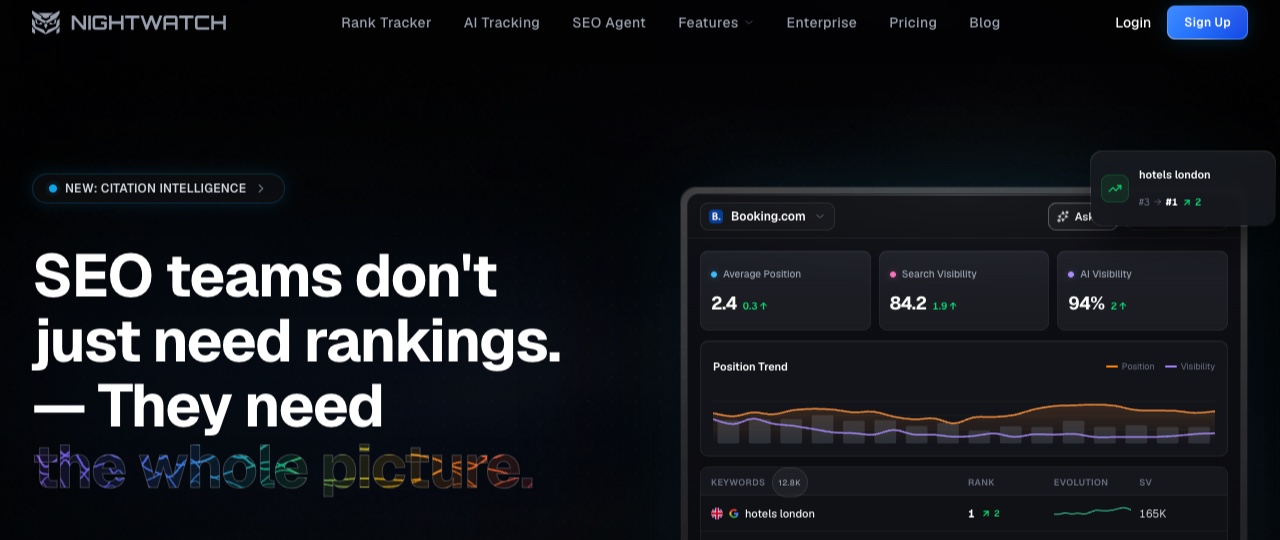
Nightwatch names Google AI Overviews, ChatGPT, Claude, Perplexity, and Gemini among its engines. Pricing is published in euros with AI prompts bundled in (no separate add-on): Starter at around €99 per month (500 keywords, 50 prompts), Professional at around €199 per month, and Agency at around €499 per month (500 prompts), all with unlimited seats. For teams that still rely on traditional SEO tracking, Nightwatch is an affordable way to monitor both search rankings and AI visibility in one dashboard.
Key features
-
Linked and unlinked citation tracking: counts the mentions that carry a link and the ones that do not.
-
Influencing queries: shows the searches behind an AI answer, not only the answer itself.
-
Citation-level sentiment and share of voice: grades the tone of each mention and tracks your share over time.
-
Classic rank tracking: covers Google, Bing, YouTube, and Maps in the same dashboard.
-
GSC, Google Analytics, and Looker Studio integrations: join AI visibility to the search data you already report on.
Quick breakdown
-
Best for: SMBs and agencies that want classic rank tracking and AI answers side by side.
-
Good to know: the AI layer is newer and prompt volumes are modest at the lower tiers.
-
Pricing: Starter offering 50 prompts is the same modest allowance as the dedicated trackers, except here it is sharing the bill with 500 keywords of rank tracking, so the AI layer is genuinely inexpensive if you were buying the rank tracker anyway. If you were not, you are paying for a rank tracker to get at 50 prompts.
- HubSpot AEO: AI visibility bundled into the CRM
Type: visibility tracker inside a CRM suite. HubSpot launched AEO at its Spring 2026 Spotlight in April, and for a lot of mid-market marketers it will be the first AI visibility tool they ever open, simply because it is already sitting in the software they log into every day.
It reports a brand visibility score per engine, competitor share of voice, sentiment on a -100 to +100 scale, and a citation analysis that breaks down which domains and content types the engines pull from. Recommendations come back as prioritized content briefs with suggested titles, keywords, and target audiences.
Its genuine differentiator is the CRM. On Marketing Hub Professional or Enterprise, HubSpot suggests prompts drawn from your buyer personas and deal data, so the prompt set reflects the questions your actual pipeline asks rather than a generic keyword list. No standalone tracker can do that. The catch is that the feature only exists if you already pay for those plans, so the $50 standalone product ships without the one thing that makes it interesting.
Coverage is the bigger limitation. HubSpot AEO tracks ChatGPT, Gemini, and Perplexity, which leaves out Google AI Overviews, one of the three engines this guide treats as the baseline, along with Claude, Copilot, Grok, and AI Mode.
Standalone pricing is $50 per month ($45 billed annually) for 25 prompts run daily across the three engines, with extra prompt packs sold on top. Marketing Hub Professional includes the same 25 prompts and Enterprise doubles it to 50. The free trial runs 28 days and is capped at 25 prompts on ChatGPT alone, so it does not show you the multi-engine product you would be buying.
On the downside, there is no crawler-log analytics, no AI traffic attribution, and no white-label reporting. Because pricing is per portal, agencies also pay again for every client they onboard. HubSpot has said the ability to act on recommendations directly inside the tool is coming later in 2026.
Key features
-
Brand visibility score: the share of your tracked prompts where your brand appears, trended per engine.
-
CRM-powered prompt suggestions: uses buyer personas and deal data on Marketing Hub Pro and Enterprise to propose the prompts worth tracking.
-
Sentiment analysis: rates how positively the engines describe you on a -100 to +100 scale.
-
Citation analysis: shows the domains and content types the engines cite when they answer your prompts.
-
Prioritized recommendations: returns content briefs with suggested titles, keywords, and target audiences.
Quick breakdown
-
Best for: teams already on Marketing Hub Professional or Enterprise who want AI visibility reporting sitting next to their CRM data at no extra cost.
-
Good to know: three engines with no Google AI Overviews coverage, a 25-prompt cap, and no crawler or attribution layer make this a first look rather than a complete AEO program. Standalone buyers also lose the CRM prompt suggestions that make it distinctive in the first place.
-
Pricing: $50 for 25 prompts is exactly $2 each. For tracking purposes, 25 prompts disappear quickly. If you track five competitor comparisons and five category questions, you have used up 40% of your tracked prompts. The bundled version is genuinely free if you already pay for Marketing Hub, though.
Tracker vs platform: do you need both?
For most teams the honest answer is a platform, not a tracker with multiple point solutions. A standalone tracker tells you that you're losing visibility, but it often stops there. It rarely tells you which page to fix, and it won’t generate the client-ready reporting you need. Buy one, and you may end up adding more tools to fill those gaps. It’s worth weighing the total cost of that setup against a single platform before you commit.
The one exception is when your needs are narrow. If your goal is to simply watch one or two engines for a single brand and you already have content and technical fixes handled elsewhere, a focused tracker is all you need. We've tested engine-specific options in our guides to Perplexity tracking tools, Copilot tracking tools, Claude tracking tools and Grok tracking tools. The moment your team starts managing two or three of those capabilities, a platform that brings them together can cost less than buying several separate tools.
How to actually measure AEO success
AEO success consists of several stages:
The six stages of AEO success
The page exists and is crawlable. If AI bots cannot reach it, nothing downstream can happen.
Think of these stages as a troubleshooting guide: no retrievals is a content problem, retrievals without citations is a citability problem, and citations without movement means the topic needs sibling content.
Set expectations on timing before you begin. Position movement inside AI answers is measured in weeks, not days, and a retrieved-but-not-yet-cited page is on track rather than failing. The strongest results usually come from building authority around a topic, not publishing one isolated article.
Attribution is where measurement gets more complicated. Ranking first in an AI answer does not capture the sale directly. The buyer reads the answer, trusts it, and often converts later through a branded search or a direct visit, and that final click gets credited to organic, direct, or paid, but never to AI. Last-click attribution structurally undercounts AI's influence, and without cross-session tracking there is no clean way to prove a chat led to a purchase weeks later.
The upside makes the effort worth it. Our own data shows AI-referred visitors arrive pre-qualified, with lower bounce rates, longer sessions, and meaningfully better conversion on considered purchases. The model does the qualifying inside the conversation, so the person who clicks arrives ready to act.
Frequently asked questions
Answer engine optimization (AEO) is the practice of getting your brand mentioned and cited inside AI-generated answers, on platforms like ChatGPT, Perplexity, and Google AI Overviews. Instead of chasing a position in a list of links, AEO focuses on becoming one of the sources an AI engine uses when forming an answer. AEO tools measure and improve that visibility.
Put your brand on the AI answer
Searchable tracks your visibility across every major answer engine, audits your pages for AI readiness, and hands you the fixes, all in one workspace.

