
Grok has grown to 64M monthly users with 134M daily queries and 263% growth, but it's still only 3.4% of the AI chatbot market. In Searchable data, Grok mentioned about 2.3 times as many brands per answer as ChatGPT on the same prompts, which makes competitor tracking especially important there. Most teams don't need a Grok-specific tool. This guide reviews 10 tracking options from $20/mo to $295/mo and helps you decide whether Grok even deserves a line item in your budget.
Grok processes 134 million queries a day, and most marketing teams have no idea whether they're showing up in any of them.
That's understandable. Grok holds just 3.4% of the AI chatbot market. It's easy to dismiss. But here's what makes it tricky: Grok pulls from X's live social feed, which means it ranks brands using signals that ChatGPT, Perplexity, and Gemini can't even see. Your competitors might be invisible everywhere else but prominent in Grok, or vice versa.
So the real question isn't "which Grok tracker should I buy?" It's "does Grok matter enough to track at all?" This guide answers both. We'll cover the honest case for (and against) dedicated Grok tracking, then review 10 tools with real pricing and limitations.
Key Takeaways
Grok has grown from 17.6M to 64M monthly users in nine months, but it still represents just 3.4% of the AI search market, so don't over-invest
Grok's X/Twitter data feed creates a unique ranking signal that no other AI engine uses, which means your visibility there can differ wildly from ChatGPT or Perplexity
On the same prompts, Grok mentioned about 2.3 times as many brands per answer as ChatGPT (Searchable data, August to September 2026), but your own brand wasn't consistently more likely to appear, so competitor tracking matters more on Grok
Most teams should track Grok through a multi-engine platform ($79-149/mo) rather than paying for a Grok-specific tool on top of their existing stack
Start with a free visibility report from Searchable to check your Grok baseline; cheapest paid options are Rankscale ($20/mo), Promptmonitor ($29/mo), and AI Rank Checker (pay-per-check)
If your GA4 doesn't show grok.com or x.ai as a referral source, Grok tracking should sit below ChatGPT, Perplexity, and AI Overviews on your priority list
Should You Even Track Grok? (The Honest Assessment)
You should track Grok if your brand has an active X presence, operates in a real-time vertical like news or finance, or if GA4 shows grok.com referral traffic. For everyone else, it's a "nice to have" that a multi-engine tracker covers well enough.
Let's start with what's real. Grok's growth is genuinely impressive: from 17.6 million monthly users in March 2025 to 64 million by December, which is a 263% jump in nine months. According to DemandSage, it handles 134 million daily queries, putting it behind ChatGPT but ahead of both Perplexity and Claude in raw volume.
But context matters. ChatGPT processes over 1 billion queries per day. Perplexity handles around 230 million. Grok's 134 million sounds big until you realise it's roughly 6% of ChatGPT's traffic. And that 3.4% market share? It means for every 100 AI search queries your customers run, maybe 3 or 4 go through Grok.
AI Chatbot Market Share (2026)
Where Grok sits in the landscape
3.4%
Grok
ChatGPT 59%
Gemini 12%
Perplexity 5%
Grok
3.4%
Others 20.6%
Grok User Growth (2025)
+263%
Monthly active users, millions
That said, Grok has one thing nobody else does: a live feed of over 100 million X posts per day. That social signal layer changes which brands appear in Grok's responses. If your company has 50K+ X followers with real engagement, Grok might surface you more than ChatGPT does. If your X presence is quiet, the opposite is true.
The practical test: Open GA4, go to Acquisition > Traffic Acquisition, and filter for grok.com or x.ai in your referral sources. If you see meaningful traffic, Grok tracking deserves dedicated attention. If you see nothing, a multi-engine platform that includes Grok alongside five or six other engines is plenty.
What Makes Grok's Ranking Different From Other AI Engines?
Grok ranks brands differently because it weighs X/Twitter social signals, post recency, and live engagement alongside traditional web authority. A brand that's invisible in ChatGPT can be Grok's top recommendation if it has strong X engagement, and vice versa.
Understanding this matters for choosing the right tool. Here's how Grok's pipeline actually works:
How Grok Decides Which Brands to Cite
Four signal layers, processed in real time
100M+ posts/day
Grok ingests live X posts, replies, and engagement data. Verified profiles with active communities get a visibility advantage unique to this engine.
Hours, not days
ChatGPT's training data lags by weeks. Grok pulls live web results. Your visibility can shift within hours of publishing.
Fresh content wins
Grok favours recent content and social proof over domain authority alone. A week-old post with X engagement beats an established guide.
Growing buying intent
Grok's shifting from chatbot to product discovery. Users ask for tool recs and brand comparisons, making visibility a revenue signal.
The biggest practical difference is how crowded Grok's answers are. When we ran the same 572 unbranded prompts through Grok and ChatGPT between August 23 and September 26, 2026, Grok mentioned 13.8 brands, products, or companies per answer on average, while ChatGPT mentioned 5.4. Grok mentioned more than ChatGPT for all 19 brands with enough answers to compare, typically about 2.3 times as many.
More brand mentions don't make Grok an easier engine to appear in. Your own brand wasn't consistently more likely to show up in Grok's answers than in ChatGPT's: it came out ahead for 10 brands and behind for seven. Grok's longer lists mostly mean more competitors share each answer with you, so a Grok tracker should report which competitors appear alongside you as well as whether you appear.
A note about the data: these figures come from brands tracked in Searchable, comparing each engine's consumer app answers to the same unbranded prompts between August 23 and September 26, 2026, about 6,100 Grok answers and 6,600 ChatGPT answers across 25 brands.
Brand-level comparisons use the 19 brands with at least 30 answers on each engine. The per-answer count includes every brand, product, or company the answer mentions. Branded prompts were excluded. Source: Searchable, August 23 to September 26, 2026.
This is why generic AI tracking tools sometimes miss the point for Grok. A tool that monitors ChatGPT citations won't tell you anything about whether your X engagement is driving Grok visibility. The best Grok trackers connect social activity to citation shifts.
How Do the Best Grok Tracking Tools Compare?
The top Grok tracking tools range from $29/mo to $295/mo, with meaningful trade-offs between price, engine coverage, data freshness, and depth of insight. Searchable offers the broadest multi-engine coverage, while Rankability claims the deepest Grok-specific intelligence.
All 10 Grok Tracking Tools at a Glance
81

Best Proof
6 engines, citation proof screenshots, weekly reports
$79/mo
75

Best Dashboards
7 engines, visual dashboards, competitor benchmarking
$89/mo
67

Best Add-on
5 engines, add-on to existing SEO suite, broad toolset
$199/mo
69

WordPress Pick
4 engines, WordPress plugin, content optimization tips
$64/mo
69

Best Sentiment
5 engines, sentiment analysis, brand perception tracking
€89/mo
59

Grok-Specific
4 engines, deepest Grok intelligence, X signal analysis
$149/mo
63

Enterprise
5 engines, enterprise reporting, team collaboration
$295/mo
61

Budget Pick
4 engines, basic rank tracking, email alerts
$29/mo
57
Pay-Per-Use
4 engines, no subscription, one-off spot checks
<$10/check
Which Grok Tracking Tools Are Actually Worth Paying For?
The 10 best Grok tracking tools in 2026 are Searchable, AIclicks, Orchly, Cairrot, Rankability, AthenaHQ, AI Rank Checker, Promptmonitor, Semrush, and Peec AI. We scored each tool on five criteria: AI engine coverage, tracking accuracy, data freshness, depth of actionable insight, and pricing transparency. Here's what each gets right, where it falls short, and who it's actually built for.
- Searchable
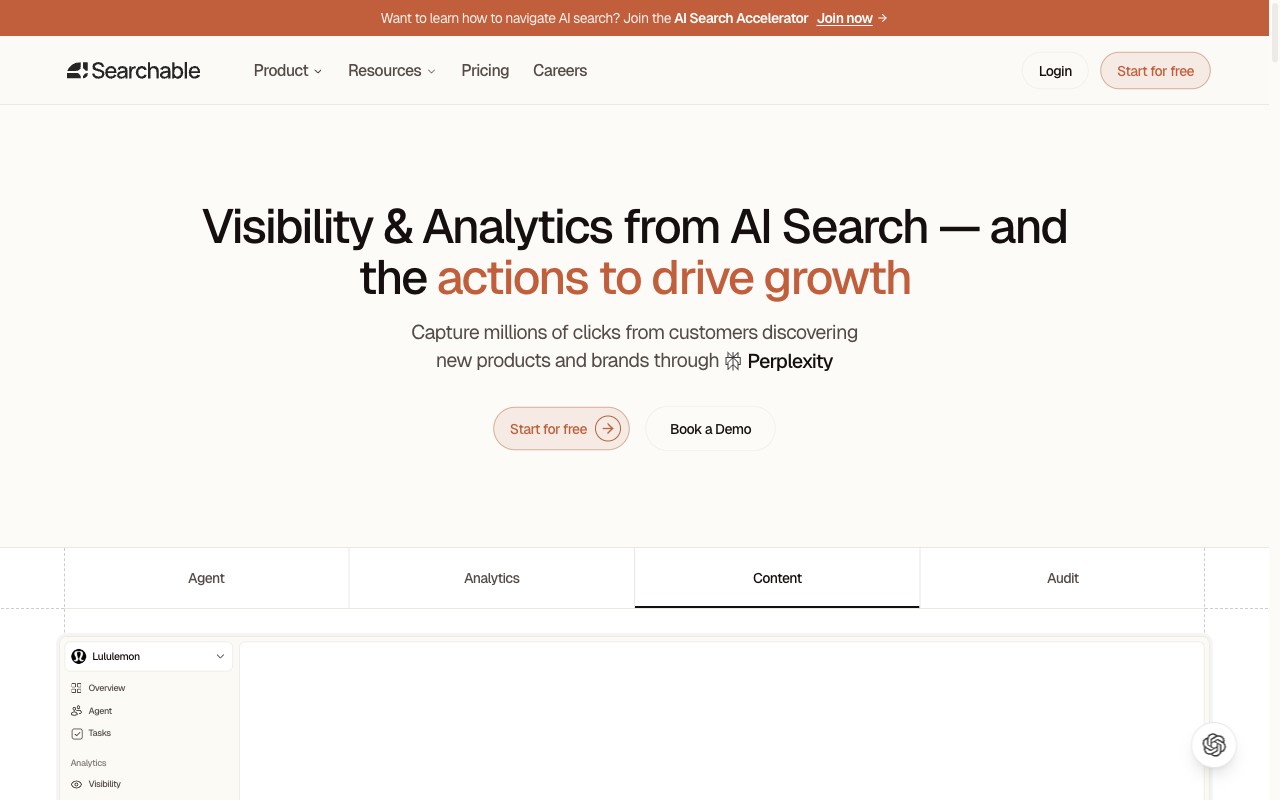
Searchable is a unified AI visibility platform that tracks your brand across Grok, ChatGPT, Perplexity, Gemini, Claude, and AI Overviews from a single dashboard, and tells you what to do about what it finds.
Tracks your brand across Grok, ChatGPT, Perplexity, Gemini, Claude, and
AI Overviews
from a single dashboard. Doesn't just show data; tells you what to do about it with specific
improvement recommendations
.
Competitive benchmarking broken down by engine
6 engines, daily refresh
- AI visibility only; won't replace your SEO platform
Best for: Marketing teams and agencies wanting all engines in one view with actionable next steps.
2. AIclicks
AIclicks is a founder-led AI visibility platform covering six major LLMs, Grok included, with a strong focus on real case study data and hands-on improvement tips.
81
Overall Score
85
80
$79-499/mo
Covers six LLMs including Grok, with a founder-led approach heavy on practical playbooks. They publish case studies openly, including one showing visibility jumping from 22% to 64% in six weeks.
Documented proof and transparent case studies
Proven playbooks alongside tracking data
- Competitive reviews only cover four tools; content leans promotional
Best for: Practitioners who want proven playbooks, not just dashboards.
3. Orchly
Orchly tracks AI visibility across seven-plus engines, Grok included, with clean dashboards and a side-by-side comparison layout built for stakeholder reporting.
75
Overall Score
82
From $89/mo
Tracks 7+ AI engines including Grok, with dashboards built for stakeholder presentations. The visual proof feature shows screenshots of actual AI responses alongside your tracking data.
Polished, screenshot-backed reports
7 engines, the widest coverage in the list
- Little guidance on what to do with the data
Best for: Teams presenting AI visibility to non-technical stakeholders.
4. Cairrot
Cairrot is a WordPress-first AEO tool that plugs AI visibility tracking (Grok included) straight into your WordPress dashboard, so you don't need a separate platform.
69
Overall Score
From $64/mo
The only tool that plugs AI visibility tracking directly into your WordPress CMS dashboard. You see Grok data right next to your content editor. Less tool sprawl, tighter workflow.
Native WordPress integration
Daily refresh, 4 engines
- WordPress-only; no Shopify, headless, or custom builds
Best for: WordPress teams wanting AI data inside their existing content workflow.
5. Rankability
Rankability is an enterprise AI visibility platform that says it uses xAI-specific ranking signals. If that holds up in testing, it's the most Grok-focused tool on this list.
59
Overall Score
$149/mo
Claims to read xAI-specific ranking signals that general platforms miss. If true, it's the most Grok-focused tool on this list. If it's marketing, you're paying $149/mo for a claim you can't verify.
Potentially deepest Grok-specific intelligence
Daily refresh with 4 engines
- xAI signals claim is unproven publicly; price locks out smaller teams
Best for: Enterprise teams willing to pay for deeper Grok intelligence. Trial first.
6. AthenaHQ
AthenaHQ is an enterprise AEO platform built for strategic AI visibility planning, covering Grok and other engines with premium pricing and a partner-style approach rather than a self-serve dashboard.
63
Overall Score
80
$295/mo
Positions itself as a strategic partner, not a dashboard. You get roadmaps, action plans, and dedicated support alongside multi-engine tracking. Built for teams that want "tell me what to do" rather than "here's your data."
Strategic guidance with dedicated support
5 engines, daily refresh
- At $295/mo, the ROI bar is extremely high
Best for: Enterprise teams with real budget wanting strategic guidance.
7. AI Rank Checker
AI Rank Checker lets you check brand visibility across AI engines (Grok included) on a pay-per-use basis, with no subscription.
57
Overall Score
85
<$10/check
No subscription, no contract. Run a Grok visibility check when you need one, pay for that check, and move on. Starts under $10.
Zero commitment, pay-per-use
Great for validation before committing to monthly spend
- Snapshots, not trends; you won't spot gradual shifts
Best for: Agencies running periodic audits or teams validating if Grok tracking is worth it.
8. Promptmonitor
Promptmonitor is a low-cost AI visibility tracker covering Grok and other engines at $29/mo, which makes it the cheapest subscription on this list.
61
Overall Score
90
$29/mo
The cheapest subscription on this list. Covers multiple AI engines including Grok. For
small businesses
testing whether AI visibility tracking delivers value, the low price removes the budget objection.
Lowest recurring price with real engine coverage
Good starting point for budget-conscious teams
- Budget price, budget features; slower updates, less depth
Best for: Solo marketers and small teams starting without financial risk.
9. Semrush (AI Visibility Add-on)
Semrush's AI visibility add-on brings Grok tracking into its established SEO suite. It's the easiest path to AI monitoring for teams already paying for Semrush.
67
Overall Score
$199/mo
+ baseIf you already pay for Semrush, their AI module adds Grok tracking to your existing workflow. No new vendor, no new login. AI platforms sent 1.13 billion referral visits in June 2025, up 357% year-over-year.
Integrates into existing Semrush workflow
5 engines, weekly refresh
- AI visibility is a bolt-on, not core; Grok depth likely falls short
Best for: Existing Semrush users adding AI tracking without a new vendor.
10. Peec AI
Peec AI is a European AI search analytics platform focused on sentiment and brand perception. It tracks whether Grok mentions you and also analyzes how Grok describes you.
69
Overall Score
From €89/mo
Goes beyond "are you mentioned?" to "how are you mentioned?" Sentiment analysis scores whether Grok talks about your brand positively, neutrally, or negatively. That distinction matters for brand managers.
Unique sentiment analysis across AI engines
5 engines, weekly refresh
- European focus; sentiment layer is overkill if you only need citation tracking
Best for: Brand managers who care about tone and perception, not just citation counts.
See Where Your Brand Stands in AI Search
Get a free AI visibility report across Grok, ChatGPT, Perplexity, Gemini, and Claude. No paid plan required.
Do You Need a Grok-Specific Tool or a Multi-Engine Platform?
Most teams should start with a multi-engine AI visibility platform that covers Grok alongside ChatGPT, Perplexity, and Gemini in one subscription. A Grok-specific tool only makes sense if your GA4 data shows Grok as a meaningful referral source or your brand has a strong X presence. Our guide to the best AEO tools compares the multi-engine options and which engines each plan covers.
Here's the simple decision:
Which approach fits your team?
Follow the decision path based on your situation
Does GA4 show grok.com as a referral source?
No
Do you have 50K+ engaged X followers?
No
Multi-Engine Platform
$79-149/mo covers Grok + 5 other engines. Start here.
Yes
Multi-Engine + Trial Grok Tool
Your X presence likely impacts Grok. Trial Rankability alongside.
Yes
Is it a top-10 referral source?
No
Multi-Engine Platform
Track it, but don't over-invest. $79-149/mo.
Yes
Dedicated Grok Tracking
Multi-engine + Grok-specific tool. Justify the $149+/mo add-on.
Multi-engine: $79-149/mo
Multi + Grok-specific: $228-298/mo
The cost maths: One multi-engine platform at $79-149/mo versus three or four single-engine trackers at $50-100 each. Consolidation almost always wins. Start unified, add specialised depth only if your data justifies the spend.
What Should You Look for When Choosing a Grok Tracker?
The six factors that matter most when picking a Grok tracking tool are data collection method, refresh frequency, engine coverage, actionable guidance, integration options, and transparent pricing. Use this checklist against any tool on this list.
Tool Evaluation Scorecard
Rate any tool against these 8 criteria. A score below 5/8 means keep looking.
Are There Free or Budget Grok Tracking Options?
The closest thing to free is Searchable's free visibility report, which covers Grok and five other engines at no cost. Beyond that, running AI queries at scale costs money, which makes sustainable free tiers nearly impossible. The cheapest paid options are Rankscale ($20/mo), Promptmonitor ($29/mo), and AI Rank Checker (pay-per-check starting under $10).
Budget Options Compared
The cheapest ways into Grok tracking
Searchable
Free
AI Rank Checker
<$10
Rankscale
$20/mo
Promptmonitor
$29/mo
$295/mo
1
Free
Paid from $125/mo
Get a free AI visibility report across all 6 engines, Grok included, before spending anything. See your baseline, then decide if ongoing tracking is worth the investment.
Free
Paid from $125/mo
2
Pay-per-use
No subscription. Run checks when you need them. Best for validation before committing to monthly spend.
<$10
per check
3
Cheapest sub
New entrant at $20/mo. The lowest recurring price available. Worth evaluating alongside Promptmonitor for cost-conscious teams.
$20/mo
4
Best budget value
$29/mo with multiple engines including Grok. The most established budget option. Removes the budget objection entirely for small teams.
$29/mo
The smartest path: start with a free visibility report from Searchable to see your baseline across all AI engines, including Grok. If the report shows you're invisible in Grok and your GA4 confirms Grok referral traffic, that's your signal to invest in ongoing tracking. If neither condition is true, Grok tracking can wait.
Frequently Asked Questions
Software that checks whether your brand appears in Grok's AI-generated responses. It tracks citations, mentions, and recommendations for queries relevant to your business. Think rank tracking, but for Grok's conversational answers instead of Google's blue links.
What's Your Next Move?
Skip the generic advice. Here's exactly what to do based on where you are right now:
If you haven't tracked AI visibility at all yet: Start with a free visibility report from Searchable. It covers Grok alongside every other major engine. That baseline tells you whether you have a Grok problem worth solving.
If you're already tracking ChatGPT and Perplexity but not Grok: Check GA4 for grok.com referral traffic. If it's there, upgrade to a multi-engine platform that includes Grok. If it's not there, Grok can wait.
If your brand is big on X with 50K+ engaged followers: Grok is likely already citing you (or conspicuously not). A multi-engine platform with daily refresh gives you the data to find out. Consider trialling Rankability alongside it if you want deeper xAI-specific signals.
If you're an agency managing multiple clients: Start every new client with a free report, then recommend ongoing tracking based on their specific AI visibility gaps. Don't default to "track everything everywhere" when some clients won't see meaningful Grok traffic for another year.
Find Out Where You Stand in AI Search
Get a free visibility report across Grok, ChatGPT, Perplexity, Gemini, and Claude. Takes 30 seconds to set up.
