

76,110 AI answers reveal how often chatbots send tourists to the same handful of Irish attractions
Searchable asked ChatGPT, Google AI Mode and Gemini to recommend Irish tourist attractions with 47 unique questions, repeated more than 76,000 times to see how often AI pushes tourists toward the same places. Across the 26 counties of the Republic of Ireland, one thing was clear: a visitor planning a trip through a chatbot is seeing a very small slice of the country.
- 75 per cent of tourist recommendations from AI chatbots give users the same top five attractions.
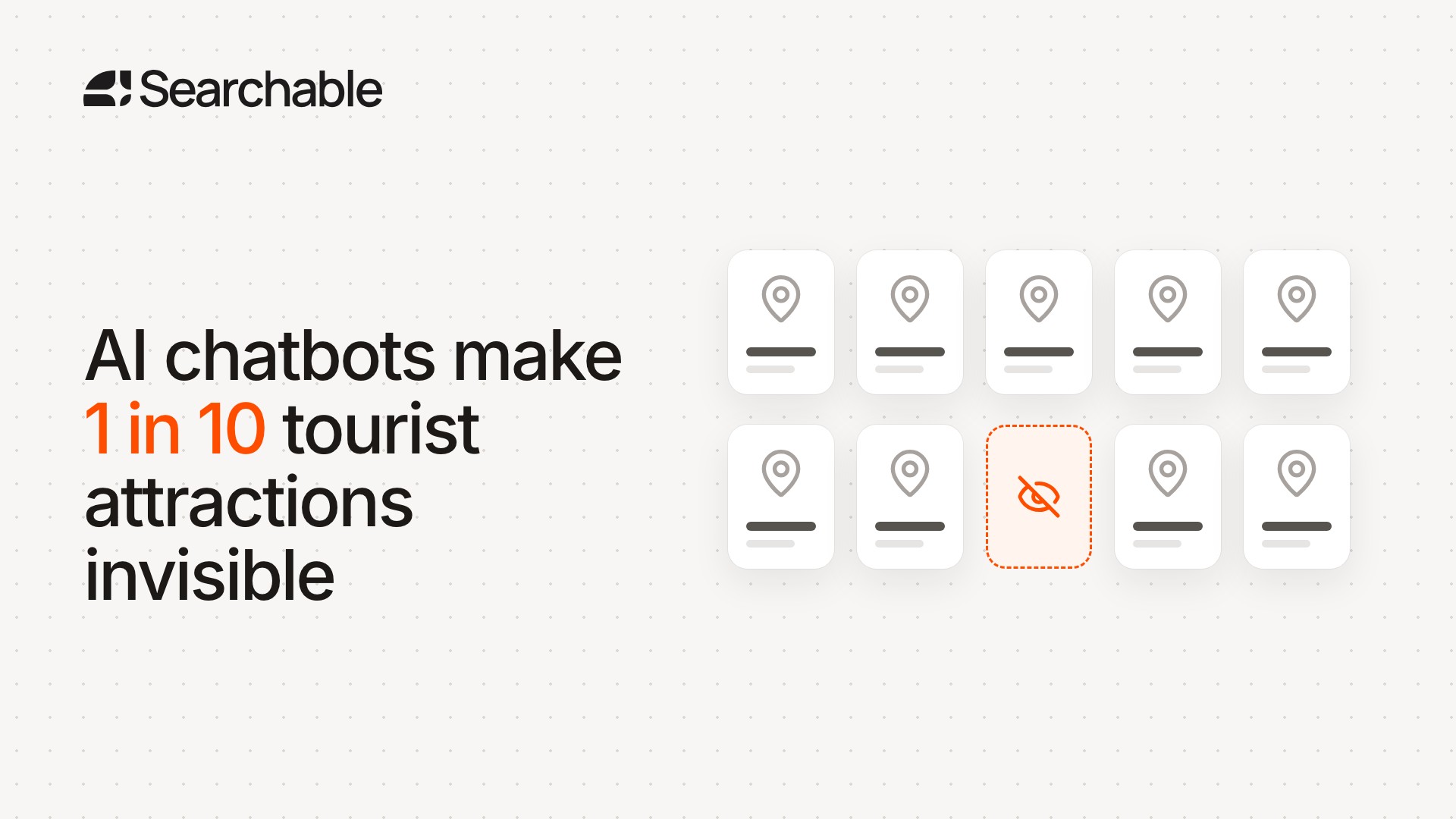
- 1 in 10 of Ireland's visitor attractions are never named by AI chatbots, however the question is asked.
- Google Gemini is the most repetitive chatbot tested, returning the same handful more often than ChatGPT or Google AI Mode.
- Galway suffers the most from AI chatbots recommending the same list of tourist attractions.
- The attraction with the most repetitive level of recommendations is Kilkenny Castle, Kilkenny (94 per cent of recommendations).
- Asking for a longer list produces more of the same canon of attractions. Even asking for hidden gems sees the same five attractions appear in 52 per cent of answers.
- Only when you ask as a specific type of traveller does the list open up, with repetition rates falling to 30 per cent.
目次
AI makes 1 in 10 of Ireland's tourist attractions invisible
However you ask AI chatbots for travel recommendations, 1 in 10 (10%) attractions are never named in any answer. Overall, just under half (47%) of attractions are regularly visible in AI recommendations, which is equivalent to 1 in 10 answers or more. Drag the handle across the map to wipe between the country as it is and the country ChatGPT, Google AI Mode and Gemini describe.
AI side: regularly visible only

How often each AI engine recommends the same five attractions
We asked the everyday travel questions: the best things to do, where to go for a first visit, what a county is famous for. For each county, the five most-recommended attractions showed up in 75 per cent of answers on average. Five names account for three quarters of what the chatbots suggest.
That figure holds whichever chatbot you ask. Different systems, trained differently, converge on the same handful of places.
Share of general recommendation answers naming a county's five most-recommended attractions, by chatbot.
How often each county recommends the same five attractions
The narrowness is not limited to a few Irish destinations. It runs across all 26 counties. Galway and Kildare are the most repetitive, returning their top five in 87 per cent of answers. Wicklow is the most varied, and even there the same five places appear in about two thirds of answers.
| County | Repeat rate | County | Repeat rate |
|---|---|---|---|
| Galway | 87% | Longford | 75% |
| Kildare | 87% | Kerry | 75% |
| Kilkenny | 85% | Westmeath | 74% |
| Meath | 84% | Cavan | 74% |
| Roscommon | 82% | Cork | 74% |
| Tipperary | 81% | Laois | 73% |
| Mayo | 79% | Monaghan | 73% |
| Offaly | 79% | Sligo | 72% |
| Limerick | 79% | Waterford | 70% |
| Carlow | 78% | Leitrim | 70% |
| Donegal | 78% | Louth | 67% |
| Wexford | 77% | Clare | 66% |
| Dublin | 76% | Wicklow | 65% |
There is no county where the chatbots spread their recommendations widely. The floor for the whole of Ireland sits at roughly 65 per cent.
One place per county the chatbots almost always name
In most counties, a single attraction is close to guaranteed. Ask about Kilkenny and you will hear about Kilkenny Castle in 94 per cent of answers. The darker a county below, the more reliably one place dominates its recommendations.
Dublin's five most recommended attractions in AI answers
Dublin is the exception. No single attraction dominates. Instead a cluster comes back together, and even the capital, with far more to offer, funnels visitors toward the same five.
Dublin: share of general recommendation answers naming each attraction.
How often AI repeats the same five attractions, by category
Perhaps the chatbots simply reach for headline sights when asked a broad question. So we also asked narrower ones. We put category-specific questions to each chatbot, the best museums, the castles, the gardens, and scored each category only against its own questions. A garden was never judged against a question about castles.
The same behaviour showed up in every category. Even at its most varied, a category still returned the same few names in more than half of answers.
Repeat rate within each category of attraction, averaged across counties and chatbots.
Where attractions can start showing up in AI answers
The findings above are the diagnosis of AI's recall problem, where an attraction is simply not considered when a chatbot assembles its answer. So what can you do about it, whether you run a single visitor attraction or market a larger destination?
Ask the chatbots your own visitors' questions and write down who gets named
Ask the AI chatbots for attraction recommendations in your area. Ask the plain version first, then ask again as the people who often come to you, whether that be a family with a four-year-old or a weekend visitor at Christmas. See which attractions get named ahead of you, and monitor them as your competitors for AI visibility.
Answer what visitors actually want to know, and say it the same way everywhere
It's important that the online descriptions of your attraction are accurate and engaging. But you should also answer the questions people will actually have. How long does it take to visit? What does it cost? Is there parking? The same goes for who the place suits, where the word accessible on its own carries almost no information. A step-free entrance, a Changing Places toilet, audio description, dogs welcome outdoors: each of those is a fact that can be matched to somebody's question.
Keep all of it current on your own website and on any visitor directories. Your website is a small share of what gets read, and contradictions between sources are a reliable way to be left out of an answer.
Get other people describing you, not just your own website
Reviews, listings and travel coverage are where your description gets repeated back. Ask visitors to leave a review and make it easy at the moment they leave, because a recent review is a specific, current description of your place written in a visitor's own words.
Keep the people around you supplied too: the hotel that recommends you, the guide who brings groups, the tourism board page, the local blog. Give them the same few sentences you use yourself so what comes back is one description rather than four.
None of this is a one-off fix, and none of it guarantees a mention. Closing the gap between being worth a visit and being in the answer is the work of AI visibility, also called answer engine optimisation. This is what Searchable measures for over one thousand brands every day.
Is AI recommending your brand?
The same repetition shapes every industry, not just travel. Track how ChatGPT, Gemini and Google AI Mode talk about your brand, and what it takes to get named.
Methodology
Searchable queried ChatGPT, Google Gemini and Google AI Mode with 47 unique questions about travel recommendations in each of Ireland's 26 counties, repeating every question 20 times per chatbot to measure how much the answers varied. That produced 76,110 answers in total. The questions covered general requests, hidden gems, itineraries for particular travellers, individual towns, and 11 specific categories of attraction, with each category scored only against questions about that category. All three tools were accessed through their standard consumer interfaces, to reflect the responses users would actually receive at scale. The named attractions were then measured on how often they were repeatedly recommended. The visibility figures count every named, real place in each county that a member of the public can visit, each listed on Wikidata, OpenStreetMap or Google and checked by hand, including heritage sites, church ruins, monuments and parks, not only paid visitor attractions. Data correct as of September 2026.