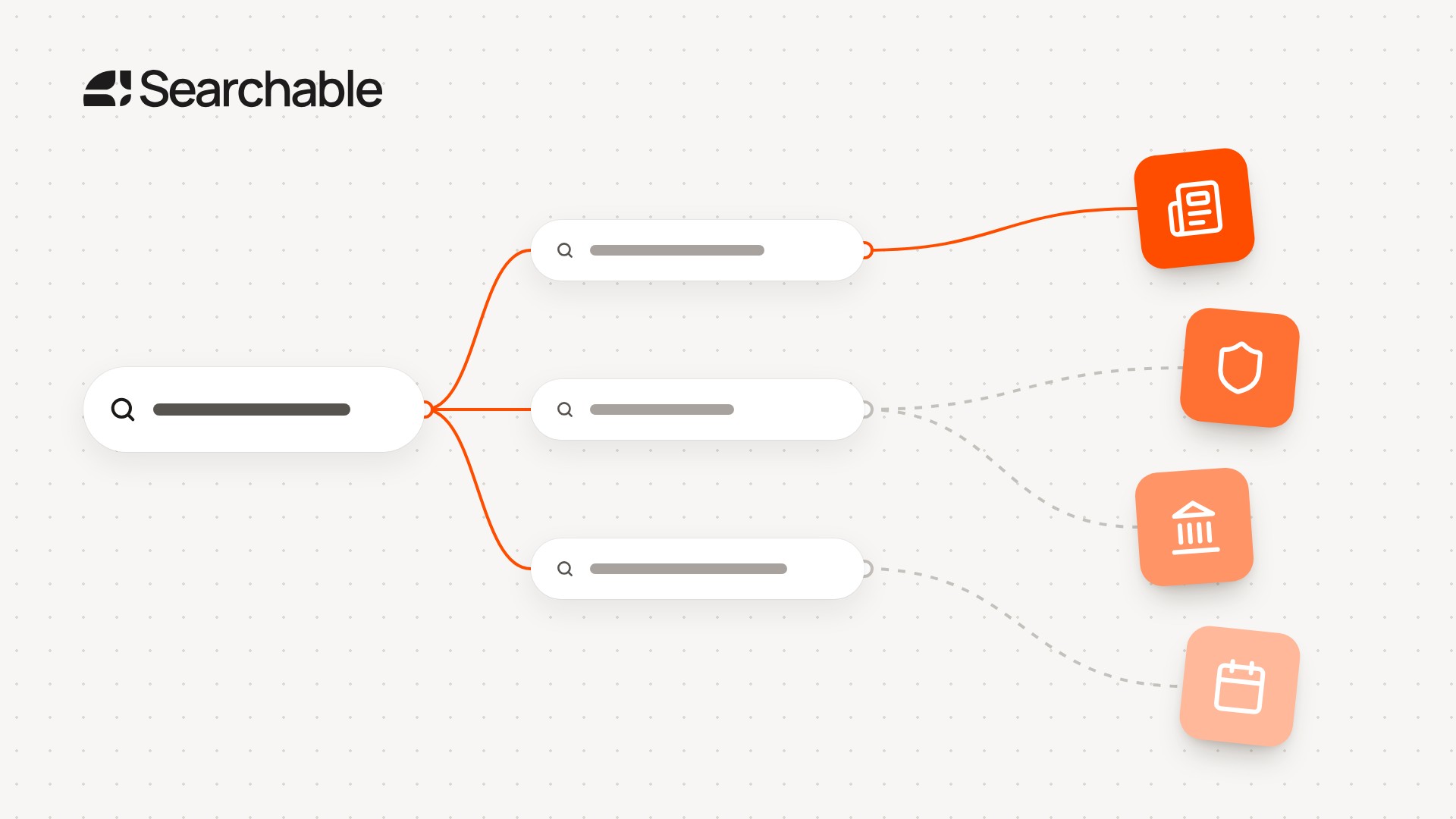
What happens between asking ChatGPT about local news in your town and getting an answer with sources
Searchable asked five AI assistants 30,000 questions about local news in 100 UK towns and cities. For ChatGPT, we also recorded the web searches it ran before answering. This page follows those searches from the question to the answer.
- 1ChatGPT decides to search the web, then rewrites your question into a search of its own.
- 2It turns that one question into anything from 1 to 35 searches, and most answers run between 1 and 7. The first searches are broad, and later ones search inside specific websites, such as the council’s.
- 3Most answers get back pages from 5 to 21 websites, and ChatGPT cites 2 to 6 of them in its reply, drawn from 1 to 5 kinds of website, such as council sites, newspapers and Wikipedia.
When you ask ChatGPT a question, it can type its own queries into a web search tool before it replies, much as you might try a few phrasings in Google. On this page, a search is one of those queries. You ask once, and ChatGPT decides how many searches to run.
We asked ChatGPT for today's top news stories in Grimsby three times. It ran two searches the first time, three the second and four the third:
- Ask 1 · 2 searchesGrimsby Lincolnshire news today September 9 2026Grimsby news September 9 2026 Lincolnshire
- Ask 2 · 3 searchesGrimsby Lincolnshire news today September 9 2026Grimsby news September 9 2026 Lincolnshire Live Grimsby TelegraphGrimsby Lincolnshire latest news today
- Ask 3 · 4 searchesGrimsby Lincolnshire news today September 9 2026Grimsby news September 9 2026 Lincolnshire Live Grimsby Telegraphsite:grimsbytelegraph.co.uk "9 SEP 2026" Grimsbysite:grimsbytelegraph.co.uk "09 SEP 2026" Grimsby news
Every count of searches on this page means these queries, the ones ChatGPT ran for a single answer.
Inhaltsverzeichnis
ChatGPT rewrites your question before it searches
The question we asked was “What are the top news stories in Grimsby, Lincolnshire, UK today?” ChatGPT never searched for that sentence. Its first search, the same in all three asks, read Grimsby Lincolnshire news today September 9 2026.
Set side by side, the changes are easy to see. “What are the top” and “stories” went, and so did “UK”. Grimsby, Lincolnshire, “news” and “today” stayed. The date was added, because “today” on its own would not tell a search engine which day. In its later searches ChatGPT added the names of two local titles it already knew, Lincolnshire Live and the Grimsby Telegraph, which nobody had mentioned.
Before any of this, ChatGPT decides whether to search at all, and in our study it searched the web for 5,863 of 6,000 answers. Across the 9,700 searches we recorded, none repeated the question word for word. The searches were shorter, 7.8 words against 11 in the question, and 296 of the 300 questions asking about “today” or “right now” were searched with the exact date.
Which words from a local news question ChatGPT kept in its searches, and what it added
Share of ChatGPT’s searches containing each part. Hover or tab to a bar for the counts
Kept from the question
Of searches whose question contained it
- Town or city name98.4%
- The word “news”83.1%
- County55.1%
- The word “local”38.1%
- “Today”, “this week” and similar28.5%
- “UK”1.6%
Added by ChatGPT
Of all 9,700 searches. No question contained these
- The year (2026)94.5%
- The month (September)75.8%
- A site: search32.5%
- A phrase in quotation marks27.1%
Every question named a town and “UK”. 6,687 of the searches came from questions that also named a county

One local news question becomes several searches that narrow to specific websites
We asked ChatGPT “What decisions has the local council made in Doncaster, South Yorkshire, UK recently?” The three asks produced two, four and eight searches. ChatGPT sends its searches in rounds: a batch at once, then another batch after the first results come back. The four-search answer ran two rounds of two:
- Search 1 · Round 1Doncaster Council recent decisions September 2026 cabinet council South Yorkshire
- Search 2 · Round 1site:doncaster.gov.uk council decisions Doncaster cabinet September 2026
- Search 3 · Round 2site:doncaster.gov.uk "2026" "Cabinet" "resolved" Doncaster June July August 2026 council
- Search 4 · Round 2site:doncaster.gov.uk/news 2026 Doncaster Council decision cabinet August 2026
The first search is broad. The rest use the site: operator, which limits a search to one website, here the council's own. In the second round ChatGPT added exact phrases in quotation marks, “Cabinet” and “resolved”, the words a council uses when it minutes a decision.
Google calls this query fan-out. It introduced the term with AI Mode in March 2025 to describe one question being split into several related searches whose results are combined into a single answer.
Across the study, ChatGPT ran anything from 1 to 35 searches for an answer, 3.2 on average. It almost always opened broad: 2,993 of 3,002 answers began without naming a website. Then it narrowed. In the first round 11.8% of searches used site:, and in the second round 70.2%.
The number of searches depends on what you ask. Planning questions averaged 9.5 searches per answer and council decisions 5.6. “Where can I read local news” averaged 1.3, and none of those answers searched inside a website. The most searches for one answer came from a planning question about Sheffield: 35 searches over eight rounds, down to a single road, Orgreave Lane, and individual application numbers such as 26/02534/FUL.
Average number of searches ChatGPT ran to write one answer, by local news question
Each question was asked about 100 towns, three times each, and searches were recorded for about 150 of those answers per question. Hover or tab to a bar for the share that searched inside a website
- Planning applications9.5
- Council decisions5.6
- Local news to know about3.9
- Catch me up on the news3.7
- This week’s headlines3.7
- Top news stories today3.6
- Events this weekend3.5
- What’s in the local paper3.2
- Summarise the local news3.2
- Housing and new homes3.2
- What people are talking about3.0
- Police incidents2.7
- What’s happening this week2.6
- Local sport news2.6
- Road closures and roadworks2.4
- Biggest news story right now2.3
- Breaking news1.8
- Who reports local news1.5
- Crime reported recently1.4
- Where to read local news1.3
ChatGPT's searches bring back a pool of pages, and it cites a few of them in the answer
Back in Doncaster, the four searches returned 25 pages from 8 websites. ChatGPT's answer cited 8 of them. Six citations went to doncaster.gov.uk, the website it had searched inside, one to the council's meeting records and one to opencouncil.network, which republishes council data.
The Guardian, The Times and six Wikipedia pages came back in the same searches, and none of them was cited. Returned pages are the ones ChatGPT had in front of it. Cited pages are the ones it linked in the text of its reply.
Pages returned and cited by website, for one ChatGPT answer about Doncaster Council
“What decisions has the local council made in Doncaster, South Yorkshire, UK recently?”
- doncaster.gov.uk12 pages
- en.wikipedia.org6 pages
- youtube.com2 pages
- doncaster.moderngov.co.uk1 page
- opencouncil.network1 page
- theguardian.com1 page
- thetimes.com1 page
- facebook.com1 page
4 searches, 25 pages returned, 8 cited
The common range for a ChatGPT answer about local news, from searches run to websites cited
Each line runs from the lowest to the highest common number per answer, covering the middle 80% of answers. Hover or tab to a row for the average
- Searches run17
- Pages returned1044
- Websites returned521
- Pages cited39
- Websites cited26
- Kinds of website cited15
3,002 ChatGPT answers. 13 answers cited nothing
One page in four that the searches return ends up cited. Searching inside a website makes a difference: in the 981 answers where ChatGPT used site:, it cited at least one of the websites it had searched inside 76% of the time.
A site: search can only return what ChatGPT's search is allowed to reach. OpenAI says sites that block its OAI-SearchBot crawler “will not be shown in ChatGPT search answers”, however precisely ChatGPT searches for them.
Methodology
- Searchable asked 20 questions about local news and local services for each of 100 UK towns and cities, three times each, to five AI assistants: ChatGPT, Perplexity, Google Gemini, Google AI Mode and Google AI Overviews. That made 30,000 prompts, run on 9 and 10 September 2026 with a UK location set and no signed-in account. The answers carried 244,725 citations from just over 10,000 websites.
- For ChatGPT, the collection tool also returned the searches ChatGPT ran and the pages they brought back for 3,002 of its 6,000 answers. Every search figure on this page is based on those 3,002 answers and the 9,700 searches behind them.
- “Most answers” means the middle 80% of answers. Kinds of website come from Searchable’s classification of every cited page into types such as council, local news, national news, police and reference.
See how AI searches for your brand
Searchable shows the searches AI assistants run for the questions your customers ask, the pages those searches return and which ones end up cited.
- See the searches AI runs for your customers’ questions
- Find which pages those searches return and cite
- Track your brand across every major AI engine
Want to chat with an expert? Book a demo
Trusted by over 2,000 marketing professionals and agencies.